
An air fryer conversion calculator converts an oven temperature and cooking time into the matching air fryer settings. The standard method lowers the oven temperature by 25°F (14°C) and shortens the cooking time by 20 percent. An air fryer reaches the same cooking result faster than a conventional oven because it circulates hot air inside a smaller chamber, and the forced airflow raises the effective heat contact at a lower temperature setting. Enter an oven temperature and cooking time in the calculator below to get the matching air fryer settings.
How Do You Convert Oven Temperature to Air Fryer Temperature?
Oven temperature converts to air fryer temperature by subtracting 25°F (14°C) from the original oven setting. A recipe that bakes at 375°F in a conventional oven uses 350°F in an air fryer. The reduction offsets the intensity of forced air contact, which increases surface browning at an equal temperature setting. This 25°F reduction functions as a starting point across basket-style air fryers, and individual models vary by a few degrees in either direction.
What Air Fryer Temperature Equals Common Oven Settings Like 350°F, 375°F, and 400°F?

350°F in a conventional oven equals 325°F in an air fryer. 375°F equals 350°F. 400°F equals 375°F. 425°F equals 400°F. These 4 conversions cover the most searched oven temperatures and follow the same 25°F reduction described above.
The table below lists 6 common oven temperatures next to the matching air fryer temperature, in both Fahrenheit and Celsius.
Oven Temperature | Air Fryer Temperature |
300°F (149°C) | 275°F (135°C) |
325°F (163°C) | 300°F (149°C) |
350°F (177°C) | 325°F (163°C) |
375°F (191°C) | 350°F (177°C) |
400°F (204°C) | 375°F (191°C) |
425°F (218°C) | 400°F (204°C) |
How Do You Convert Oven Cooking Time to Air Fryer Time?
Oven cooking time converts to air fryer time by cutting the original time by 20 percent. A recipe that bakes for 30 minutes in the oven cooks for 24 minutes in an air fryer (30 x 0.8 = 24). The reduction happens because circulating air transfers heat to the food's surface faster than the still air inside a conventional oven. Checking the food 2 to 3 minutes before the calculated time ends accounts for the fact that air fryer models vary in fan speed and wattage.
What Is the 20/20 Rule for Air Fryer Conversion?

The 20/20 rule combines both adjustments into one formula: reduce the temperature by 25°F and the time by 20 percent at the same time. A recipe listed at 400°F for 30 minutes converts to 375°F for 24 minutes using this rule. The name reflects the two adjustment values, a 25-degree drop paired with a 20 percent time cut. This combined rule applies to basket-style air fryers as a general starting point rather than an exact result for every food and model.
Why Does Food Type Change the Air Fryer Conversion Formula?
Food type changes the air fryer conversion formula because moisture content, density, and structure affect how fast heat reaches the center of the food. Meat and poultry require an internal temperature check rather than a time estimate alone. Baked goods rise while cooking and dry out if the surface browns before the center sets. Frozen food starts at a colder temperature than fresh food, which adds cooking time even though the appliance chamber itself heats within minutes. Each food category is covered in the 3 sections below.
How Do You Convert Meat and Poultry Cooking Times for an Air Fryer?
Meat and poultry cooking times convert using the 25°F and 20 percent baseline, but internal temperature determines doneness, not the clock. According to the USDA Food Safety and Inspection Service, poultry reaches a safe minimum internal temperature at 165°F, ground meats at 160°F, and whole cuts of beef, pork, lamb, and veal at 145°F followed by a 3-minute rest. Bone-in cuts take 20 to 30 percent longer than boneless cuts of the same weight, because bone conducts heat differently than muscle tissue. A food thermometer placed in the thickest part of the meat confirms doneness accurately, and time alone does not.
How Do You Convert Baking Recipes Like Cakes and Cookies for an Air Fryer?
Baking recipes convert with a larger time cut than savory food, 20 to 30 percent less time instead of the standard 20 percent, because the compact chamber browns the surface before the center finishes rising. A cake pan filled to half or two-thirds capacity prevents batter overflow during the rise. A sheet of foil placed loosely over the top after the surface browns protects it from further darkening while the center finishes. A toothpick inserted into the center and removed clean confirms doneness more accurately than the timer. Thin batters such as tempura or souffle mixtures do not set well under strong airflow and perform better in a conventional oven.
How Do You Convert Frozen Food Instructions for an Air Fryer?
Frozen food instructions convert differently from fresh food instructions, because packaged frozen food already lists a temperature close to what an air fryer needs, and the main adjustment applies to time rather than temperature. Frozen fries, nuggets, and vegetables cook directly from the freezer without thawing first. A cold starting temperature adds 2 to 5 minutes to the package time even though the air fryer chamber itself heats within minutes. Shaking the basket at the halfway point exposes every side of the food to moving air and produces even crisping.
How Does Air Fryer Brand and Model Affect Conversion Accuracy?
Air fryer brand and model affect conversion accuracy because wattage, basket shape, and airflow design shift the actual result by a few minutes in either direction. Higher-wattage units with stronger fans finish faster than the standard conversion suggests. Larger-cavity oven-style units take a few minutes longer than the calculated time. These differences are detailed by brand and by physical design in the 2 sections below.
How Do You Adjust the Conversion for Ninja, Cosori, Philips, and Instant Pot Air Fryers?
Ninja air fryers run hotter than the standard conversion suggests, due to fan wattage between 1500 and 1800 watts, and the Max Crisp setting reduces time by an additional 10 to 20 percent beyond the standard 20 percent cut. Cosori's square basket shape follows the 25°F and 20 percent rule closely, without a documented brand-specific adjustment. Instant Vortex models include a viewing window that allows a doneness check without opening the basket. Philips air fryers use a base design that distributes airflow evenly, which produces consistent results for baked goods. Individual models within the same brand still vary by a few minutes, and a manufacturer's manual gives the most model-specific numbers.
How Do Basket-Style, Oven-Style, and Paddle-Style Air Fryers Differ in Conversion Needs?
Basket-style, oven-style, and paddle-style air fryers differ in conversion needs because chamber size and air movement pattern change how fast heat reaches the food. A basket-style unit has a compact chamber and direct airflow, which matches the standard 25°F and 20 percent rule closely. An oven-style unit has a larger cavity, which adds a few minutes to the calculated time because hot air takes longer to fill the space. A paddle-style unit uses a rotating arm instead of a static basket and suits foods like rice or stir-fry dishes rather than typical oven-recipe conversion.
What Other Variables Affect Air Fryer Conversion Accuracy Besides Temperature and Time?
Two additional variables affect air fryer conversion accuracy beyond the standard formula: the portion size of the food, and the altitude at which the cooking happens. Both variables shift the required cooking time even when the calculated temperature stays the same. Each variable is covered in its own section below.
Does Portion Size or Quantity of Food Change the Air Fryer Conversion?

Portion size changes the air fryer conversion because a larger mass of food takes longer to reach the same internal temperature, and a fuller basket reduces airflow around each piece. A small portion of 1 to 2 servings uses the calculated time without adjustment. A large or family-size batch requires 5 to 10 extra minutes and performs better split into 2 or more batches, since a full basket blocks the airflow that produces a crisp texture.
Do You Need to Adjust Air Fryer Cooking Times at High Altitude?
Air fryer cooking times at high altitude require an adjustment because thinner air and lower atmospheric pressure change how heat and moisture move through food, the same way altitude affects conventional baking. At elevations above 3,000 feet, cooking time increases by 5 to 8 percent for every additional 1,000 feet of elevation. Baked items also benefit from a small amount of additional liquid in the recipe to offset faster moisture loss at altitude.
How Do You Convert Gas Mark Oven Temperatures to Air Fryer Settings?
Gas mark oven temperatures convert to air fryer settings by first translating the gas mark number to Celsius or Fahrenheit, then applying the standard 25°F (14°C) reduction. Gas mark 6 equals 200°C (400°F) in a conventional oven, which converts to roughly 180°C (375°F) in an air fryer. This two-step process applies the same formula used for direct Fahrenheit and Celsius conversion, with gas mark as the starting reference point instead of a direct temperature.
The table below matches 6 common gas mark settings to their Celsius, Fahrenheit, and air fryer equivalent.
Gas Mark | Celsius / Fahrenheit | Air Fryer Equivalent |
3 | 170°C / 325°F | 150°C / 300°F |
4 | 180°C / 350°F | 160°C / 325°F |
5 | 190°C / 375°F | 170°C / 350°F |
6 | 200°C / 400°F | 180°C / 375°F |
7 | 220°C / 425°F | 200°C / 400°F |
8 | 230°C / 450°F | 205°C / 425°F |
How Do You Convert Fan (Convection) Oven Settings vs Conventional Oven Settings to an Air Fryer?
Fan oven settings and conventional oven settings convert to an air fryer differently, because an air fryer is itself a compact convection device, and a fan oven setting already includes part of the adjustment a conventional setting still needs. A conventional oven setting of 180°C converts to roughly 160°C in an air fryer, the standard reduction. A fan oven setting of 160°C for the same dish converts to roughly 150°C to 155°C in an air fryer, a smaller additional reduction, since the fan oven number already accounts for circulating air. Oven manuals that list both a conventional and a fan temperature side by side identify which starting point a recipe uses, which prevents applying the reduction twice.
How Do You Convert Deep Fryer Temperatures to an Air Fryer?
Deep fryer temperatures convert to an air fryer by reducing the deep fryer setting by 25°F to 30°F and replacing submerged oil with a light spray. Deep-fried chicken wings cooked at 350°F in oil use roughly 325°F in an air fryer. Cooking time in the air fryer runs similar to or slightly longer than deep frying, since no hot oil directly surrounds the food to transfer heat, and shaking or flipping the food partway through replaces the even coating that oil submersion normally provides.
What Common Mistakes Cause Inaccurate Air Fryer Conversions?
Inaccurate air fryer conversions happen most often from 2 technique errors that occur after the correct numbers are calculated: overcrowding the basket and skipping the preheat step. A converted time and temperature produce the wrong result if either step is skipped, regardless of how precise the calculation was. Additional errors include applying oil beyond 1 to 2 teaspoons, which causes smoking, and placing an unweighted liner near the heating element.
Why Does Overcrowding the Basket Ruin a Converted Recipe?
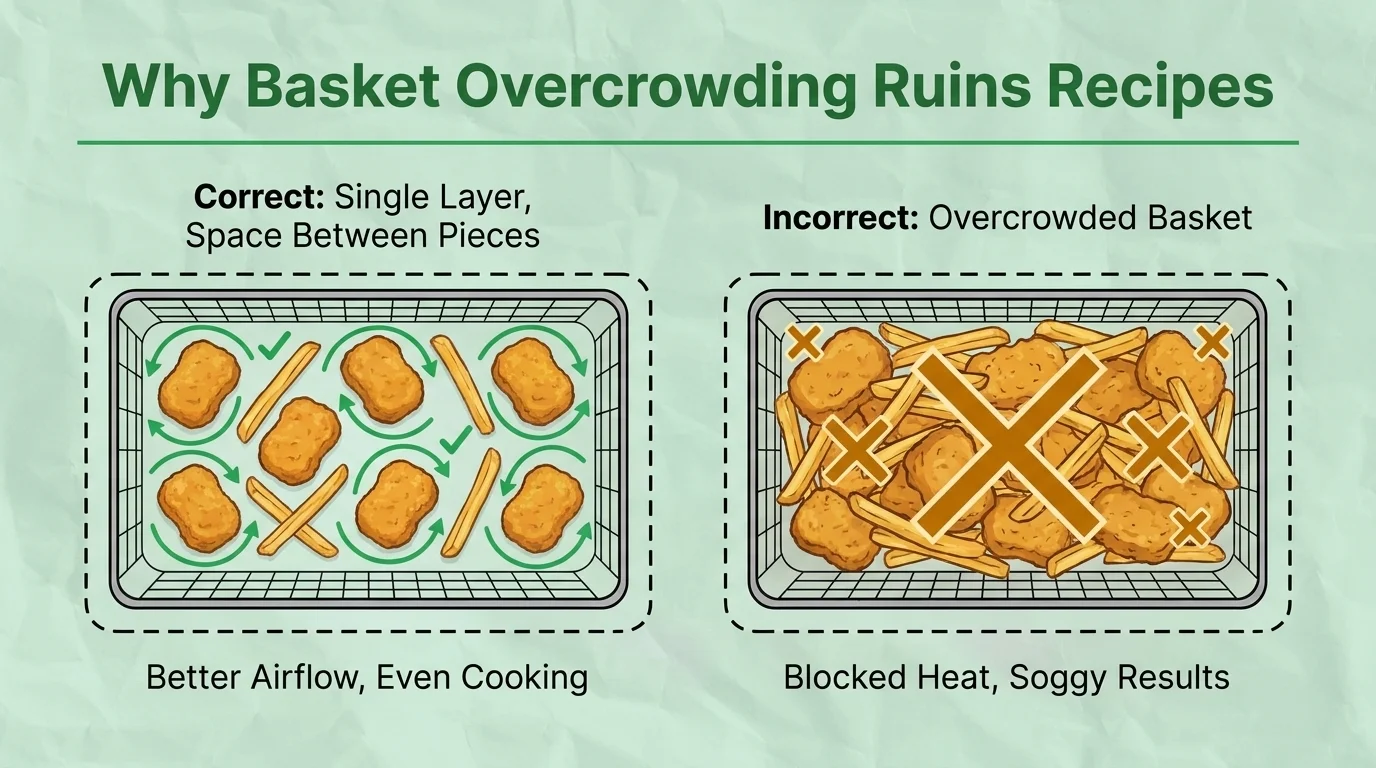
Overcrowding the basket ruins a converted recipe because blocked airflow prevents hot air from reaching every surface of the food, and the food steams instead of crisping. A single layer with visible space between pieces allows air to circulate around each item. Cooking in 2 or more batches produces a more consistent result than 1 overloaded batch, and shaking or flipping the food at the halfway point exposes new surfaces to the moving air.
Why Is Preheating Important When Using a Conversion Calculator?
Preheating matters for a conversion calculator because the calculated time assumes the chamber already sits at the target temperature, and a cold start adds 3 to 5 minutes of unaccounted cooking time. Air fryer models reach the target temperature within 2 to 3 minutes of preheating, and Ninja and Cosori models include a dedicated preheat button. Skipping the preheat step requires adding 3 to 5 extra minutes to whatever time the calculator produced.
How Do You Verify That a Converted Recipe Is Fully Cooked and Safe to Eat?

A converted recipe is verified as fully cooked and safe to eat by checking internal temperature with a food thermometer rather than trusting the calculated time alone. According to the USDA Food Safety and Inspection Service, poultry reaches a safe temperature at 165°F, ground meats at 160°F, and whole cuts of beef, pork, lamb, and veal at 145°F with a 3-minute rest. Baked goods are checked with a toothpick inserted into the center, which comes out clean when the item finishes cooking. Checking the food 2 to 3 minutes before the calculated time ends, then adding time in 2 to 3 minute increments, produces a more reliable result than 1 large adjustment.
The table below lists the USDA Food Safety and Inspection Service's safe minimum internal temperature for 4 common food categories.
Food Category | Safe Minimum Internal Temperature |
Poultry (chicken, turkey, duck) | 165°F (74°C) |
Ground meats (beef, pork, lamb, veal) | 160°F (71°C) |
Whole cuts (beef, pork, lamb, veal) | 145°F (63°C), plus a 3-minute rest |
Reheated leftovers | 165°F (74°C) |
How Does Air Fryer Conversion Fit Into Everyday Air Fryer Cooking?
Air fryer conversion connects to 9 related cooking situations beyond a single oven recipe. A recipe written for an air fryer with only a conventional oven available reverses the same formula. A recipe written for a microwave or a toaster oven applies a related but distinct method. Comparing an air fryer to a convection oven, checking food safety, cleaning the unit, choosing accessories, selecting a model for baking, and converting ingredient measurements each connect to a dedicated page for that specific need. The 9 sections below cover each of these situations in the context of accurate conversion.
How Do You Convert an Air Fryer Recipe Back to a Conventional Oven?
An air fryer recipe converts back to a conventional oven by adding 25°F (14°C) to the air fryer temperature and adding 20 to 25 percent more time. An air fryer setting of 350°F for 20 minutes converts to roughly 375°F for 25 minutes in a conventional oven. The complete reverse chart and food-specific adjustment notes appear in the Air Fryer to Oven Conversion Calculator.
Can You Use Air Fryer Conversion Rules for a Microwave Instead of an Oven?
Air fryer conversion rules do not transfer directly to a microwave, because a microwave heats food through internal moisture using radiation, while an air fryer heats food by moving hot air across its surface. Food reheated first in a microwave and finished in an air fryer regains a crisp texture at roughly 350°F to 390°F for 3 to 5 minutes. The complete method for combining or substituting between the 2 appliances appears in the Microwave to Air Fryer Conversion Calculator.
How Is Converting for a Toaster Oven Different From a Standard Air Fryer Conversion?
Converting for a toaster oven differs from a standard air fryer conversion because a toaster oven cavity holds more air volume than a basket air fryer, which adds a few extra minutes to the standard converted time. Toaster ovens with a built-in air fry setting often include part of this adjustment already, and checking the specific model's manual prevents applying the reduction twice. The complete adjustment method for combination units appears in the Toaster Oven to Air Fryer Conversion Calculator.
What Is the Difference Between an Air Fryer and a Convection Oven?
An air fryer differs from a convection oven mainly in chamber size, since both appliances circulate hot air with a fan, but the air fryer's smaller chamber concentrates that airflow closer to the food. This concentrated airflow is the underlying reason the 25°F and 20 percent conversion rule exists. The complete feature set, cost, and typical use cases between the 2 appliances are compared in the Air Fryer to Convection Oven Comparison Guide.
What Are the Best Practices for Air Frying Frozen Food Without a Recipe?
Frozen food without package instructions cooks well starting at 400°F (200°C), shaken at the halfway point, and checked 2 to 3 minutes before the estimated finish time. Frozen food goes directly from the freezer into the basket without thawing. Specific times for over 30 individual frozen food items are listed in the Air Fryer Frozen Food Guide.
How Do You Choose the Right Internal Temperature for Air Fryer Meat and Poultry?
The right internal temperature for air fryer meat and poultry follows the same USDA Food Safety and Inspection Service minimums used for any cooking method: 165°F for poultry, 160°F for ground meat, and 145°F with a 3-minute rest for whole cuts of beef, pork, lamb, and veal. The complete reference across every protein type and cut appears in the Meat and Poultry Internal Temperature Safety Guide.
What Are the Best Air Fryer Accessories for More Accurate Conversion Results?
The accessories that improve conversion accuracy include an instant-read meat thermometer, perforated parchment liners, and a properly sized baking pan. A meat thermometer confirms doneness instead of relying on the converted time alone. A perforated liner allows air to pass through, unlike a solid liner that blocks circulation. The complete list of recommended tools for air fryer cooking appears in the Air Fryer Accessories Guide.
How Do You Clean and Maintain Your Air Fryer for Consistent Cooking Results?
Cleaning and maintenance affect conversion accuracy because built-up grease on the basket and heating element insulates the surface and changes how evenly heat reaches the food. A well-maintained air fryer tracks closer to the calculator's numbers than a neglected one. The complete step-by-step cleaning method appears in the Air Fryer Cleaning and Maintenance Guide.
Which Air Fryer Model Is Best for Baking Cakes and Desserts?
Models with even heat distribution and a larger flat base handle baking conversions more reliably than compact basket models built for fries and wings. Oven-style and dual-zone units produce more consistent baking results due to steadier airflow around a pan. Specific models suited to cakes and desserts are compared in the Best Air Fryer for Baking Guide.
How Do Ingredient Measurement Conversions Work Alongside Air Fryer Recipe Adjustments?
Recipe scaling and ingredient measurement conversion operate separately from temperature and time conversion, though both often come up when adapting the same recipe. Unit and weight conversion for the ingredients scaled most often is covered by the Butter Grams to Cups Calculator, Flour Cups to Grams Calculator, Sugar Cups to Grams Calculator, and Salt Teaspoons to Grams Calculator.
Frequently Asked Questions
Does air fryer basket size change the conversion result?
A larger basket holds more food in a single layer, which uses the standard conversion without adjustment, while a smaller basket forces smaller batches at the same converted time.
Does the 25-degree rule apply the same way in Celsius as in Fahrenheit?
The Celsius equivalent uses a 14°C reduction instead of 25°F, since the 2 scales measure temperature differently, and both reductions represent the same physical temperature change.
Can an air fryer replace a broiler setting?
An air fryer replaces most broiler functions at a similar or slightly lower temperature, since both methods apply direct, high heat to the food's surface.
Does opening the basket during cooking affect the converted time?
Opening the basket briefly to check food loses a small amount of heat, which adds roughly 1 minute to the remaining cook time, and a small chamber size lets most units recover the lost heat within seconds.