
A baking conversion calculator converts between the volume units (cups, tablespoons, teaspoons), weight units (grams, ounces), and oven temperature units (Fahrenheit, Celsius, Gas Mark) used in baking recipes. Because a cup measures volume and a gram measures weight, converting cups to grams depends on which ingredient is selected. Recipes from the US, UK, and metric countries also use different cup sizes, so the measurement system matters as much as the ingredient itself. A converted result is a close estimate rather than an exact figure, since how an ingredient is measured, such as scooped versus spooned, can shift its real weight. The calculator also helps with related problems, like turning a fractional ingredient such as 0.8 egg into a weighable amount, and it flags the most common mistakes that throw off a converted measurement. Use the calculator above to convert any baking measurement instantly.
What Units Does a Baking Conversion Calculator Convert Between?
A baking conversion calculator converts between 3 unit categories: volume, weight, and temperature. Volume units include the cup, tablespoon, teaspoon, millilitre, and litre. Weight units include the gram, kilogram, ounce, and pound. Temperature units include Fahrenheit, Celsius, and Gas Mark. Volume and weight measure two different physical properties, so a cup to gram conversion needs the ingredient selected first for an accurate result.
The table below lists each unit category the calculator handles, along with its abbreviation and what it measures.
Unit Category | Units | Abbreviation | What It Measures |
Volume | Cup, Tablespoon, Teaspoon, Millilitre, Litre | c, tbsp, tsp, mL, L | Space an ingredient occupies |
Weight | Gram, Kilogram, Ounce, Pound | g, kg, oz, lb | Mass of an ingredient |
Temperature | Fahrenheit, Celsius, Gas Mark | °F, °C, Gas Mark | Oven heat setting |
How Do You Convert Cups to Grams for Baking Ingredients?
Converting cups to grams uses the formula grams = cups multiplied by grams per cup for that specific ingredient. A cup measures a fixed volume, but the ingredient inside it changes the weight. Flour weighs about 120 to 125 grams per cup when spooned and leveled, according to the King Arthur Baking ingredient weight chart. Granulated sugar weighs about 200 grams per cup. Butter weighs about 227 grams per cup. These figures are approximate, so the calculator requires the ingredient to be selected for an accurate result.
The table below lists the approximate grams per cup for 3 common baking ingredients.
Ingredient | Grams per Cup (approx.) |
Flour (spooned and leveled) | 120 g – 125 g |
Granulated sugar | 200 g |
Butter | 227 g |
Why Does the Same Cup Measurement Weigh Differently for Different Ingredients?

The same cup measurement weighs differently across ingredients because a cup measures volume, not weight. Volume describes the space an ingredient takes up. Weight describes its mass. Dense ingredients such as sugar or honey pack more mass into the same cup than lighter, airier ingredients such as flour or cocoa powder. 1 cup of flour weighs about 120 grams, while 1 cup of granulated sugar weighs about 200 grams, even though both fill the same size cup.
How Do You Convert Tablespoons and Teaspoons to Grams?
Converting tablespoons and teaspoons to grams follows the same density rule as cups, applied at a smaller volume. 1 tablespoon equals 3 teaspoons. 1 cup holds 16 tablespoons. Converting 2 tablespoons of butter to grams starts with butter at 227 grams per cup, divides that figure by 16 for about 14 grams per tablespoon, then multiplies by 2 for a result of about 28 grams.
How Do You Convert Ounces to Grams for Baking Ingredients?
Converting ounces to grams uses a fixed weight to weight ratio: 1 ounce equals about 28.35 grams. This figure comes from the US National Institute of Standards and Technology. This conversion does not need an ingredient density figure, unlike cups to grams, since both units already measure weight. An 8 ounce block of cream cheese equals about 227 grams. A 4 ounce portion of chocolate equals about 113 grams.
What Do You Do If Your Ingredient Is Not Listed in a Baking Conversion Calculator?
If an ingredient is not listed, enter a custom density figure directly in grams per cup or grams per millilitre. A reader who knows an ingredient weighs 130 grams per cup from a package label or a scale test can enter that figure directly. This step avoids a mismatched result that comes from picking a similar but different listed ingredient.
How Do You Convert a Pinch, Dash, or Smidgen Into a Measurable Amount?
A pinch equals about 1/16 teaspoon, a dash equals about 1/8 teaspoon, and a smidgen equals about 1/32 teaspoon. These terms appear most often in older and hand written recipes, in place of an exact teaspoon fraction. They are not standardized the way a teaspoon is, so treat the figures as a practical starting point rather than an exact figure. Salt, spices, and baking soda in small batch recipes use these terms most often.
The table below lists 4 informal small quantity terms and their approximate teaspoon values.
Term | Approx. Teaspoon Value |
Pinch | 1/16 tsp |
Dash | 1/8 tsp |
Smidgen | 1/32 tsp |
Nip | 1/64 tsp |
Why Do Cup Measurements Vary Between US, UK, and Metric Recipes?

Cup measurements vary between US, UK, and metric recipes because the word cup refers to 3 different fixed volumes. The US customary cup measures 236.59 mL. The UK imperial cup measures 284.13 mL and appears mostly in older recipes. The metric cup measures 250 mL and is used today in the UK, Australia, Canada, and New Zealand. Using the wrong cup size for a recipe's country of origin introduces an error before any ingredient density is even considered.
The table below compares the 3 common cup sizes in millilitres.
Cup Type | Volume (mL) | Where Used |
US customary cup | 236.59 mL | United States |
UK imperial cup | 284.13 mL | Older UK recipes |
Metric cup | 250 mL | UK, Australia, Canada, New Zealand (modern) |
What Is the Difference Between a US Cup and a Metric Cup?
A US cup measures 236.59 mL and a metric cup measures 250 mL, a gap of about 5.7 percent. American recipes use the US cup. Australian, Canadian, and modern UK recipes use the metric cup. This gap stays small for a single cup measurement but compounds across a full recipe with several cup measurements.
How Do You Convert an Old UK Imperial Recipe to Metric?
Converting an old UK imperial recipe to metric starts with the imperial cup at 284.13 mL, since pre-1960s UK recipes use this size rather than the 250 mL metric cup. 1 imperial cup of flour converts to about 1.2 US cups, or about 142 grams of flour. Ounces in old UK recipes use the same avoirdupois ounce used elsewhere, so only the cup size and sometimes the oven temperature need extra care.
Step | Value |
1 imperial cup | 284.13 mL |
Converted to US cups | ≈ 1.2 cups |
Converted to grams (flour) | ≈ 142 g |
How Do You Convert Oven Temperature for Baking?
A baking conversion calculator converts oven temperature between Fahrenheit, Celsius, and Gas Mark. Getting oven temperature wrong affects bake time and texture as much as an ingredient measurement error.
How Do You Convert Fahrenheit to Celsius for Baking?
Converting Fahrenheit to Celsius uses the formula Celsius = (Fahrenheit minus 32) divided by 1.8. The reverse formula is Fahrenheit = (Celsius multiplied by 1.8) plus 32. A fan (convection) oven runs about 20°C or 25°F hotter than a conventional oven at the same dial setting, so many recipes list a separate fan oven adjustment.
The table below lists 5 common baking temperatures in Fahrenheit with their Celsius equivalents.
Fahrenheit | Celsius |
325°F | 163°C |
350°F | 177°C |
375°F | 191°C |
400°F | 204°C |
425°F | 218°C |
What Is a Gas Mark and How Does It Convert to Fahrenheit and Celsius?

Gas Mark is a temperature scale used mainly in UK gas ovens, running from Gas Mark 1 to Gas Mark 9. Gas Mark 4 equals 350°F, which equals 180°C. Gas Mark does not scale in a simple linear way with Fahrenheit or Celsius, so a lookup table gives a more reliable result than a formula.
The table below matches 9 Gas Mark numbers to their Fahrenheit and Celsius equivalents.
Gas Mark | Fahrenheit | Celsius |
1 | 275°F | 140°C |
2 | 300°F | 150°C |
3 | 325°F | 165°C |
4 | 350°F | 180°C |
5 | 375°F | 190°C |
6 | 400°F | 200°C |
7 | 425°F | 220°C |
8 | 450°F | 230°C |
9 | 475°F | 240°C |
How Accurate Is a Baking Conversion Calculator?
A baking conversion calculator gives an approximate result based on typical ingredient density, not a guaranteed figure. This happens because how an ingredient is measured physically changes its weight per cup. Measuring technique often causes a bigger error than the calculator's underlying density figure.
Why Does Scooping Flour Give a Different Weight Than Spooning It?

Scooping flour packs more flour into a cup than spooning it, which adds 20 to 30 percent more flour than a recipe intended. This figure comes from Serious Eats' guide to measuring baking ingredients. The spoon and level method spoons flour loosely into the cup, then levels it with a straight edge. The scoop and pack method dips the cup directly into the bag, which compacts the flour. This difference is one of the most common causes of dry, dense baked goods.
Should You Weigh Ingredients Instead of Using Cups for Baking?
Weighing ingredients on a digital scale removes the volume and packing variability that a cup measurement carries. A gram stays the same regardless of how it is measured. Professional bakeries and bread bakers weigh ingredients almost exclusively for this reason. Home baking with cups remains common and workable, as long as the spoon and level method stays consistent.
How Do You Convert Eggs and Other Whole Ingredients When Scaling a Recipe?
Converting a fractional whole ingredient such as 0.8 egg starts with weighing 1 whole egg, then multiplying that figure by the fraction needed. A medium egg weighs about 50 grams without the shell. 0.8 egg equals about 40 grams of whisked egg to measure on a scale. This same method applies to any whole item that cannot be split by eye, such as a single lemon's zest or juice.
Step | Value |
Weight of 1 medium egg (no shell) | 50 g |
Fraction needed | 0.8 |
Weight to measure | 40 g |
What Common Mistakes Happen When Converting Baking Measurements?
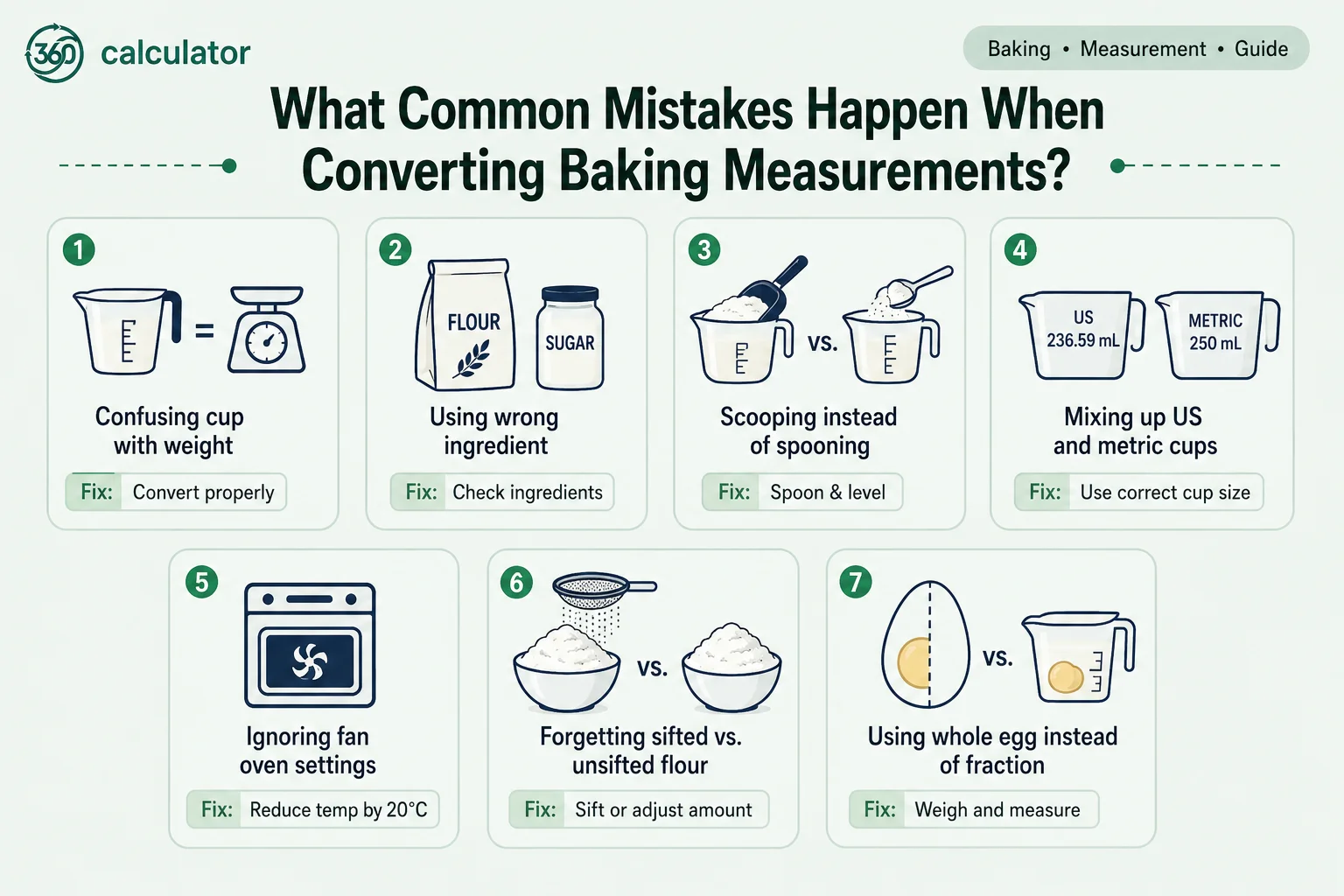
There are 7 common mistakes that affect a baking measurement conversion. Each mistake below includes a short, direct fix.
• Treating a cup as a fixed weight instead of a fixed volume, which produces a wrong gram result. Fix: select the specific ingredient before converting.
• Using one ingredient's density figure for a different ingredient. Fix: match the density figure to the exact ingredient.
• Scooping flour instead of spooning and leveling it. Fix: spoon flour into the cup, then level with a straight edge.
• Mixing up US and metric or imperial cup sizes. Fix: confirm the recipe's country of origin before selecting a cup size.
• Ignoring the fan oven temperature offset. Fix: lower a fan oven's target temperature by about 20°C or 25°F.
• Confusing sifted flour weight with unsifted flour weight. Fix: measure flour the same way the recipe specifies, sifted or unsifted.
• Forgetting that a fractional whole item like 0.8 egg needs to be weighed rather than guessed. Fix: weigh 1 whole egg first, then multiply by the fraction needed.
How Does Baking Conversion Fit Into Broader Recipe Planning and Kitchen Math?
Converting a single measurement is usually one step in a larger task, such as resizing a recipe, substituting an ingredient form, or adjusting bake time for a different pan size. Each of these related tasks uses its own dedicated calculator, covered in the sections below.
How Do You Convert Yeast Types When a Recipe Calls for a Different Kind?
Converting between fresh yeast, active dry yeast, and instant dry yeast uses a specific multiplier, since the 3 types are not interchangeable at a 1 to 1 ratio. Fresh yeast to active dry yeast uses roughly a 0.4 multiplier. Instant dry yeast to active dry yeast uses roughly a 1.2 multiplier. The Fresh Yeast to Active Dry Yeast Calculator covers the full multiplier table for every yeast type combination.
Yeast Type | Converts To | Multiplier |
Fresh yeast | Active dry yeast | ≈ 0.4 |
Instant dry yeast | Active dry yeast | ≈ 1.2 |
How Do You Scale a Recipe Up or Down for a Different Serving Size?
Scaling a recipe multiplies every ingredient by the same factor, once each unit is already converted correctly. Doubling a recipe suits a larger gathering. Halving a recipe suits two people. The Recipe Conversion Calculator handles this scaling step as the natural next step after converting units on this page.
How Do You Convert Grams to Tablespoons or Teaspoons for a Specific Ingredient?
Converting grams back to tablespoons or teaspoons uses the same ingredient density logic covered earlier on this page, applied in reverse at a smaller volume. This reverse direction matters most for ingredients measured in small amounts, such as baking powder, salt, or spices. The Grams to Tablespoons or Teaspoons Calculator covers this reverse conversion for every listed ingredient.
How Do You Convert Milligrams to Teaspoons for Small Ingredient Amounts Like Baking Powder?
Converting milligrams to teaspoons applies the same density principle used for grams, scaled down further for small quantity ingredients. Leavening agents such as baking powder and baking soda, and flavoring extracts, sometimes appear in milligrams in precise or professional recipes. The Milligrams to Teaspoons Calculator handles this small quantity conversion for common baking ingredients.
How Do You Convert a Cake Pan Size to Another Shape or Size?
Converting a cake pan to a different shape or size compares pan area rather than applying a simple unit conversion. A 9 inch round pan swaps for a square pan or a different diameter round pan once the areas match. Oven temperature stays the same when the pan changes, only the bake time and the thickness of the finished bake change. The Pan Size Conversion Calculator compares area across common pan shapes and sizes.
How Do You Adjust Baking Time When You Change Pan Size or Oven Type?
Adjusting baking time for a pan size or oven type change is a separate calculation from a straight temperature or ingredient conversion. A larger or shallower pan usually needs less time at the same temperature. A smaller or deeper pan usually needs more time. The Baking Time Calculator covers the full adjustment method for pan size and oven type changes.
How Do You Convert Between Metric and Imperial Weight Units Like Ounces and Pounds?
Converting between metric and imperial weight units, such as ounces and pounds, is a general weight conversion unrelated to a specific ingredient's density. A bulk baking project that needs a total dough weight in kilograms starts from a pounds figure using this conversion. The Ounces to Pounds Calculator covers common weight unit pairs, including ounces to grams and pounds to kilograms.
The table below lists 3 common weight unit pairs used in baking.
Unit Pair | Conversion |
1 oz | 28.35 g |
1 lb | 453.59 g |
1 lb | 0.4536 kg |
Frequently Asked Questions
Is a Baking Conversion Calculator Exact?
No, a baking conversion calculator gives an approximate figure, since ingredient measuring technique also affects the actual weight.
Does 1 Cup Always Weigh the Same Amount in Grams?
No, 1 cup weighs a different amount in grams for every ingredient, since a cup measures volume and not weight.
What Is the Fastest Way to Convert Fahrenheit to Celsius for Baking?
Subtract 32 from the Fahrenheit figure, then divide by 1.8 for a quick Celsius estimate.
Can a US Recipe Be Used With a Metric Cup?
Yes, but the result shifts by about 5.7 percent per cup, since the US cup measures 236.59 mL and the metric cup measures 250 mL.
How Much Does 1 Pinch of Salt Weigh?
1 pinch of salt measures about 1/16 teaspoon, which converts to roughly 0.3 grams.
Related Baking and Kitchen Math Conversions
The conversions below extend the baking conversion calculator into related kitchen math tasks. Each linked page covers one specific conversion in full.
• Fresh Yeast to Active Dry Yeast Calculator covers multipliers for fresh, active dry, and instant dry yeast.
• Recipe Conversion Calculator scales an entire recipe up or down once individual units are converted.
• Grams to Tablespoons or Teaspoons Calculator reverses the cups to grams logic for small quantity ingredients.
• Milligrams to Teaspoons Calculator handles milligram scale conversions for leavening agents and extracts.
• Pan Size Conversion Calculator compares pan area across round, square, and rectangular pans.
• The Baking Time Calculator adjusts bake duration for a pan size or oven type change.
• Ounces to Pounds Calculator covers general metric and imperial weight pairs beyond ingredient density.