
Grams to cups conversion depends on the ingredient's density, since grams measure weight and cups measure volume.
The calculator above converts 15 ingredients instantly, including flour, sugar, butter, rice, milk, honey, oats, cornstarch, chocolate chips, baking powder, salt, and yeast.
This page includes a worked example that converts a full recipe's ingredients at once, an explanation of why cup measurements change based on scooping technique and country, and direct answers to common questions, including whether 100 grams equals 1 cup for every ingredient.
What Determines How Many Cups a Given Weight in Grams Equals?
The ingredient's density determines how many cups a given weight in grams equals.
Grams measure mass, and cups measure volume, so converting between them requires a third variable that links weight to volume. Density supplies that link, expressed in grams per milliliter.
Why Do Grams and Cups Measure Different Things?
A gram measures mass, and a cup measures volume, so the two units connect only through the ingredient's density.
Water has a density of 1 gram per milliliter, so 1 cup of water weighs 237 grams. All-purpose flour has a lower density near 0.51 grams per milliliter, so 1 cup of flour weighs 120 grams, 117 grams less than the same cup of water.
What Is the Formula for Converting Grams to Cups?
Cups equal grams divided by the cup size in milliliters multiplied by the ingredient's density in grams per milliliter.
Converting grams to cups by hand follows 4 steps:
1. Identify the ingredient and its density in grams per milliliter.
2. Multiply the cup size in milliliters by the density value.
3. Divide the ingredient's weight in grams by that result.
4. Round the result to the nearest common fraction, such as 1/4 or 1/2 cup.
This sequence applies to every ingredient, only the density value changes.
For example, 100 grams of all-purpose flour converts to 0.8 cups: 100 grams divided by 236.59 milliliters multiplied by 0.529 grams per milliliter equals 0.8 cups. According to the National Institute of Standards and Technology, the US customary cup measures 236.59 milliliters.
What Is the Formula for Converting Cups to Grams?
Grams equal cups multiplied by the cup size in milliliters multiplied by the ingredient's density.
For example, 1 cup of granulated sugar converts to 200 grams: 1 cup multiplied by 236.59 milliliters multiplied by 0.85 grams per milliliter equals 200 grams.
How Many Grams Are in a Cup for Common Cooking and Baking Ingredients?
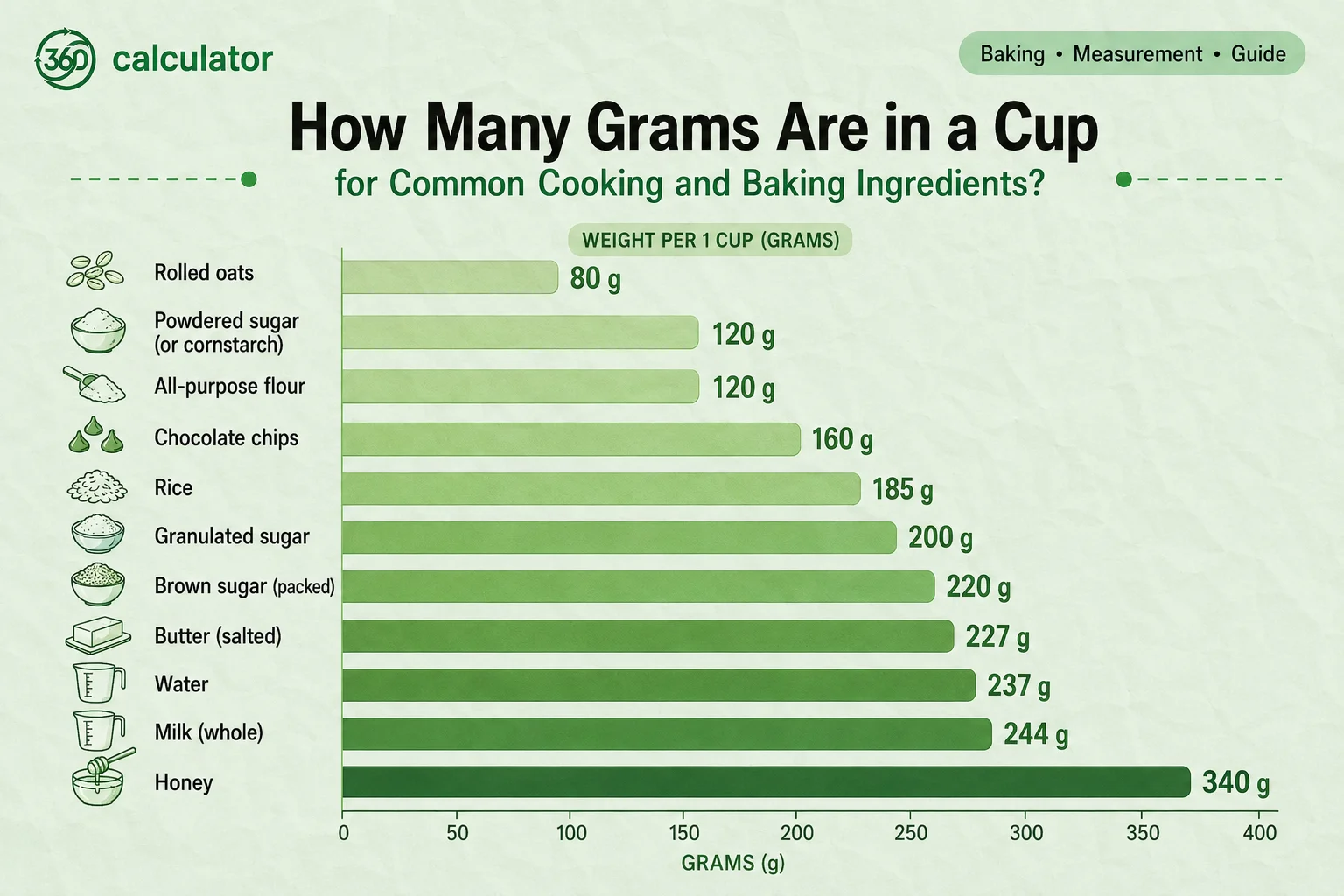
The weight of 1 cup ranges from 80 grams for rolled oats to 340 grams for honey, depending on the ingredient's density.
The table below lists the weight in grams for 1 cup of 12 common cooking and baking ingredients, measured with a US customary cup (236.59 milliliters) using the spoon-and-level method for dry ingredients.
Ingredient | Grams per Cup |
All-purpose flour | 120 |
Granulated sugar | 200 |
Brown sugar (packed) | 220 |
Powdered sugar | 120 |
Butter | 227 |
Rice (uncooked) | 185 |
Water | 237 |
Milk | 244 |
Honey | 340 |
Rolled oats | 80 |
Cornstarch | 120 |
Chocolate chips | 160 |
According to the Food and Agriculture Organization of the United Nations, ingredient density values vary by moisture content, particle size, and temperature.
How Many Grams of Flour Are in a Cup?
1 cup of all-purpose flour weighs 120 grams, using the spoon-and-level method.
Scooping the cup directly from the bag increases the weight to 150 grams, a 25% increase. Bread flour weighs 127 grams per cup, and cake flour weighs 115 grams per cup. According to King Arthur Baking Company, the spoon-and-level method produces the most consistent flour measurement for home bakers.
How Many Grams of Sugar Are in a Cup?
1 cup of granulated sugar weighs 200 grams.
Packed brown sugar weighs 220 grams per cup, 20 grams more than the same cup left unpacked. Powdered sugar weighs 120 grams per cup, due to air between the fine particles.
How Many Grams of Butter Are in a Cup?
1 cup of butter weighs 227 grams, equal to 2 standard US sticks.
Half a cup of butter weighs 113 grams, equal to 1 stick. US butter sticks carry printed measurement markings, so this conversion stays consistent regardless of scooping technique.
How Many Grams of Rice Are in a Cup?
1 cup of uncooked white rice weighs 185 grams.
Cooked rice doubles in volume, so 1 cup of uncooked rice yields 2 to 2.5 cups of cooked rice. Brown rice weighs a similar 183 grams per cup uncooked.
How Many Grams of Water and Milk Are in a Cup?
1 cup of water weighs 237 grams, and 1 cup of whole milk weighs 244 grams.
Milk weighs more than water per cup, due to dissolved fat and protein content. Liquid ingredients convert more consistently than dry ingredients, since liquids do not compress or settle in the cup.
How Many Grams of Honey and Syrup Are in a Cup?
1 cup of honey weighs 340 grams.
Honey weighs 3 times more than cocoa powder per cup, at 100 grams for cocoa powder. Molasses and golden syrup weigh a similar amount to honey per cup, due to comparable density.
How Many Grams of Oats, Cornstarch, Chocolate Chips, and Nuts Are in a Cup?
1 cup of rolled oats weighs 80 grams, the lightest ingredient on this page.
The table below lists the gram weight for 1 cup of 4 additional pantry ingredients.
Ingredient | Grams per Cup |
Rolled oats | 80 |
Cornstarch | 120 |
Chocolate chips | 160 |
Almonds (whole) | 140 |
How Many Grams of Baking Powder, Salt, and Yeast Are Used in Small Measurements?
1 tablespoon of baking powder weighs 15 grams, and 1 teaspoon weighs 5 grams.
The table below lists the gram weight of 3 ingredients typically measured in tablespoons or teaspoons rather than full cups.
Ingredient | Per Tablespoon | Per Teaspoon |
Baking powder | 15 g | 5 g |
Salt (fine) | 18 g | 6 g |
Dried yeast | n/a | 3.5 g |
How Do You Convert a Full Recipe's Ingredients From Grams to Cups?
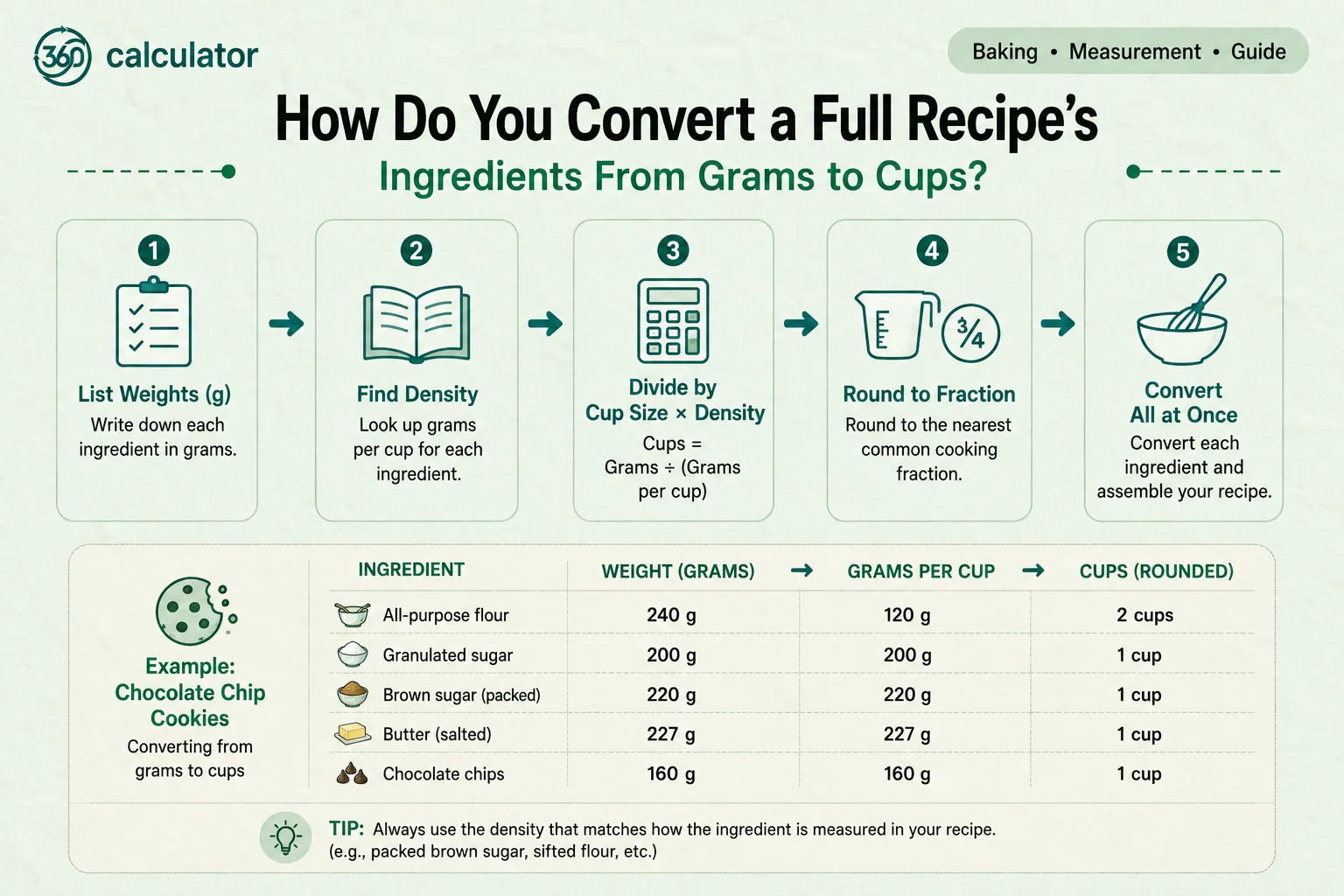
Converting a full recipe from grams to cups requires applying the density-based formula to each ingredient separately, then combining the converted amounts into 1 ingredient list.
Converting a full recipe follows 5 steps:
1. List every ingredient's weight in grams.
2. Identify each ingredient's density value.
3. Divide each weight by its cup size multiplied by density.
4. Round each result to the nearest common fraction.
5. Convert every ingredient at once, rather than switching between grams and cups mid-recipe.
Converting every ingredient in a single pass prevents the most common recipe error, mixing measurement systems partway through a dish.
A standard chocolate chip cookie recipe demonstrates this process.
The table below converts 5 ingredients from a chocolate chip cookie recipe.
Ingredient | Grams | Cups |
All-purpose flour | 240 g | 2 cups |
Granulated sugar | 200 g | 1 cup |
Brown sugar (packed) | 220 g | 1 cup |
Butter | 227 g | 1 cup |
Chocolate chips | 160 g | 1 cup |
What Are the Most Common Questions About Grams to Cups Conversion Accuracy?
Does 100 Grams Always Equal 1 Cup for Every Ingredient?
No, 100 grams does not equal 1 cup for every ingredient.
100 grams of all-purpose flour equals 0.8 cups, while 100 grams of granulated sugar equals 0.5 cups, a 0.3 cup difference between the 2 ingredients.
Does 250 Grams of Water Fill 1 Metric Cup?
Yes, 250 grams of water fills 1 metric cup.
A metric cup measures 250 milliliters, and water has a density of 1 gram per milliliter, so the 2 values match exactly. Dry ingredients do not follow this same equivalence, since their density differs from water.
Why Does Measuring by Cups Produce Inconsistent Gram Results?
Measuring by cups produces inconsistent gram results because scooping technique changes how tightly an ingredient packs into the cup.
How Does the Spoon-and-Level Method Differ From Scoop-and-Pack?
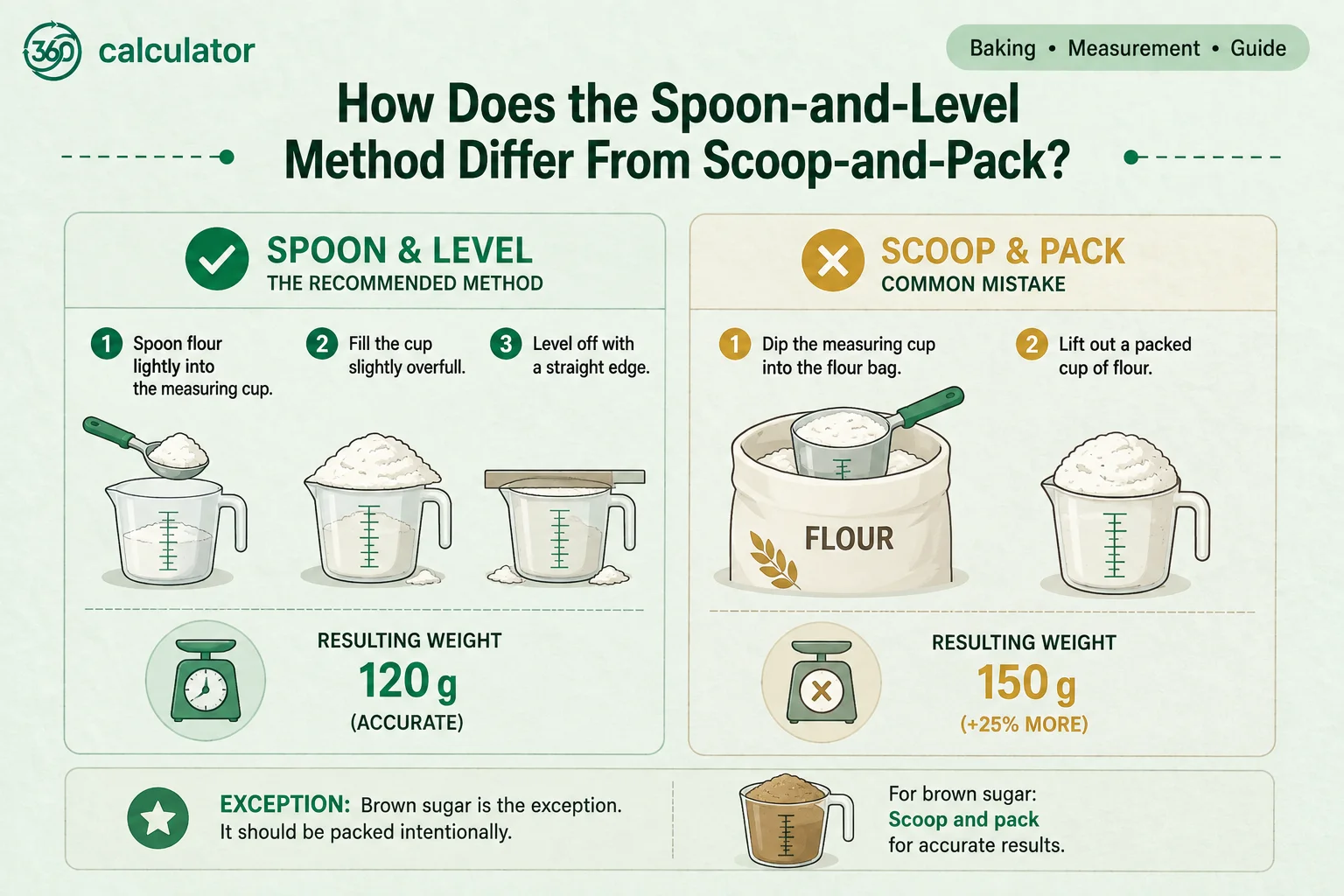
The spoon-and-level method spoons the ingredient into the cup and levels it with a straight edge, while scoop-and-pack dips the cup directly into the bag and compresses the ingredient.
Scoop-and-pack adds 20 to 30 grams of extra flour per cup, compared to spoon-and-level. Brown sugar reverses this convention, since recipes expect it packed into the cup.
What Do Scant, Heaped, and Level Cup Measurements Mean?
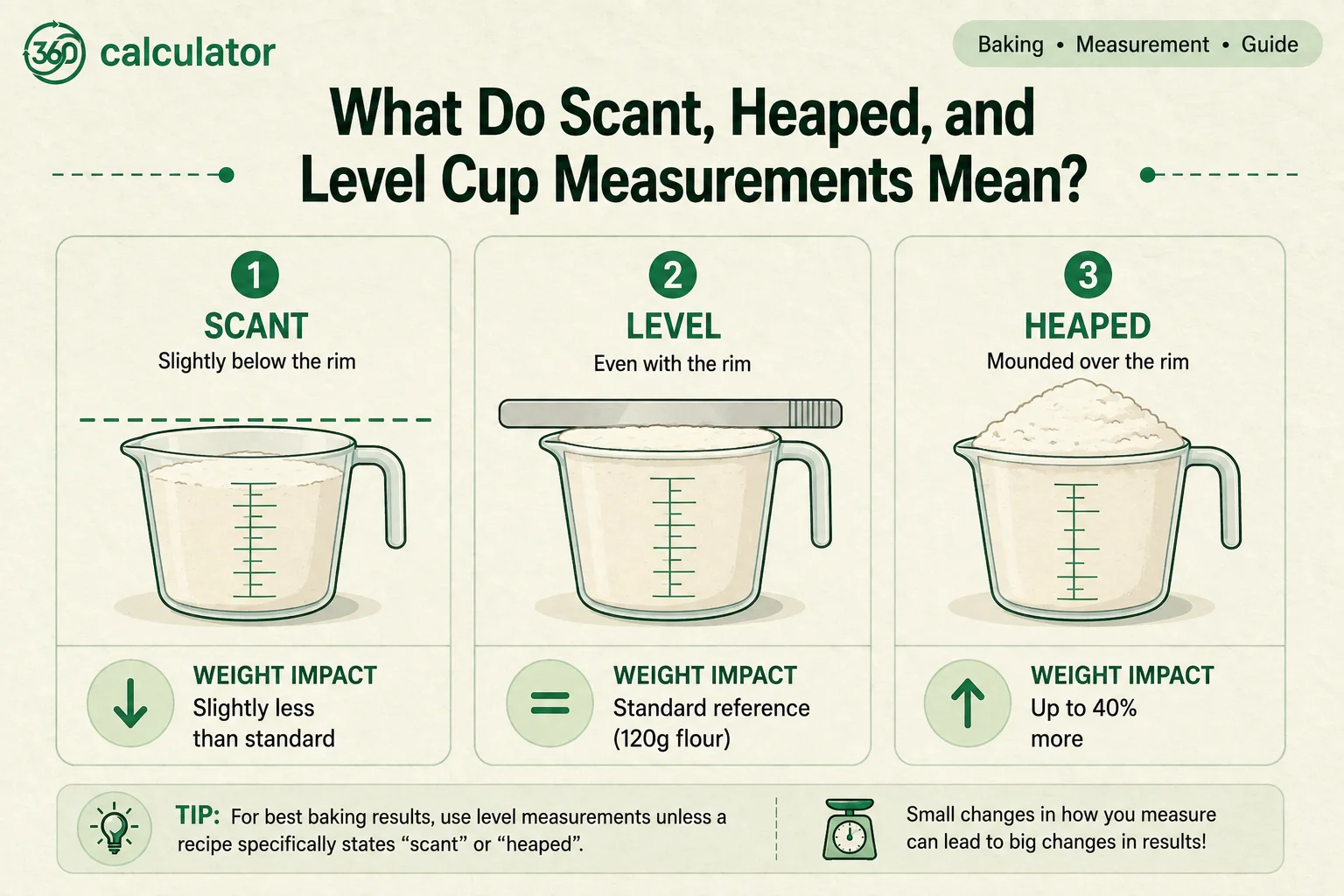
A level cup is filled and leveled flat with a straight edge, a heaped cup is filled above the rim without leveling, and a scant cup holds slightly less than a full cup.
A heaped cup of flour weighs up to 40% more than a level cup of the same flour. Recipes default to a level cup unless the recipe specifies heaped or scant.
How Much Can Measuring Technique Change the Gram Weight of a Cup?
Measuring technique can change the gram weight of 3 cups of flour by up to 120 grams.
A 120 gram difference changes a soft, airy loaf into a dense, heavy one. The same variation applies to any dry ingredient measured by volume instead of weight.
Is a Kitchen Scale More Accurate Than a Measuring Cup?
Yes, a kitchen scale is more accurate than a measuring cup.
A scale measures weight directly, removing variation from scooping, packing, and settling. Professional bakeries use grams and baker's percentage for this reason, since weight stays constant regardless of how an ingredient is handled.
How Does Cup Size Vary by Country?
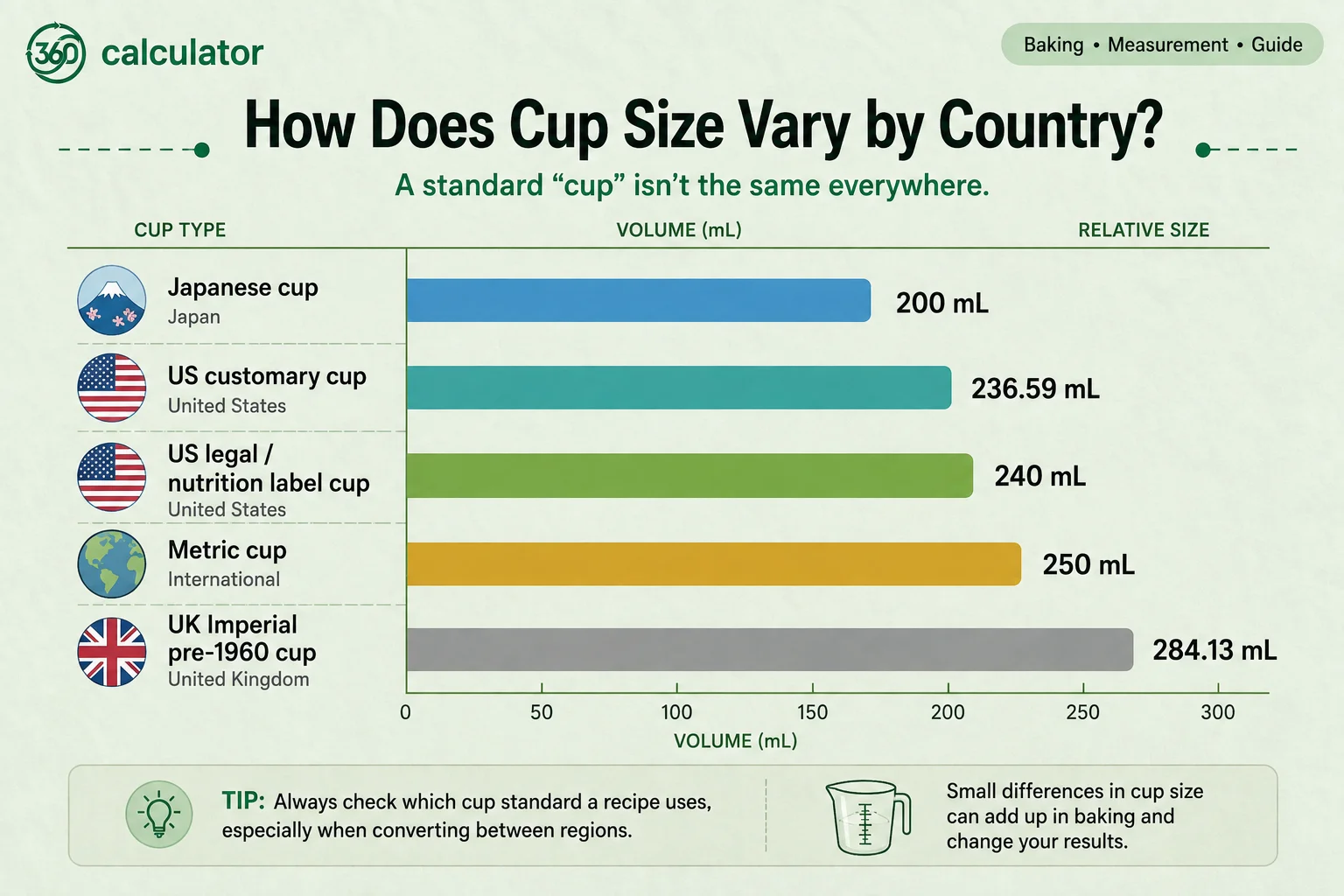
Cup size varies by country from 200 milliliters in Japan to 284 milliliters in pre-1960s United Kingdom recipes.
What Is the Difference Between a US Cup and a Metric Cup?
A US cup measures 236.59 milliliters, and a metric cup measures 250 milliliters, a 5.6% difference.
An Australian recipe that calls for 2 cups of flour expects 260 grams, while a US recipe with the same wording expects 240 grams, a 20 gram gap between the 2 countries.
What Is the Difference Between a US Legal Cup and a US Customary Cup?
The US legal cup used for nutrition labeling measures 240 milliliters, while the customary cup used in recipes measures 236.59 milliliters. According to the U.S. Food and Drug Administration, this legal definition applies specifically to nutrition labeling, not recipe writing.
The 3.41 milliliter difference rarely changes a recipe's outcome, but explains small discrepancies between nutrition labels and recipe measurements.
How Do Imperial and Japanese Cups Compare to the US Cup?
An imperial cup measures 284.13 milliliters, and a Japanese cup measures 200 milliliters, a 42% difference between the 2.
The imperial cup appears mainly in United Kingdom recipes published before 1960. Checking a recipe's country of origin prevents applying the wrong cup standard.
Does a Tablespoon Size Also Vary by Country?
Yes, a tablespoon size varies by country.
A US, UK, and New Zealand tablespoon measures 15 milliliters, while an Australian tablespoon measures 20 milliliters, a 33% difference. This difference affects tablespoon-measured ingredients, such as baking powder or oil, more than full cup measurements.
How Does the Grams to Cups Conversion Connect to Other Recipe Measurement Conversions?
The Grams to cups conversion connects to 4 other recipe measurement conversions that use the same density-based formula: tablespoons, teaspoons, ounces, and milliliters.
Each related conversion swaps the cup size or unit value in the same formula used above. The sections below cover each related conversion in its own context.
How Do You Convert Cups to Grams?
The formula used on this page works in reverse for the Cups to Grams Conversion, multiplying instead of dividing.
1 cup of sugar converts to 200 grams using this reversed formula.
How Do You Convert Grams to Tablespoons?
The same density formula applies to a smaller volume unit in the Grams to Tablespoons Conversion, useful for spices and small ingredient amounts.
15 grams of baking powder converts to 1 tablespoon.
How Do You Convert Grams to Teaspoons?
The smallest common recipe quantities, including salt, yeast, and vanilla extract, are covered by the Grams to Teaspoons Conversion.
1 teaspoon of salt weighs 6 grams, while 1 teaspoon of baking powder weighs 5 grams.
How Do You Convert Milliliters to Cups?
A volume-to-volume calculation, without requiring a density value, defines the Milliliters to Cups Conversion.
This conversion applies mainly to liquid ingredients, which are usually measured by volume directly.
How Do You Convert Ounces to Cups?
Whether the ounce measurement is a weight ounce or a fluid ounce determines the method used in the Ounces to Cups Conversion.
A fluid ounce of milk and a weight ounce of flour convert using 2 different methods.
How Do You Use a Butter Conversion Calculator?
Gram, cup, tablespoon, and stick conversions specific to butter's consistent US stick packaging are provided by the Butter Conversion Calculator.
1 cup of butter equals 227 grams or 2 standard sticks.
How Do You Use a Flour Conversion Calculator?
5 flour types are covered separately, since each carries a different density, in the Flour Conversion Calculator.
All-purpose, bread, cake, whole wheat, and self-raising flour each convert to a different gram weight per cup.
How Do You Scale a Recipe Using Gram Measurements?
Every gram value gets multiplied by the same scaling factor, avoiding the cup fractions created by scaling volume measurements, in the Recipe Scaling Calculator.
Doubling a recipe in grams requires multiplying every ingredient's weight by 2.
How Do You Choose and Use a Kitchen Scale for Baking?
Scale features relevant to baking, including gram increments and a tare function, are covered in the Kitchen Scale Buying Guide.
A tare function resets the scale to 0 between ingredients, allowing multiple ingredients to be weighed in 1 bowl.
How Do You Get a Printable Grams to Cups Conversion Chart?
The ingredient values from this page get condensed into 1 page for kitchen wall reference in the Printable Baking Conversion Chart.
The printable chart covers the same 12 ingredients listed above.
Is There a Mobile App for Converting Grams to Cups?
The same conversion formula and ingredient list, in an offline format, come through the Grams to Cups Mobile App.
The app functions without a wifi connection, useful while grocery shopping or in a kitchen without service.
Grams to cups conversion, applied consistently with the correct density value, produces the same result every time, regardless of which ingredient, country, or recipe uses it.
Frequently Asked Questions
Do All Recipes Use the Same Cup Size?
No, recipes do not use the same cup size. A recipe's country of origin determines its cup standard, ranging from 200 milliliters to 284 milliliters.
Can You Convert Grams to Cups Without a Kitchen Scale?
Yes, converting grams to cups without a scale is possible using density values and the conversion formula. A calculator or conversion chart replaces the need for manual density lookups.
Why Do Some Recipes List Both Grams and Cups?
Some recipes list both grams and cups to serve readers in different countries and with different kitchen tools. Grams serve readers with a scale, while cups serve readers without one.
Does Sifting Flour Change Its Gram Weight per Cup?
Yes, sifting flour changes its gram weight per cup. Sifted flour weighs 110 grams per cup, 10 grams less than unsifted flour measured with the spoon-and-level method, since sifting adds air between the particles.