
The MG to TSP Conversion Calculator converts a milligram weight into teaspoons using a substance's density. Milligrams measure mass, teaspoons measure volume, and density is the fixed number that links the two units together.
The calculator covers 9 substances: water, milk, salt, sugar, flour, honey, cooking oil, baking soda, and liquid medicine. This page explains the density based formula, lists milligrams per teaspoon for 8 common substances, covers liquid medicine dosage, answers 4 common accuracy questions, explains why teaspoon measuring produces inconsistent results and when a scale works better, describes how teaspoon size changes by country, and connects this conversion to 17 related recipe, dosage, and measurement conversions.
What Determines How Many Teaspoons a Given Weight in Milligrams Equals?
A substance's density determines how many teaspoons a given milligram weight equals. Milligrams measure mass, teaspoons measure volume, and density, expressed in milligrams per milliliter, links the two units together.
Why Do Milligrams and Teaspoons Measure Different Things?
Milligrams measure how heavy a substance is, teaspoons measure how much space it fills. Flour fills more space per milligram than salt, and water sits between the two in density. According to the National Institute of Standards and Technology, a US teaspoon holds exactly 4.92892 milliliters regardless of what fills it.
What Is the Formula for Converting MG to TSP?
Teaspoons equal milligrams divided by density in milligrams per milliliter, then divided by 4.92892.
Formula: tsp = mg ÷ (density in mg/mL × 4.92892)
The conversion follows 3 steps:
1. Find the substance's density in grams per milliliter.
2. Convert that density to milligrams per milliliter, if it is listed in grams per milliliter, by multiplying by 1,000.
3. Divide the milligram weight by the density in milligrams per milliliter, then divide the result by 4.92892.
5,000 mg of a substance with a density of 0.7 g/mL equals about 1.449 tsp. Converting 0.7 g/mL to 700 mg/mL, then dividing 5,000 by 700, gives 7.143 mL, and dividing 7.143 by 4.92892 gives 1.449 tsp. According to the National Institute of Standards and Technology, 4.92892 milliliters is the defined volume of 1 US customary teaspoon.
What Is the Formula for Converting TSP to MG?
Milligrams equal teaspoons multiplied by density in milligrams per milliliter, then multiplied by 4.92892.
Formula: mg = tsp × density (mg/mL) × 4.92892
1 tsp of water equals about 4,929 mg. Water's density of 1,000 mg/mL, multiplied by 4.92892, produces this figure. The calculation runs the same formula as mg to tsp, in reverse.
How Many Milligrams Are in a Teaspoon for Common Substances?

A level teaspoon of a common kitchen substance weighs between about 2,600 mg and 7,000 mg, depending on density. The exact weight shifts with grind size, packing, and temperature.
The table below lists the approximate milligram weight of 1 level teaspoon for 8 common substances.
Substance | Mg per Teaspoon |
Water | 4,929 |
Milk | 5,077 |
Table Salt | 6,013–6,085 |
Granulated Sugar | 4,190 |
All-Purpose Flour | 2,600–2,612 |
Honey | 6,999–7,083 |
Cooking Oil | 4,535 |
Baking Soda | 4,732 |
How Many MG Are in a Teaspoon of Water?
1 teaspoon of water weighs about 4,929 mg. Water's density of 1.00 g/mL, multiplied by 4.92892 mL, produces this figure. Many people apply this water based figure to every other substance, which produces an incorrect result for denser or lighter ingredients.
How Many MG Are in a Teaspoon of Salt?
1 teaspoon of table salt weighs about 6,013 mg to 6,085 mg. Salt is denser than water, so it weighs more per teaspoon. Packed salt weighs slightly more than loosely spooned salt.
How Many MG Are in a Teaspoon of Sugar?
1 teaspoon of granulated sugar weighs about 4,190 mg. Sugar weighs less per teaspoon than salt, and more than flour.
How Many MG Are in a Teaspoon of Flour?
1 teaspoon of all-purpose flour weighs about 2,600 mg to 2,612 mg, the lightest of the 8 common substances covered here. Treating 5,000 mg of flour as 1 teaspoon produces close to a 100 percent error, since flour needs almost 2 teaspoons to reach 5,000 mg.
How Many MG Are in a Teaspoon of Honey?
1 teaspoon of honey weighs about 6,999 mg to 7,083 mg, depending on the source. Honey is the densest of the 8 common kitchen ingredients covered on this page.
How Many MG Are in a Teaspoon of Milk, Cooking Oil, and Baking Soda?
1 teaspoon of milk weighs about 5,077 mg, 1 teaspoon of cooking oil weighs about 4,535 mg, and 1 teaspoon of baking soda weighs about 4,732 mg. All 3 sit close to water's density, unlike flour or honey.
How Many Teaspoons Are 100 MG, 500 MG, and 1,000 MG of Water?
The table below converts 3 common milligram amounts of water into teaspoons, using water's density as the baseline.
Milligrams of Water | Teaspoons |
100 mg | 0.02 tsp |
500 mg | 0.1 tsp |
1,000 mg | 0.2 tsp |
The main formula above applies to any other substance, using its own density instead of water's.
How Many MG Are in 1/4 and 1/2 Teaspoon?
Amount of Water | Milligrams |
1/4 tsp | 1,232 mg |
1/2 tsp | 2,465 mg |
The figure changes with substance density the same way a full teaspoon does.
How Do You Convert MG to TSP for Liquid Medicine Dosage?
Liquid medicine dosage treats 5 mL as 1 teaspoon, and a water-like liquid medicine near 1,000 mg/mL puts 1 teaspoon near 5,000 mg.
The real active ingredient dose sits on the label as milligrams per milliliter or milligrams per 5 milliliters, not on this general estimate. A household teaspoon is not a calibrated dosing device, and an oral syringe or dosing cup measures a dose more reliably.
How Many MG Are in a Teaspoon of Liquid Medicine?
The milligram amount in a teaspoon of liquid medicine depends on the label's printed concentration, not a fixed rule. At a labeled concentration of 120 mg per 5 mL, 1 teaspoon delivers about 120 mg of active ingredient. The answer changes with every product.
Why Shouldn't You Use a Kitchen Teaspoon to Measure Medicine Dosage?

A kitchen teaspoon varies from the standardized 4.92892 mL figure, unlike a calibrated oral syringe or dosing cup. According to the U.S. Food and Drug Administration, household spoons produce inconsistent volumes compared to marked dosing devices.
How Do You Calculate a Child's Medicine Dose in Teaspoons From MG per KG?

The calculation follows 4 steps:
4. Convert the child's weight to kilograms.
5. Multiply the weight in kilograms by the labeled mg/kg dose to get the total milligrams.
6. Divide the total milligrams by the label's mg/mL concentration to get milliliters.
7. Divide the milliliters by 5 to get teaspoons.
A 20 kg child at a placeholder dose of 10 mg/kg needs 200 mg total. At a placeholder label concentration of 100 mg/mL, that equals 2 mL, or 0.4 teaspoons. A pharmacist or doctor should confirm any dose before giving medicine to a child.
What Common Questions Come Up About MG to TSP Conversion Accuracy?
The questions below answer 4 common accuracy doubts about mg to tsp conversion.
Does 5,000 MG Always Equal 1 Teaspoon?
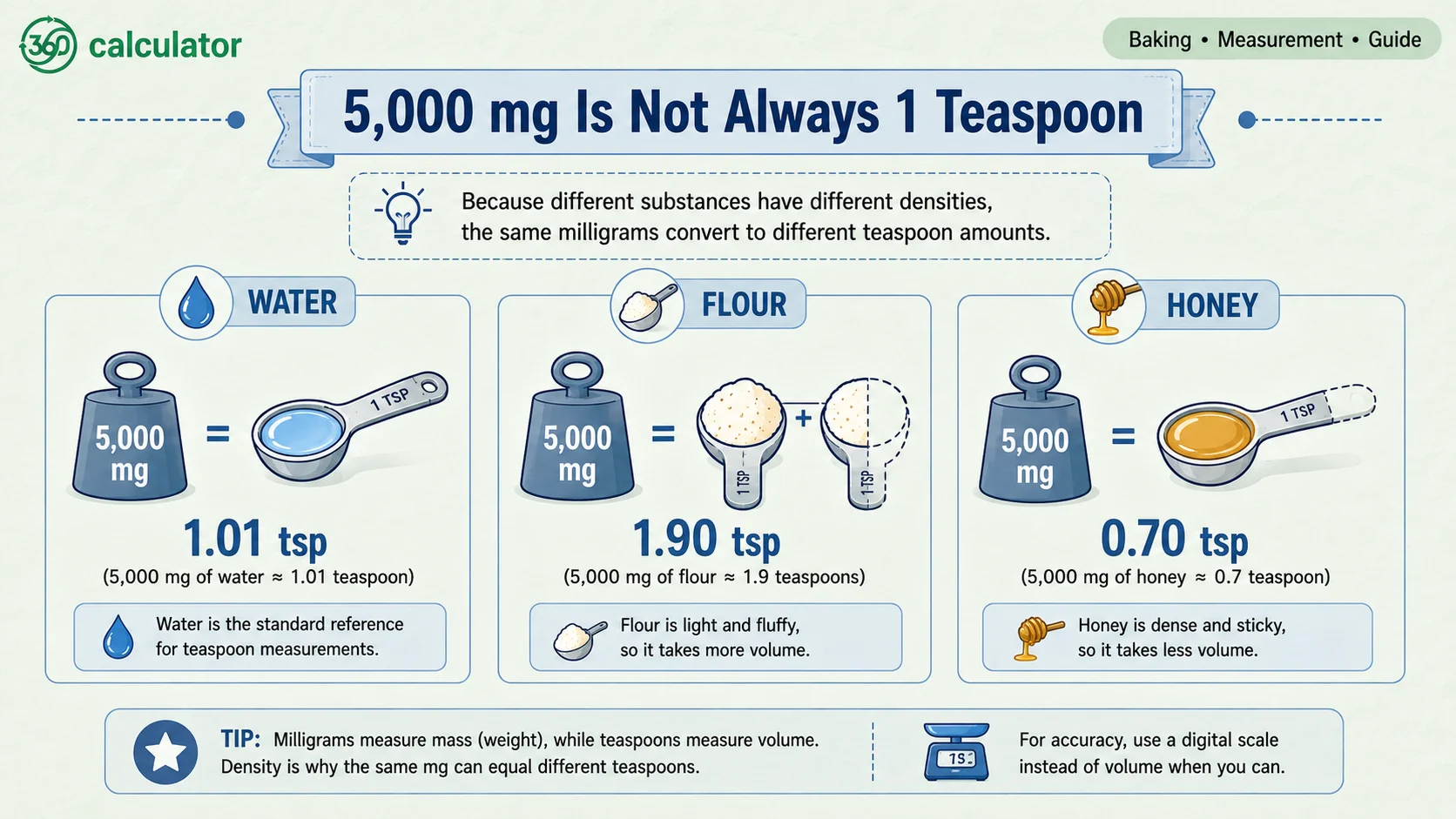
No, 5,000 mg does not always equal 1 teaspoon. The figure holds only for water-like density, and it is false for flour, about 1.9 tsp, and honey, about 0.7 tsp, at the same 5,000 mg.
Substance | Teaspoons at 5,000 mg |
Water | 1.01 tsp |
Flour | 1.9 tsp |
Honey | 0.7 tsp |
Is 5 MG the Same as 1 Teaspoon?
No, 5 mg is not the same as 1 teaspoon. 5 mg is a tiny mass, far below a teaspoon of any common substance, while the actual water-like baseline is 5 mL, which equals about 5,000 mg.
Why Can't You Use One Fixed Number to Convert MG to TSP for Every Substance?
One fixed number cannot convert mg to tsp for every substance because density is not optional, it decides the result every time. Flour shows this directly, since applying the water based number to flour produces close to a 100 percent error.
How Many Milligrams Are in a Tablespoon?
1 US tablespoon of water weighs about 14,787 mg, 3 times the teaspoon figure, and other substances can use the MG to Tablespoon Conversion Calculator, which applies the same density based formula, using 14.7868 mL.
Why Does Measuring MG in Teaspoons Produce Inconsistent Results?
Measuring mg in teaspoons produces inconsistent results because teaspoon measuring itself, packing and leveling, adds variation on top of density.
How Does Substance Density Affect MG to TSP Accuracy?
An estimated or wrong density value produces a wrong mg to tsp reading. Reliable density values come from reference databases or the product label, not estimation.
Is a Milligram Scale More Accurate Than a Teaspoon for Small Amounts?
Yes, a milligram scale is more accurate than a teaspoon for small amounts. A scale removes the packing and leveling variance that a spoon introduces, which matters most for small supplement or medicine amounts.
How Do You Accurately Measure Small MG Amounts of Supplement Powder With a Teaspoon?
Standard kitchen spoons are not marked in decimals, so amounts under about 1/8 teaspoon are hard to measure with a typical spoon set. Calibrated mini measuring spoons, in 1/16, 1/20, and 1/32 teaspoon sizes, or a milligram scale, measure doses under roughly 300 mg to 500 mg more accurately.
How Does Teaspoon Size Vary by Country and Standard?

Teaspoon size varies by country and standard, not every teaspoon holds 4.92892 mL. The country or labeling standard behind a recipe changes the correct mg to tsp result.
What Is the Difference Between a US Teaspoon and a Metric Teaspoon?
A US teaspoon holds 4.92892 mL, a metric teaspoon holds 5 mL.
Standard | Volume | Tsp at 5,000 mg Water |
US Teaspoon | 4.92892 mL | 1.014 tsp |
Metric Teaspoon | 5 mL | 1.000 tsp |
The gap between the 2 standards equals about 1.4 percent, small enough to rarely matter in practice.
What Is the Difference Between a US Teaspoon and a UK Teaspoon?
A UK teaspoon holds about 5.919 mL, roughly 20 percent larger than a US teaspoon. Checking a recipe or label's country of origin first prevents this gap from producing an incorrect measurement.
What Is the US Legal Teaspoon Used for Nutrition Labeling?
The US legal teaspoon used for nutrition labeling equals exactly 5 mL, not the 4.92892 mL customary figure. According to the FDA and the National Institute of Standards and Technology, this legal definition rarely changes a practical outcome.
How Does the MG to TSP Conversion Connect to Other Recipe, Dosage, and Measurement Conversions?
MG to TSP conversion sits among several related mass to volume and unit scaling conversions used in cooking, supplements, and medicine dosing. Each linked topic below is covered in the specific context of its own page, letting a reader jump to the exact conversion needed next.
How Do You Convert TSP to MG?
Converting tsp to mg runs the same density formula in reverse, starting from a teaspoon amount instead of a milligram weight, and a recipe or scoop measurement that needs a total milligram figure can use the TSP to MG Conversion Calculator for this.
How Do You Convert MG to ML?
Converting mg to mL uses the same density link as mg to tsp, but skips the teaspoon constant since milliliters already measure volume, and medicine labels printed directly in mg per mL work well with the MG to ML Conversion Calculator.
How Do You Convert MG to Tablespoons?
Converting mg to tablespoons uses the same density approach as mg to tsp, with a larger constant, since 1 tablespoon equals 3 teaspoons, and a recipe or dose written in tablespoons instead of teaspoons can use the MG to Tablespoon Conversion Calculator.
How Do You Convert MCG to MG?
Converting mcg to mg is a pure mass to mass conversion, multiplying or dividing by 1,000, with no density step involved, and supplement labels that mix micrograms and milligrams can use the MCG to MG Conversion Calculator, unlike mg to tsp, which needs density.
How Do You Convert MG to Grams?
Converting mg to grams divides by 1,000, with no density needed, and the gram equivalent before working through the tsp formula comes from the MG to Grams Conversion Calculator.
How Do You Convert TSP to ML?
Converting tsp to mL is a volume to volume conversion, with no density figure needed since both units measure volume, and the mL equivalent of a teaspoon comes directly from the TSP to ML Conversion Calculator.
How Do You Convert MG to CC?
Converting mg to cc uses the identical density formula as mg to mL, since 1 cc equals 1 mL, and medical dosing documents that use cc instead of mL can rely on the MG to CC Conversion Calculator.
How Do You Convert Grams to Milliliters?
Converting grams to mL follows the same density link as mg to tsp, one level up, dividing grams by density in g/mL, and a gram scale reading before converting down to mg and tsp can use the Grams to Milliliters Conversion Calculator.
How Do You Convert MCG to ML?
Converting mcg to mL combines 2 conversions, a unit scale step from mcg to mg or g, and a density step, and very small supplement or medication amounts measured in micrograms can use the MCG to ML Conversion Calculator.
How Do You Convert MG to Ounces?
Converting mg to ounces first requires stating whether the ounce is a weight ounce or a fluid ounce, then applying the matching mass to mass or density based method, and this directly searched query is covered by the MG to Ounces Conversion Calculator.
How Do You Convert Grams to Teaspoons?
Converting grams to teaspoons uses the identical density formula as mg to tsp, one level up in mass, dividing grams by density in g/mL and by the teaspoon's mL volume, and a reader working from a gram scale reading instead of milligrams can use the Grams to Teaspoons Conversion Calculator.
How Do You Use a MG to Tablets Calculator?
A tablets calculator answers a different question than this page, how many whole or partial tablets equal a target mg dose, based on the strength printed on the tablet, and a reader with pills instead of a liquid can use the MG to Tablets Calculator.
How Do You Use an IU to MG Calculator for Supplements?
International Units convert to mg differently for every supplement, such as vitamin D or vitamin E, with no single universal ratio, unlike the fixed physical formula used for mg to tsp, and a supplement user starting from an IU dose can use the IU to MG Conversion Calculator.
How Do You Use a Pediatric Medicine Dosage Calculator?
A dedicated pediatric calculator carries the mg per kg body weight step through to a final mL or teaspoon dose automatically, while this page only outlines the steps conceptually, and a real child's dose calls for the Pediatric Dosage Calculator instead.
How Do You Convert Cups to Teaspoons?
Converting cups to teaspoons uses a simple volume ratio, 1 cup equals 48 teaspoons, with no density needed, and a recipe that lists a mg based ingredient across a cup measurement can use the Cups to Teaspoons Conversion Calculator.
How Do You Get a Printable MG to TSP Conversion Chart?
A printable chart condenses this page's substance table onto 1 page for a kitchen or medicine cabinet, and repeated use without opening a calculator each time is covered by the Printable MG to TSP Conversion Chart.