
An IU to mcg or mg converter turns an International Unit (IU) value into its equivalent mass in micrograms (mcg) or milligrams (mg) for vitamin D, vitamin A, and vitamin E. IU measures the biological activity of a substance, while mcg and mg measure physical weight. The conversion factor between these two systems changes by vitamin and, for vitamin A and vitamin E, by the specific form of the nutrient. Vitamin D uses one fixed factor across both of its forms. Vitamin A and vitamin E each require a form selection before a conversion produces an accurate result. Supplement labels and doctor recommendations sometimes list the same dose in different units, and this calculator removes that mismatch.
What Does IU Mean as a Unit of Measurement?
IU stands for International Unit, a measurement of a substance's biological activity rather than its physical weight. According to the NIH Office of Dietary Supplements, an IU varies by substance, since each vitamin or hormone produces a different biological effect per unit of mass. One IU of vitamin D does not equal one IU of vitamin A or one IU of vitamin E in physical amount. The exact mass behind one IU depends on the vitamin and, in two cases, on the form of that vitamin.
Why Is IU Not a Fixed Weight Like mg or mcg?
IU has no single fixed mass equivalent because it measures biological potency instead of physical weight. One milligram always equals 1,000 micrograms, regardless of substance. One IU of vitamin E, by contrast, equals 0.67 mg in its natural form and 0.45 mg in its synthetic form, despite both carrying the same vitamin E label. A general IU to mg formula does not work across every vitamin.
How Did the International Unit Become a Standard for Vitamins?
The World Health Organization introduced the first IU standard for vitamin D in 1931, using vitamin D2 as the reference form. The organization adjusted the reference to vitamin D3 in 1949. Vitamin A and vitamin E adopted their own IU systems in the mid-20th century, before regulators later shifted toward metric units for supplement labels.
Is IU Only Used for Vitamins?
No, IU also measures insulin, certain antibiotics, and hormone products. The mass to activity ratio for insulin differs entirely from any vitamin ratio, so a vitamin conversion factor never applies to an insulin dose. A prescriber's exact instructions take priority over any general IU conversion for these non-vitamin substances.
How Do You Convert IU to mcg and mg for Vitamin D?
1 IU of vitamin D equals 0.025 mcg, and 1 mcg equals 40 IU. This factor applies equally to vitamin D2 (ergocalciferol) and vitamin D3 (cholecalciferol), so the form does not change the calculation. Divide the mcg result by 1,000 to get the equivalent in mg.
What Is the Exact IU to mcg Formula for Vitamin D?
mcg equals IU divided by 40, and IU equals mcg multiplied by 40. 400 IU divided by 40 equals 10 mcg. This division works the same way for any vitamin D dose.
How Many mcg Are in Common Vitamin D Doses?
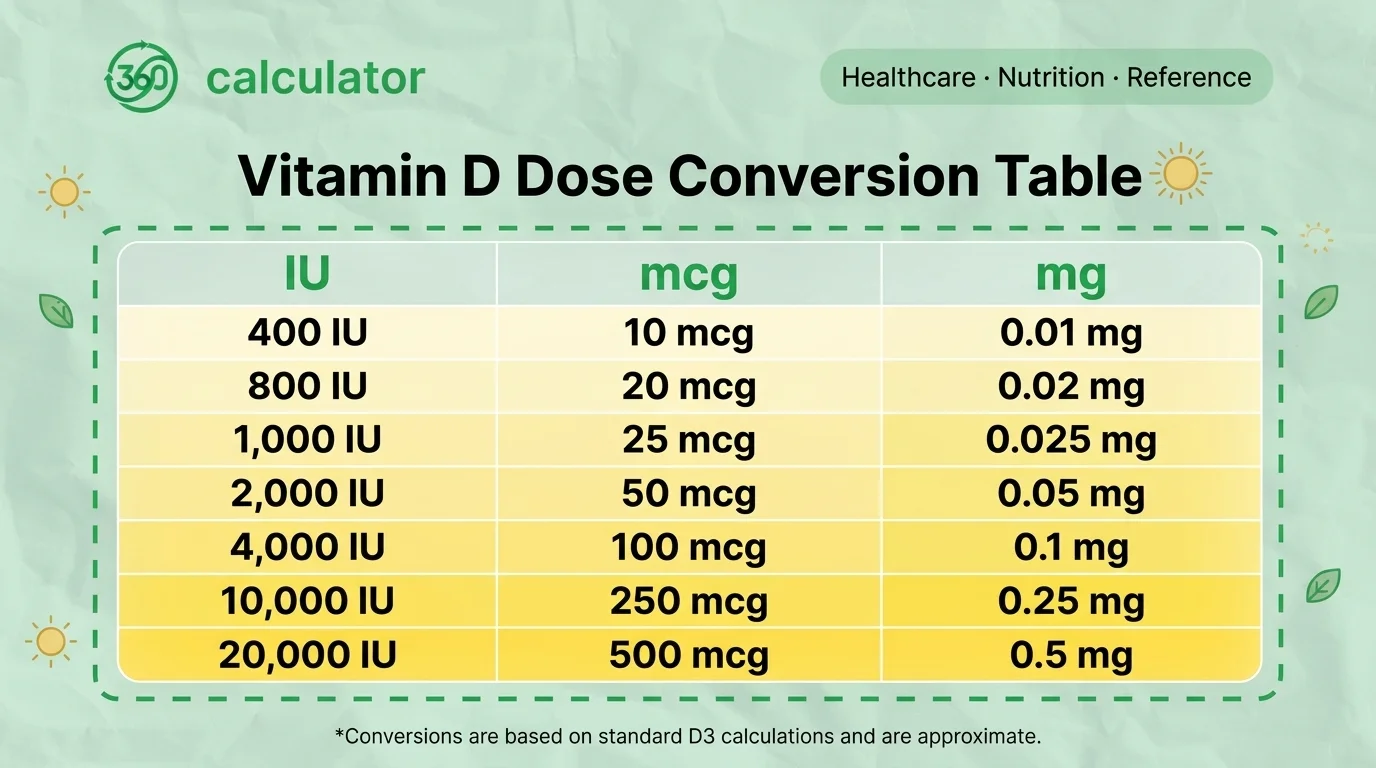
The table below lists the mcg and mg equivalents for the seven most searched vitamin D doses.
IU | mcg | mg |
400 | 10 | 0.01 |
800 | 20 | 0.02 |
1,000 | 25 | 0.025 |
2,000 | 50 | 0.05 |
5,000 | 125 | 0.125 |
10,000 | 250 | 0.25 |
20,000 | 500 | 0.5 |
Is 400 IU the Same as 10 mcg of Vitamin D?
Yes, 400 IU of vitamin D equals 10 mcg. 1,000 IU equals 25 mcg. 2,000 IU equals 50 mcg. 5,000 IU equals 125 mcg.
Does the Vitamin D Conversion Differ Between D2 and D3?
No, the IU to mcg conversion factor stays identical for both D2 and D3. The body processes ergocalciferol (D2) and cholecalciferol (D3) differently, but the conversion math does not change between them.
How Do You Convert IU to mcg for Vitamin A?
1 IU of retinol equals 0.3 mcg RAE, 1 IU of supplemental beta-carotene equals 0.3 mcg RAE, and 1 IU of dietary beta-carotene equals about 0.05 mcg RAE. The Institute of Medicine created the RAE (Retinol Activity Equivalent) system in 2001 to account for how efficiently the body converts each form of vitamin A into usable retinol. The source of vitamin A changes the conversion factor, unlike vitamin D.
What Is the IU to mcg RAE Formula for Retinol?
mcg RAE equals IU multiplied by 0.3, for preformed retinol. 500 IU of retinol equals 150 mcg RAE. Retinol is the reference point the RAE system was built around, making this the simplest of the three vitamin A conversions.
What Is the Reverse Formula for mcg RAE to IU for Vitamin A?
IU equals mcg RAE divided by 0.3, for retinol. 150 mcg RAE divided by 0.3 equals 500 IU.
How Does the Conversion Change for Beta-Carotene Sources?
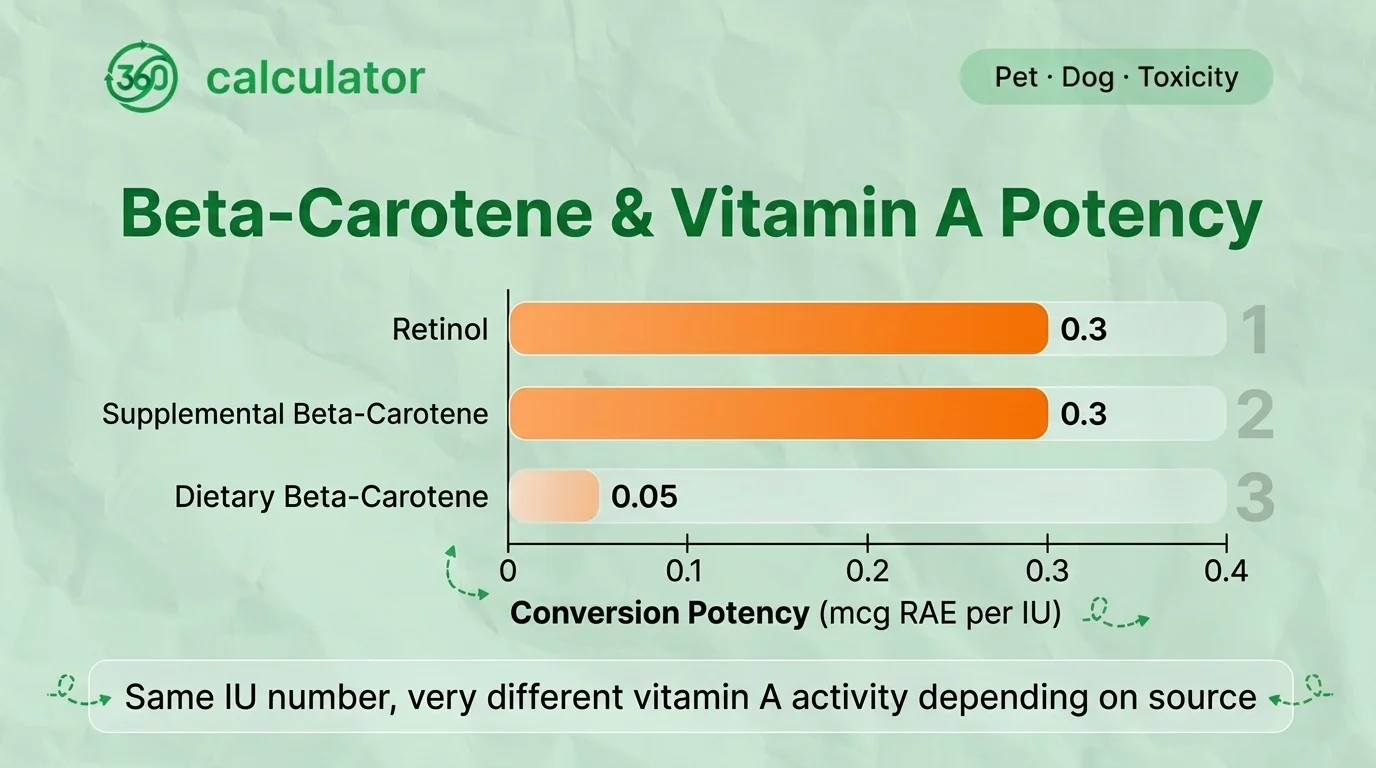
Supplemental beta-carotene converts at 0.3 mcg RAE per IU, the same rate as retinol, while dietary beta-carotene converts at about 0.05 mcg RAE per IU. Supplemental beta-carotene in oil form uses 1 IU equals 0.6 mcg of beta-carotene, and 2 mcg of supplemental beta-carotene equals 1 mcg RAE. Dietary beta-carotene from food uses 12 mcg of beta-carotene equals 1 mcg RAE, making it far less potent per IU than the supplemental form. A supplement label and a food diary entry with the same IU number do not deliver the same vitamin A activity.
The table below compares the IU to mcg RAE factor across the three main vitamin A sources.
Source | IU to mcg RAE factor |
Retinol | 0.3 |
Supplemental beta-carotene | 0.3 |
Dietary beta-carotene | 0.05 |
Why Does Vitamin A Use RAE Instead of a Simple IU to mcg Ratio?
Vitamin A uses RAE because the body absorbs different forms of vitamin A at different efficiencies. A single flat IU to mcg ratio would misrepresent the actual biological activity delivered by each source.
Do Other Vitamin A Forms Have Different Conversion Factors?
Yes, alpha-carotene and beta-cryptoxanthin both convert at 1 mcg RAE per 24 mcg, an even lower rate than dietary beta-carotene. This distinction matters for tracking vitamin A from whole foods, not from supplements, since supplements rarely use these two forms.
How Do You Convert IU to mg for Vitamin E?
Natural vitamin E converts at 1 IU equals 0.67 mg, and synthetic vitamin E converts at 1 IU equals 0.45 mg. The reverse direction uses 1 mg of natural vitamin E equals about 1.49 IU, and 1 mg of synthetic vitamin E equals about 1.10 IU. The two forms carry different biological potency per milligram, despite both appearing under the same vitamin E label.
What Is the IU to mg Formula for Natural Vitamin E?
mg equals IU multiplied by 0.67, for d-alpha-tocopherol. 400 IU converts to 268 mg. Natural vitamin E appears on a label as d-alpha-tocopherol, without a second l in the name.
What Is the IU to mg Formula for Synthetic Vitamin E?
mg equals IU multiplied by 0.45, for dl-alpha-tocopherol. 400 IU converts to 180 mg. Synthetic vitamin E appears on a label with the dl prefix.
Why Do Natural and Synthetic Vitamin E Have Different Conversion Factors?

Synthetic vitamin E contains a mixture of eight stereoisomers, and only one of the eight matches the natural form exactly. This mixture makes synthetic vitamin E roughly half as biologically active per milligram, so the same IU number translates to a higher mg amount for the synthetic form.
How Do You Use the IU to mcg or mg Calculator Correctly?
Using the calculator correctly requires four steps in order. Skipping the form selection for vitamin A or vitamin E produces a wrong answer, since these are the two vitamins where one flat factor does not apply.
1. Identify the vitamin.
2. Identify the form, if the vitamin is vitamin A or vitamin E.
3. Enter the known IU, mcg, or mg value.
4. Select the conversion direction.
Which Details Do You Need Before Entering a Value?
A correct conversion needs four pieces of information: the vitamin name, the form, the number itself, and the current unit.
● The vitamin name: D, A, or E
● The form: natural or synthetic for vitamin E, retinol or beta-carotene for vitamin A
● The numeric value to convert
● The unit that value is currently in
This information appears on a supplement label next to the ingredient name, inside parentheses.
What Is a Worked Example of an IU to mcg Conversion?
A 2,000 IU vitamin D supplement converts to 50 mcg, then to 0.05 mg. Divide 2,000 by 40 to get 50 mcg. Divide 50 by 1,000 to get 0.05 mg. This two-step process applies to any vitamin D dose in IU.
What Mistakes Do People Make When Converting IU to mcg or mg?

People make three common mistakes when converting IU to mcg or mg. Each mistake has one direct fix.
● Assuming one universal IU to mg formula works across all vitamins. Fix: check the vitamin specific factor before converting.
● Confusing mcg with mg and landing off by a factor of 1,000. Fix: confirm the unit before recording or taking a dose.
● Skipping the form check for vitamin A or vitamin E. Fix: identify retinol, beta-carotene, natural, or synthetic before converting.
Why Can't You Use One Formula for Every Vitamin?

The table below compares the conversion basis for vitamin D, vitamin A, and vitamin E.
Vitamin | Conversion basis | Factor |
Vitamin D | Fixed, applies to D2 and D3 | 0.025 mcg per IU |
Vitamin A | Depends on source: retinol or beta-carotene | 0.3 or 0.05 mcg RAE per IU |
Vitamin E | Depends on form: natural or synthetic | 0.67 or 0.45 mg per IU |
How Do mcg and mg Get Confused in Dosing?
mcg and mg get confused because mg is 1,000 times larger than mcg. Misreading 1,000 mcg as 1,000 mg produces a dose 1,000 times higher than intended. Checking the unit before taking a supplement prevents this error.
How Does This Calculator Relate to Reading a Supplement Label?
This calculator connects to label reading because the FDA required most vitamin D, A, and E labels to show mcg or mg as the primary figure, with IU shown in parentheses. This change rolled out between 2016 and 2021, depending on company size, as part of the Nutrition Facts label update. Older and newer bottles of the same product can look different even though the dose has not changed.
What Changed When the FDA Moved Supplement Labels From IU to mcg?
The agency required the switch to give consumers a consistent, biologically accurate unit across products. Manufacturers now show mcg as the primary unit, with IU listed as a secondary reference in parentheses.
The compliance deadline fell between 2016 and 2021, depending on company size, and the full regulatory timeline is covered in the FDA Supplement Label Changes guide.
What Is the Difference Between mcg and mg on a Supplement Label?
mcg and mg differ by a factor of 1,000 on any supplement label, not only for vitamin D, A, and E.
This ratio holds for every nutrient on the label, including B12, folate, and vitamin K, and the full nutrient by nutrient breakdown appears in the mcg vs mg comparison guide.
What Is the Recommended Daily Allowance for Vitamin D in mcg and IU?
The recommended daily allowance for vitamin D ranges between 10 mcg and 20 mcg, depending on life stage. Adults ages 19 to 70 need 15 mcg (600 IU) daily, and adults over 70 need 20 mcg (800 IU) daily.
The full breakdown by age and life stage is listed in the Vitamin D RDA and dosage guide.
What Is the Difference Between Natural and Synthetic Vitamin E?
Natural and synthetic vitamin E differ in how they appear on a label and in bioavailability. Natural vitamin E lists as d-alpha-tocopherol, and synthetic vitamin E lists as dl-alpha-tocopherol.
Cost, absorption, and full product selection guidance appear in the Natural vs synthetic vitamin E guide.
How Do You Calculate Total Vitamin A Intake Using RAE?
Total vitamin A intake from multiple sources sums correctly only in RAE, not in raw IU. RAE values from food and supplements add together directly, while IU values from different sources cannot combine into one accurate total.
The full multi-source addition process runs through the Vitamin A RAE intake calculator.
What Is the Safe Upper Limit for Vitamin D, A, and E?
The adult upper limit sits at 100 mcg for vitamin D, 3,000 mcg RAE for preformed vitamin A, and 1,000 mg for vitamin E. Exceeding these amounts without medical supervision raises the risk of toxicity, and consulting a healthcare provider before exceeding standard doses is recommended.
The full breakdown by age and life stage is listed in the Vitamin upper intake limits guide.
What Is an International Unit Used for in Insulin Dosing?
Insulin prescriptions also use IU, separately from any vitamin conversion. Insulin IU dosing depends on the specific insulin product and a prescriber's exact instructions, not on any vitamin formula.
The full explanation for insulin specifically is covered in the Insulin IU dosing guide.
Frequently Asked Questions
How Many mcg Equal 1 IU of Vitamin D?
1 IU of vitamin D equals 0.025 mcg.
Does the Vitamin A Conversion Change Without a Form Selection?
Yes, skipping the form selection changes the result by up to six times, since retinol converts at 0.3 mcg RAE per IU and dietary beta-carotene converts at about 0.05 mcg RAE per IU.
Can This Calculator Convert Vitamin K From IU to mcg?
No, vitamin K uses mcg only, since no IU value exists for vitamin K.
What Happens if the Wrong Vitamin E Form Gets Selected?
The mg result changes by about 33%, since natural vitamin E converts at 0.67 mg per IU and synthetic vitamin E converts at 0.45 mg per IU.
Is 1 IU the Same Across Every Vitamin?
No, 1 IU represents a different physical mass for each vitamin, since IU measures biological activity rather than weight.