

A pediatric mg to kg dosing calculator turns a child's weight and a prescribed dose per kilogram into a usable milligram, milliliter, or tablet amount. The tool multiplies weight in kilograms by the ordered mg/kg value, adjusts the result for dosing frequency, then converts the milligram amount into a liquid volume or tablet count using the product concentration. Parents use this method to check a home dose for common medicines such as acetaminophen or ibuprofen. Nurses and pharmacists use the same formula to verify a prescription before giving a drug in a clinic or hospital. This page covers the core formula, the 5 inputs a calculator needs, 3 common calculation mistakes, body surface area dosing, 2 legacy age and weight based rules, neonatal dosing limits, and the safety steps that apply before giving any weight based dose.
How Do You Calculate a Pediatric Dose Using Mg Per Kg?
A pediatric dose by weight equals the child's weight in kilograms multiplied by the ordered dose in milligrams per kilogram. The result states a single dose or a daily total, depending on how the prescriber writes the order. The sections below break this formula into 6 individual steps, from weight conversion to the final measurable amount.
What Is the Formula for Weight-Based Pediatric Dosing?

The formula states Total Dose (mg) equals Weight (kg) multiplied by Dose (mg/kg). A 10 kg child with an order of 40 mg/kg/day receives 400 mg per day. Splitting that amount into 2 doses gives 200 mg per dose. Converting 200 mg through a 400 mg per 5 mL concentration gives 2.5 mL per dose. The steps below apply to most weight based pediatric orders.
1. Convert weight to kilograms.
2. Multiply weight by the ordered mg/kg value.
3. Divide the total by the number of doses per day, if the order states a daily amount.
4. Divide the single dose by the concentration in mg per mL to find the volume.
How Do You Convert a Child's Weight From Pounds to Kilograms Before Dosing?
Weight in kilograms equals weight in pounds divided by 2.2. A 22 lb child weighs 10 kg. Every dosing formula on this page and most drug labels state weight in kilograms, not pounds, so this conversion happens before any other step. A skipped or reversed conversion multiplies the final dose by roughly 2.2 times its correct value.
What Is the Difference Between Mg/Kg/Day and Mg/Kg/Dose?
Mg/kg/day states the total amount given across 24 hours, mg/kg/dose states the amount given at one single administration. An order written as mg/kg/d without further detail requires clarification from the prescriber before calculation, since it does not state daily total or single dose format. The table below compares the 2 formats using 1 example of each.
Term | Meaning | Example |
mg/kg/day | Total amount given across 24 hours | 40 mg/kg/day split into 2 doses gives 20 mg/kg per dose |
mg/kg/dose | Amount given at 1 single administration | 20 mg/kg/dose given twice daily reaches 40 mg/kg per day |
What Is the Difference Between Dose and Dosage in Pediatric Medication Orders?
A dose names the specific amount given at one time, a dosage names the complete instruction, covering the dose, the frequency, and the duration of treatment. A dosage instruction of 40 mg/kg/day for 7 days produces a single dose of 200 mg twice daily in a 10 kg child. This page uses both terms in their exact sense to avoid confusion between a single number and a full treatment plan.
How Do You Convert a Calculated Mg Dose Into Milliliters or Tablets?
Volume in mL equals the mg dose divided by the concentration in mg per mL. A label stating 400 mg per 5 mL first converts to 80 mg per mL, then a 200 mg dose divides by 80 mg/mL for a 2.5 mL result. A tablet count equals the mg dose divided by the tablet strength, and a partial tablet applies only if the tablet carries a score line for splitting.
How Do You Apply a Maximum Single Dose or Maximum Daily Dose Cap?
The maximum single dose and maximum daily dose listed on the product label cap the calculated result, whichever value is lower applies. Children at or above roughly 50 kg commonly switch to the standard adult dose instead of a continued weight based calculation, according to pediatric dosing references.
What Inputs Does an Accurate Pediatric Dose Calculator Need?
An accurate calculator needs 5 inputs: weight, dose factor, frequency, concentration, and maximum dose caps. Each input changes the final result in a distinct way, described in the sections below.
● Weight, entered in kilograms or pounds with automatic conversion.
● Dose factor, the ordered mg/kg or mcg/kg amount, marked as per dose or per day.
● Frequency, the number of doses given each day.
● Concentration, the product strength in mg per mL or mg per tablet.
● Maximum dose caps, the labeled single and daily limits.
Why Does Child Weight Need to Be Entered in Kilograms, Not Pounds?
Weight in kilograms matches the unit used on drug labels and pediatric dosing references worldwide. A calculator that accepts pounds converts the number internally before running the formula. An unconverted pound value used directly in a kilogram based formula produces a dose roughly 2.2 times too high.
Why Does Dosing Frequency Change the Single Dose Result?

Frequency sets how many equal parts the daily total splits into. An 800 mg/day total splits into 400 mg per dose across 2 doses, or roughly 267 mg per dose across 3 doses. The daily total stays fixed while the single dose amount changes with the entered frequency.
What Do Common Pediatric Dosing Frequency Abbreviations Mean?
There are 5 common frequency abbreviations on pediatric orders: qD, BID, TID, QID, and the q-hour group. The table below lists each abbreviation and its plain language meaning.
Abbreviation | Meaning |
qD | Once a day |
BID | Twice a day |
TID | 3 times a day |
QID | 4 times a day |
q6h / q8h / q12h | Every 6, 8, or 12 hours |
Misreading one of these abbreviations changes the frequency entered into the calculator and therefore the single dose result.
Why Does Drug Concentration Matter for Volume Calculations?
Concentration converts a milligram dose into a real, measurable liquid volume. A 250 mg dose from a 125 mg/5 mL product measures 10 mL, the same 250 mg dose from a 250 mg/5 mL product measures 5 mL. Entering the wrong concentration doubles or halves the measured volume even when the milligram calculation is correct.
What Are the Most Common Mistakes When Calculating Mg/Kg Doses?
There are 3 common calculation mistakes in pediatric mg/kg dosing: decimal point errors, mg and mcg mix ups, and rounding too early. A study published by the National Institutes of Health found pediatric patients experience medication errors at roughly twice the rate seen in adult patients.
How Does a Misplaced Decimal Point Cause a Tenfold Dosing Error?
A shifted decimal point changes a dose by a factor of 10. Writing 0.5 mg as 5 mg turns a safe pediatric dose into a potentially toxic amount. Writing every conversion step in full, rather than performing the arithmetic mentally, prevents this error.
Why Does Confusing Mg and Mcg Lead to Dangerous Doses?
1 milligram equals 1000 micrograms. Confusing the 2 units produces an error 1000 times larger than the intended dose, a larger gap than a simple decimal shift. Clinical documentation uses "mcg" instead of the Greek micro symbol specifically to prevent this misreading.
Why Is Rounding Too Early in a Calculation a Risk?
Rounding an intermediate result compounds small errors into a meaningfully wrong final dose. A calculation that rounds the weight conversion, then rounds the daily total, then rounds the single dose, drifts further from the correct answer at each step. Carrying extra decimal places through every step, then rounding only the final answer, keeps the result accurate.
When Is Body Surface Area (BSA) Used Instead of Weight for Pediatric Dosing?
BSA dosing applies to select high potency drugs, particularly chemotherapy agents, rather than everyday pediatric medicines. Organ growth and physiological function track more closely with BSA than with body weight after roughly 1 year of age. Weight based mg/kg dosing remains the standard method for common antibiotics and pain relievers.
What Is the BSA Formula and How Is It Used to Calculate a Pediatric Dose?

BSA in square meters equals the square root of height in centimeters multiplied by weight in kilograms, divided by 3600. The Mosteller formula, published in the New England Journal of Medicine, provides this calculation method. The West Nomogram offers a chart based alternative to calculating BSA directly. The table below shows each step of the calculation for a 16.8 kg child measuring 97 cm, with a 2 mg/m2 order.
Step | Calculation | Result |
1 | Height x Weight | 97 x 16.8 = 1629.6 |
2 | Divide by 3600 | 1629.6 / 3600 = 0.4527 |
3 | Square root | square root of 0.4527 = 0.67 m2 |
4 | Multiply by the mg/m2 order | 0.67 x 2 = 1.34 mg |
What Are Young's Rule and Clark's Rule for Pediatric Dosing?
Young's Rule and Clark's Rule are 2 older methods that estimate a child's dose from an adult dose using age or weight in pounds. Weight based mg/kg dosing replaces both rules for most current pediatric prescribing. Nursing education materials and radiopharmaceutical dosing practices reference these 2 formulas.
How Does Young's Rule Calculate a Pediatric Dose by Age?
Young's Rule divides the child's age by the child's age plus 12, then multiplies that fraction by the adult dose. A 6 year old child under this rule receives 6/18, or 1/3, of the adult dose. This rule does not account for individual growth variation and does not apply to infants.
How Does Clark's Rule Calculate a Pediatric Dose by Weight in Pounds?
Clark's Rule divides the child's weight in pounds by 150, then multiplies that fraction by the adult dose. A 50 lb child under this rule receives 50/150, or 1/3, of the adult dose. The rule uses pounds directly rather than converting to kilograms, and compares the child's weight against a 150 lb standard adult reference weight.
How Should Neonates and Infants Be Dosed Differently From Older Children?
Neonates under 28 days old and very low birth weight infants require separate, lower, or differently timed dosing compared to older children on the same mg/kg figure. Immature kidney and liver function in this age group changes how a drug clears from the body. The American Academy of Pediatrics states that neonatal drug clearance differs significantly from older infants due to this organ immaturity. A general pediatric mg/kg calculator does not replace a neonatal specific dosing reference for this age group.
What Safety Precautions Should You Follow When Giving a Weight-Based Pediatric Dose?

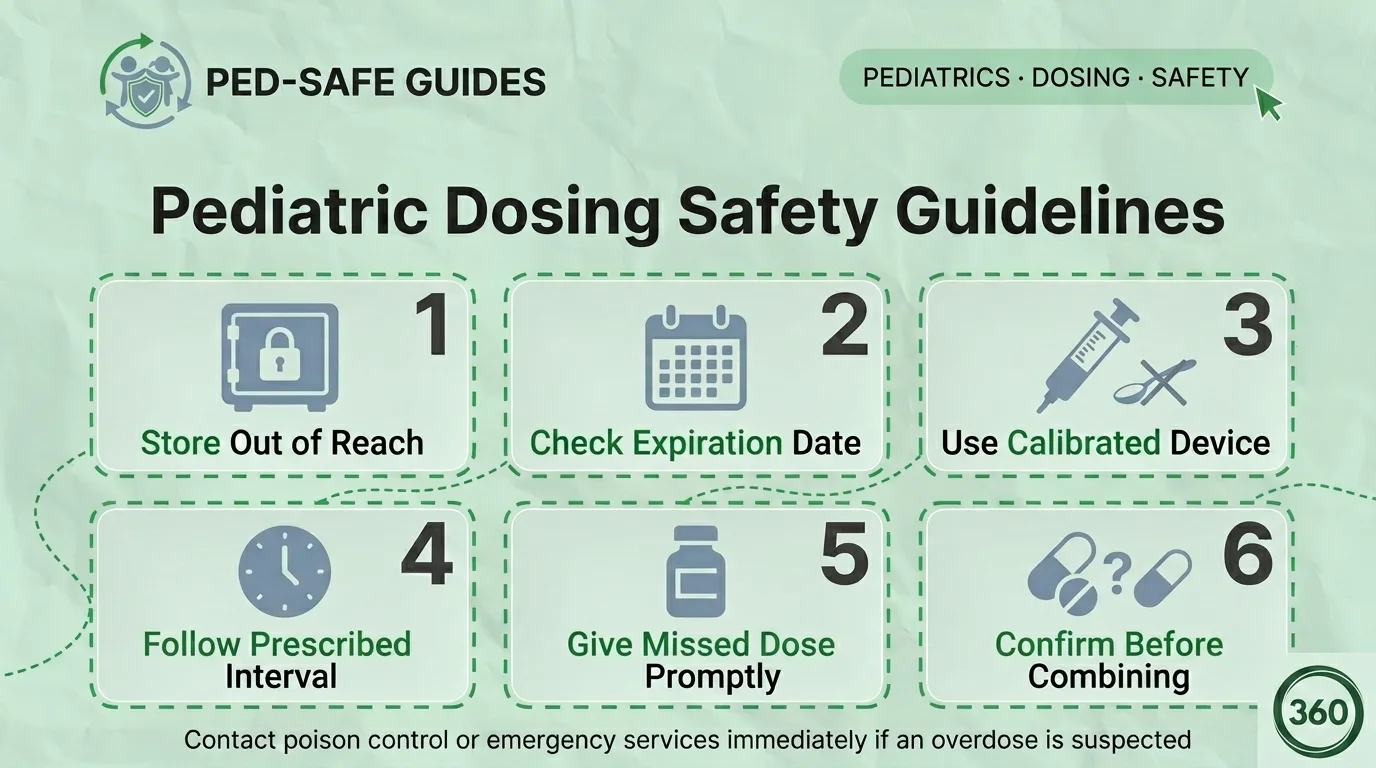
There are 6 safety steps to follow when giving a weight based pediatric dose.
● Store medication out of a child's reach.
● Check the expiration date before giving any dose.
● Use the calibrated dosing device included with a liquid medicine instead of a household spoon.
● Give doses at the prescribed interval.
● Give a missed dose as soon as it is remembered, then resume the normal schedule.
● Confirm with a pharmacist before combining 2 medications that may share an active ingredient.
The U.S. Food and Drug Administration recommends the calibrated dosing device specifically because household spoons vary in volume. Keep a poison control contact accessible, and contact poison control or emergency services immediately if an overdose is suspected.
How Does Pediatric Weight-Based Dosing Fit Into Broader Medication Safety Calculations?
Pediatric weight based dosing shares its core formula with several related medication calculations. Unit conversion, body surface area dosing, intravenous rate calculation, and weight based dosing for adult patients all use the same weight times dose logic covered above. The sections below apply this formula to specific medicines and related conversions.
How Do You Convert Pounds to Kilograms for Medical Calculations?
Converting weight from pounds to kilograms is the first step before any dosing calculation on this page, not just a general measurement task, since medical references and drug labels state weight in kilograms. The Pounds to Kilograms Conversion divides the pound value by 2.2 to produce the kilogram figure used in every formula here.
How Do You Convert Mcg to Mg Accurately for Medication Dosing?
Pediatric orders written in micrograms occur most often with very small doses, where a missed conversion produces the 1000 fold error described earlier on this page. The Mcg to Mg Conversion divides the microgram value by 1000 to reach the milligram figure.
How Do You Calculate Body Surface Area for Pediatric Drug Dosing?
A reader whose medication order states mg/m2 rather than mg/kg applies the Mosteller formula described earlier, or turns to the Body Surface Area Pediatric Dose Calculator to avoid the square root step by hand. This dedicated calculator uses both height and weight, unlike the weight only mg/kg method covered elsewhere on this page.
How Do You Calculate IV Drip Rate for Pediatric Infusions?
A weight based dose intended for intravenous administration requires the total volume, the infusion time, and the tubing drip factor, with continuous infusions adding a mcg/kg/min rate. The IV Drip Rate Calculator adds this time and volume component, which the oral dosing formula on this page does not cover.
What Is the Correct Acetaminophen Dose by Weight for Children?
Liquid acetaminophen products were standardized to a single 160 mg per 5 mL concentration in the United States in 2011, though chewable tablets are available at an 80 mg strength, so the label strength requires a check before each dose. The Acetaminophen Pediatric Dosing Calculator applies the mg/kg formula covered on this page to 1 of the most common home medicines.
What Is the Correct Ibuprofen Dose by Weight for Children?
Ibuprofen carries a caution against use in infants under 6 months of age unless a pediatrician directs otherwise. The Ibuprofen Pediatric Dosing Calculator applies the same weight based formula to this second common over the counter medicine.
What Is the Correct Amoxicillin Dose by Weight for Children?
A typical order divides the daily total across 2 or 3 doses, and the exact mg/kg figure depends on the treated condition. The Amoxicillin Pediatric Dosing Calculator uses the mg/kg/day format described earlier on this page for 1 of the most prescribed pediatric antibiotics.
Why Is Cetirizine (Zyrtec) Dosed by Age Instead of Weight in Children?
Cetirizine dosing commonly follows 3 age groups rather than a per kilogram figure, since the standard dose already accounts for the typical weight range within each age bracket, though the exact cutoffs and mg amounts vary by product. The Age-Based OTC Pediatric Dosing Calculator covers this small group of medicines dosed by age bracket rather than weight.
How Do You Use Dimensional Analysis for Pediatric Dosage Calculations?
Nursing students use a structured alternative to the direct formula covered above, one that reduces the unit and decimal errors described earlier on this page. Dimensional Analysis for Nursing Dosage Calculations arranges units so they cancel correctly, which is what makes this method work.
How Is Weight-Based Dosing Used Outside of Pediatrics, Such as for Adults or Obese Patients?
Heparin, weight based antibiotic dosing, and obese patient dosing, where actual weight compares against ideal body weight, use this same method outside pediatric care. The Weight-Based Dosage Calculator for Adults applies the identical weight times dose per kg formula to these select adult medications.
Frequently Asked Questions
Does a Heavier Child Always Receive a Higher Dose?
A heavier child receives a higher milligram dose under the same mg/kg order, though the dose per kilogram stays identical between children on the same order. A 20 kg child and a 10 kg child on the same 10 mg/kg order receive 200 mg and 100 mg respectively, at the same 10 mg/kg rate.
Can Two Children of the Same Age Receive Different Doses?
2 children of the same age receive different doses if their weights differ, since weight, not age, drives the standard mg/kg calculation. Young's Rule forms the exception, not the default method covered on this page.
Does This Calculator Replace a Pharmacist's Check?
A pediatric dosing calculator performs the arithmetic only and does not replace a pharmacist or prescriber's verification. A calculated result requires confirmation against the current product label, the maximum dose caps, and the child's specific medical history before use.
What Happens if a Dose Is Given Twice by Mistake?
A double dose requires immediate contact with poison control or emergency services, since the safe response depends on the specific medicine and the amount given. Store the medication information and the child's weight nearby, since responders ask for both.