
A steroid conversion calculator is a clinical tool that turns a dose of one corticosteroid into an equivalent dose of another. Enter the current drug and dose, choose the drug to switch to, and the tool returns the matching amount based on published potency ratios. This calculator covers hydrocortisone, cortisone, prednisone, prednisolone, methylprednisolone, triamcinolone, betamethasone and dexamethasone, along with deflazacort and paramethasone where listed. Fludrocortisone is handled separately because it is used mainly for its mineralocorticoid effect, and topical, inhaled, intramuscular and intra-articular steroids fall outside its scope as well.
Below is a look at the situations that call for a conversion, a complete equivalency chart for quick reference, the calculation method with a worked example, how oral and intravenous dosing compare, why dosing frequency can shift after a switch, and the safety checks worth running before acting on any result.
Which Corticosteroids Does the Conversion Calculator Compare?
This calculator works with eight corticosteroids that are commonly interchanged in clinical practice: hydrocortisone, cortisone, prednisone, prednisolone, methylprednisolone, triamcinolone, betamethasone and dexamethasone. Deflazacort and paramethasone appear on some versions of the chart as well. These drugs fall into three loose families, the cortisone type, made up of hydrocortisone and cortisone, the prednisolone type, made up of prednisone, prednisolone, methylprednisolone and triamcinolone, and the dexamethasone type, made up of betamethasone and dexamethasone.
Fludrocortisone is usually left off the main comparison list. It is prescribed for its mineralocorticoid effect, the way it helps the body hold onto sodium, rather than for fighting inflammation, so it does not fit neatly into an anti-inflammatory potency table.
What Is the Anti-Inflammatory Potency of Each Corticosteroid?
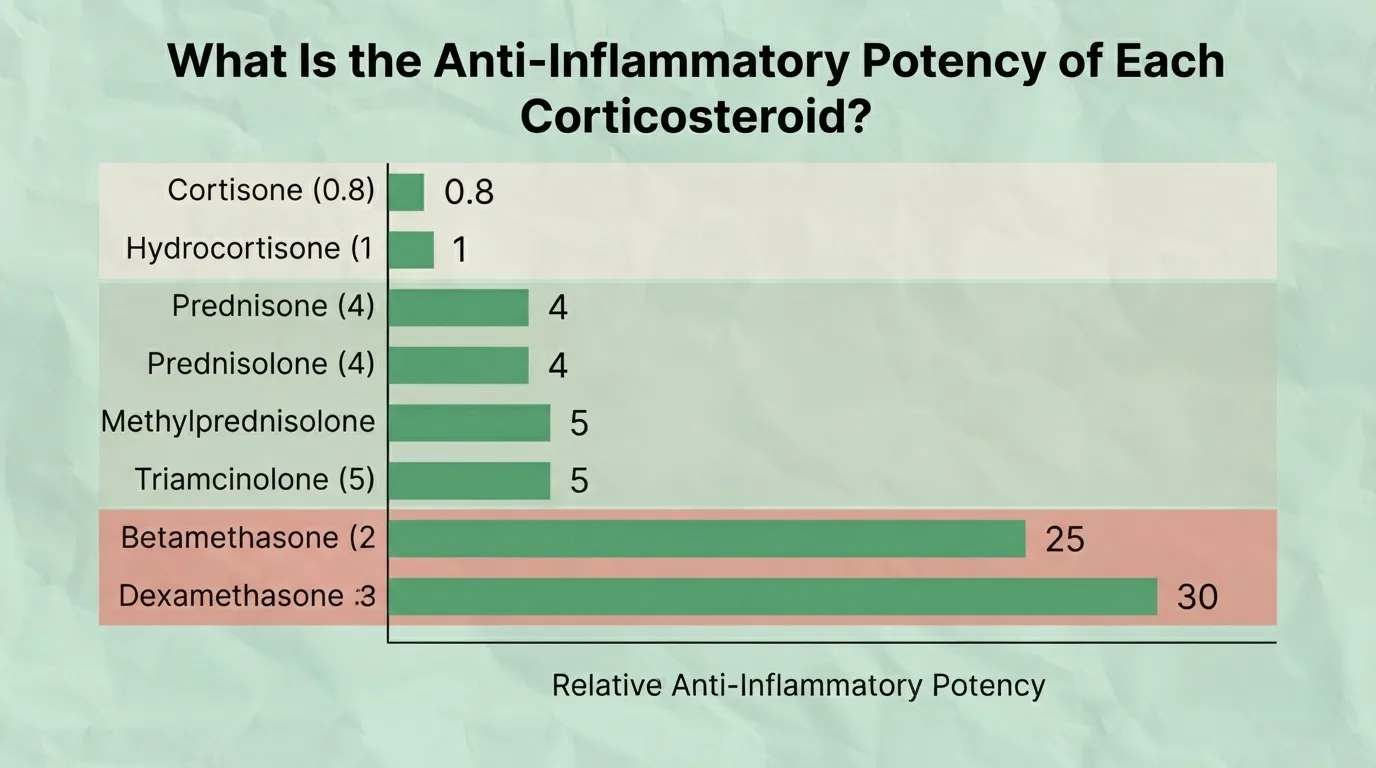
Anti-inflammatory potency describes how strongly a corticosteroid binds to glucocorticoid receptors and suppresses inflammation, measured against hydrocortisone, which is set at a potency of 1. Cortisone sits close to hydrocortisone at about 0.8. Prednisone and prednisolone come in at about 4. Methylprednisolone and triamcinolone are a bit stronger, around 5. Betamethasone and dexamethasone are the most potent of the group, generally listed between 25 and 30.
A higher potency number means a smaller milligram dose is needed for the same anti-inflammatory effect. This is why a 20 mg dose of hydrocortisone is roughly equal to just 5 mg of prednisone, and to well under 1 mg of dexamethasone.
Different sources round these figures slightly differently. Some list dexamethasone and betamethasone's equivalent dose as 0.6 mg, others as 0.75 mg or 0.8 mg. None of these figures is wrong, they come from different reference tables built on the same underlying research.
Drug | Potency vs Hydrocortisone | Approx Equivalent Dose (mg) |
Hydrocortisone | 1 | 20 |
Cortisone | 0.8 | 25 |
Prednisone | 4 | 5 |
Prednisolone | 4 | 5 |
Methylprednisolone | 5 | 4 |
Triamcinolone | 5 | 4 |
Betamethasone | 25 to 30 | 0.6 to 0.8 |
Dexamethasone | 25 to 30 | 0.6 to 0.8 |
Is There a Simple Way to Remember Corticosteroid Potency Order?
One easy way to keep the order straight is to think in three tiers. The weakest tier holds the short acting drugs, cortisone and hydrocortisone. The middle tier holds the intermediate acting drugs, prednisone and prednisolone, followed closely by methylprednisolone and triamcinolone. The strongest tier holds the long acting drugs, betamethasone and dexamethasone. Once the three tiers are set in memory, the exact numbers become easier to look up rather than guess.
What Is the Duration of Action for Each Corticosteroid?
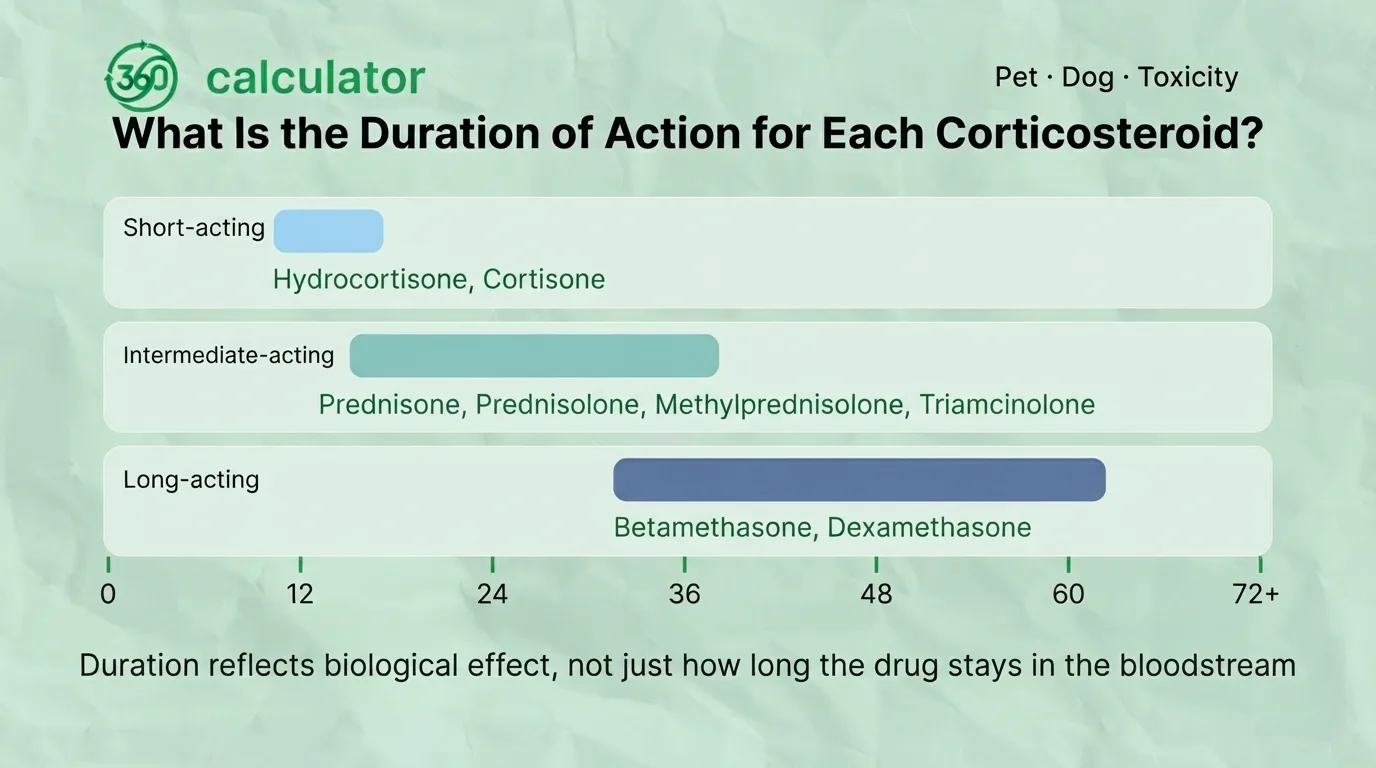
Corticosteroids are also grouped by how long their effect lasts, known as duration of action. Short acting drugs, hydrocortisone and cortisone, last about 8 to 12 hours. Intermediate acting drugs, prednisone, prednisolone, methylprednisolone and triamcinolone, last about 12 to 36 hours. Long acting drugs, betamethasone and dexamethasone, last about 36 to 72 hours.
This classification refers to biological half-life rather than plasma half-life. Plasma half-life only measures how long the drug stays in the bloodstream, while biological half-life reflects how long its actual effect on the body lasts, which is the figure that matters for deciding how often a dose needs repeating.
Duration Category | Drugs | Approx Hours |
Short | Hydrocortisone, Cortisone | 8 to 12 |
Intermediate | Prednisone, Prednisolone, Methylprednisolone, Triamcinolone | 12 to 36 |
Long | Betamethasone, Dexamethasone | 36 to 72 |
Which Corticosteroids Have Mineralocorticoid Activity?
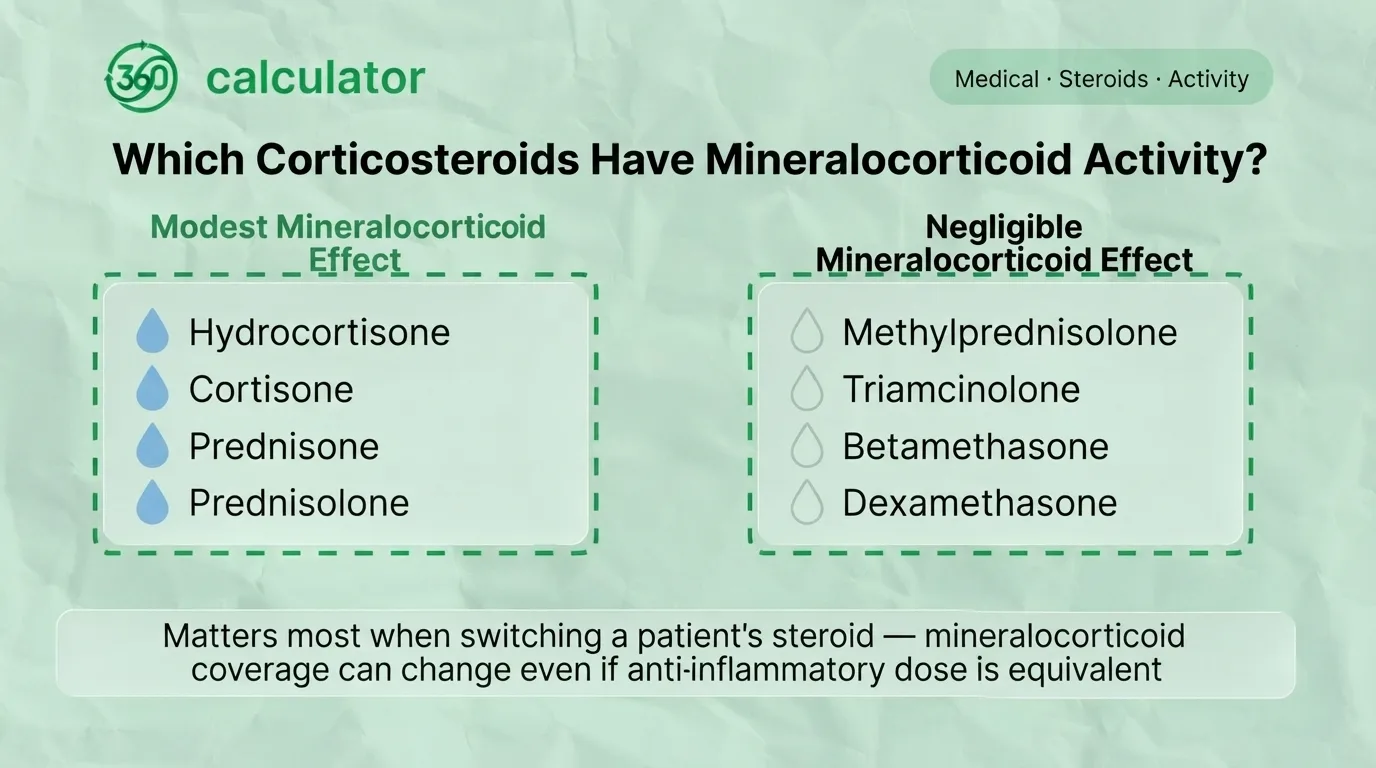
Mineralocorticoid activity is a separate property from anti-inflammatory potency. It describes a drug's effect on sodium and water retention rather than inflammation. Hydrocortisone, cortisone, prednisone and prednisolone all carry a modest mineralocorticoid effect. Methylprednisolone, triamcinolone, betamethasone and dexamethasone carry a negligible one.
Published figures for this effect vary a little between sources. Prednisone's mineralocorticoid potency is listed around 0.3 in some tables and around 0.6 in others. Fludrocortisone sits at the opposite extreme, with a very high mineralocorticoid potency and only a small, clinically negligible anti-inflammatory effect at its usual therapeutic dose.
Modest Mineralocorticoid Effect | Negligible Mineralocorticoid Effect |
Hydrocortisone | Methylprednisolone |
Cortisone | Triamcinolone |
Prednisone | Betamethasone |
Prednisolone | Dexamethasone |
What Are the Common Brand Names for Each Corticosteroid?
Corticosteroids are often prescribed and discussed by brand name rather than generic name. The table below matches the two.
Generic Name | Common Brand Name(s) |
Hydrocortisone | Cortef |
Cortisone | Cortone |
Prednisone | Deltasone |
Prednisolone | Prelone, Orapred |
Methylprednisolone | Medrol, Solu-Medrol |
Triamcinolone | Kenalog, Aristospan |
Betamethasone | Celestone |
Dexamethasone | Decadron |
Which Steroids and Routes Are Not Covered by This Calculator?
A few corticosteroids and routes of administration fall outside standard conversion tables. Budesonide and beclomethasone, both inhaled steroids, are not part of this comparison because inhaled dosing works on a different scale and targets the lungs directly rather than the whole body. Topical creams and ointments, inhaled formulations, intramuscular depot injections and intra-articular injections are all outside the scope of this calculator as well.
If a dose needs converting for one of these forms, a pharmacist is the right person to consult rather than applying the oral or intravenous figures above.
When Is a Steroid Conversion Needed in Clinical Practice?
A conversion typically comes up in a handful of everyday situations. A patient may need to switch between an oral and an intravenous formulation, or a prescriber may need to change drugs because of availability, a side effect profile, or a patient specific factor such as another health condition or pregnancy. Conversions also happen when moving between a short acting and a long acting steroid for chronic disease management or during assessment of the adrenal axis. A conversion often accompanies a change in care setting too, such as hospital admission, discharge, or transfer to another facility.
What Does a Complete Steroid Equivalency Chart Look Like at a Glance?
For a quick reference rather than a full explanation, the table below brings together the equivalent dose, anti-inflammatory potency, mineralocorticoid potency and duration of action for each corticosteroid in one place. A printable version of this chart is useful for quick lookup at the bedside or in the pharmacy.
Drug | Equivalent Dose (mg) | AI Potency | Mineralocorticoid Potency | Duration |
Hydrocortisone | 20 | 1 | Modest | Short |
Cortisone | 25 | 0.8 | Modest | Short |
Prednisone | 5 | 4 | Modest | Intermediate |
Prednisolone | 5 | 4 | Modest | Intermediate |
Methylprednisolone | 4 | 5 | Negligible | Intermediate |
Triamcinolone | 4 | 5 | Negligible | Intermediate |
Betamethasone | 0.6 to 0.8 | 25 to 30 | Negligible | Long |
Dexamethasone | 0.6 to 0.8 | 25 to 30 | Negligible | Long |
How Do You Calculate an Equivalent Corticosteroid Dose?

The calculation behind any steroid conversion follows three steps. First, find the anti-inflammatory potency of the current steroid. Second, multiply the current dose by that potency to get a hydrocortisone equivalent value. Third, divide that value by the potency of the target steroid to arrive at the new dose. This is the same logic a conversion calculator runs automatically once a drug, dose and target drug are entered.
What Is a Worked Example of Converting Prednisone to Methylprednisolone?
Take a patient on 20 mg of prednisone who needs to switch to methylprednisolone. Prednisone has a potency of 4, so 20 mg multiplied by 4 gives a hydrocortisone equivalent of 80. Methylprednisolone has a potency of 5, so 80 divided by 5 gives 16 mg. The equivalent methylprednisolone dose is 16 mg.
In practice, this figure is often rounded to match an available tablet or vial strength, since exact milligram amounts are not always practical to dispense.
Why Does the Conversion Factor Change Based on the Reference Steroid?
Every published potency table uses hydrocortisone as a common reference point, fixed at a potency of 1. That shared reference is what allows any two drugs on the list to be converted into each other, since the conversion factor between two non hydrocortisone drugs is simply the ratio of their two individual potencies rather than a separate number to memorize for every possible pair.
This also explains why different sources sometimes disagree slightly. Some tables list dexamethasone's equivalent dose as 0.75 mg, others list 0.8 mg. Prednisone's mineralocorticoid potency appears as 0.3 in one source and 0.6 in another. These are not contradictions so much as rounding differences between the studies each table was built on.
Why Can't Fludrocortisone Be Converted Using the Same Anti-Inflammatory Potency Method?
Fludrocortisone is prescribed for its mineralocorticoid effect rather than its anti-inflammatory one. It does carry a small anti-inflammatory potency, roughly one tenth that of hydrocortisone, but at its usual therapeutic dose of about 0.05 to 0.2 mg per day, that effect is small enough to be clinically negligible. Because of this, fludrocortisone is not converted to another corticosteroid using the standard anti-inflammatory potency method, and most conversion tables list it separately rather than alongside the main group.
Is the Oral Dose of a Corticosteroid the Same as the IV Dose?
For the drugs covered in this calculator, oral and intravenous doses are generally treated as milligram equivalent in standard conversion tables. There is a nuance worth knowing though. Oral potency can in practice run a little lower than intravenous potency, since a portion of an oral dose, in some cases up to about 50 percent, may not reach systemic circulation before being broken down.
It is also worth repeating that this calculator applies only to oral and intravenous routes. Topical, inhaled, intramuscular and intra-articular steroids are not covered, as noted earlier.
Why Does Dosing Frequency Change After a Steroid Conversion?
Because corticosteroids differ in how long their effect lasts, switching between them can change how often a dose needs to be given. Moving from a short acting steroid dosed several times a day to a long acting steroid usually means once daily dosing is enough. Moving the other direction may mean splitting the new dose across the day instead of giving it all at once.
For example, hydrocortisone dosed every six hours adds up to a certain total daily amount. Converting that total to prednisone gives a dose that can usually be given just once a day, since prednisone's longer duration of action does not require repeated dosing to maintain the same effect. The calculator itself outputs a total daily equivalent dose, and deciding how to split that dose across the day is left to the prescriber.
Why Is the Total Daily Dose Used Instead of Matching Each Individual Dose When Converting Steroids?
A common point of confusion is why total daily dose is used for conversion rather than matching the amount active at any single moment. It seems logical to assume that once a short acting steroid's blood level drops, only what remains active should count. In practice though, a corticosteroid's anti-inflammatory and immune effects come from changes in gene activity inside cells, effects that build up and fade slowly rather than switching on and off with blood level. Because of this, the relevant measure is cumulative exposure over 24 hours, not the instantaneous amount in circulation at any given point, which is why conversion tables are built around total daily dose.
What Are the Safety Limits of a Steroid Conversion Calculator?
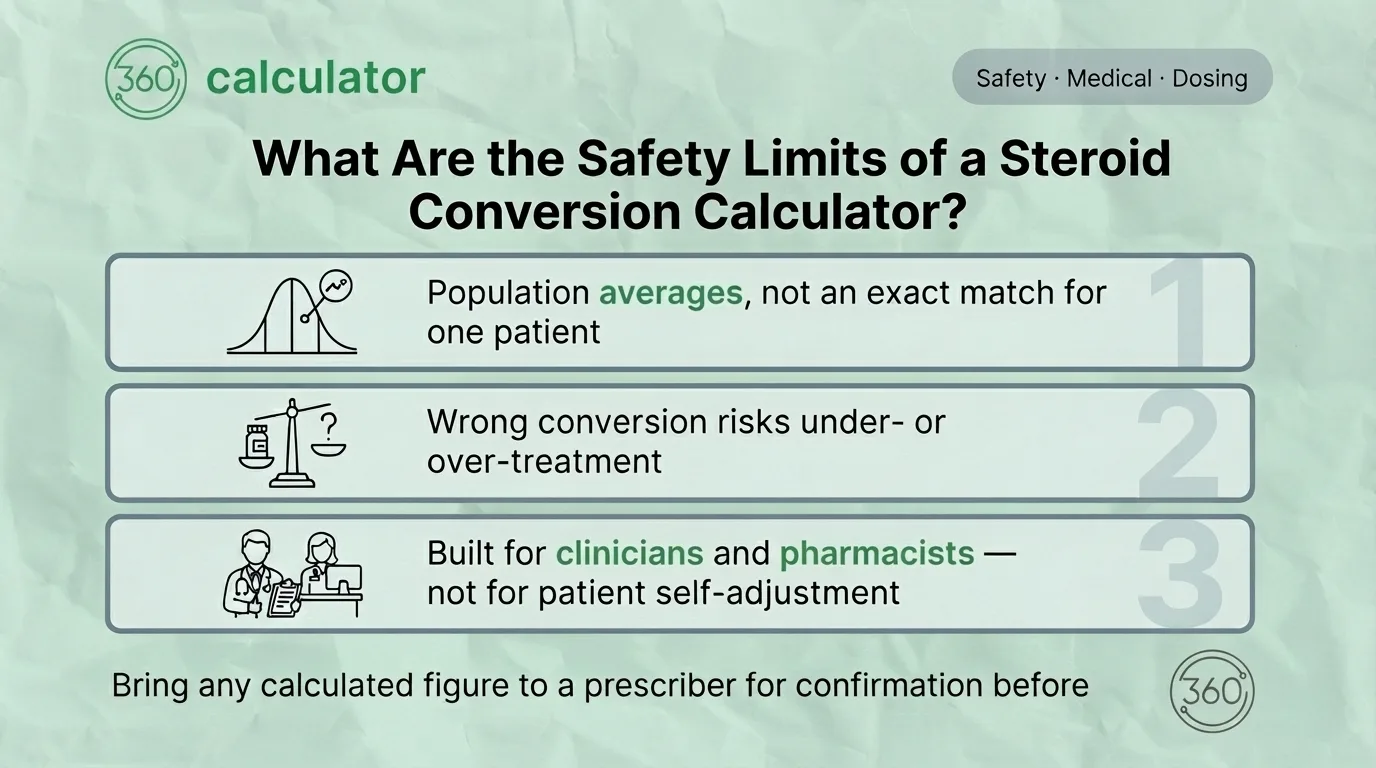
Potency tables come from decades old pharmacodynamic research and reflect average equivalence across a population, not an exact match for any one patient. A steroid conversion calculator does not replace clinical judgment, and it is not meant for patients to use on their own to adjust their medication. Getting a conversion wrong in either direction carries real risk, under treating a condition can trigger a disease flare or adrenal crisis, while over treating it raises the risk of side effects and infection.
Why Should Mineralocorticoid Effect Be Checked Before Converting a Steroid Dose?
Switching from a steroid with modest mineralocorticoid effect, such as hydrocortisone, to one with negligible effect, such as dexamethasone, can leave a gap in mineralocorticoid coverage. This matters most for patients with primary adrenal insufficiency, who may need fludrocortisone added or adjusted separately. As a reference point, hydrocortisone 20 mg, cortisone 25 mg, and prednisone or prednisolone 50 mg each provide a mineralocorticoid effect roughly equal to 0.1 mg of fludrocortisone.
How Do Drug Interactions and Organ Disease Affect Steroid Conversion Accuracy?
Standard conversion tables assume normal drug metabolism, an assumption that does not always hold. Medications that induce or inhibit cytochrome P450 enzymes can speed up or slow down how quickly a corticosteroid is broken down. Severe kidney disease, severe liver disease and hyperthyroidism can each change how a steroid behaves in the body as well. In any of these situations, a pharmacist or prescriber should adjust the calculated dose rather than treating it as a final answer.
Who Should Not Adjust Steroid Doses Without Medical Supervision?
This calculator is built for clinicians, pharmacists, nursing staff and students, people trained to weigh its output against the full clinical picture. Patients and caregivers should not use it to change a dose on their own. If a calculated figure raises a question, the right next step is to bring it to a prescriber for confirmation rather than acting on it directly.
How Does Steroid Conversion Fit Into a Patient's Full Corticosteroid Treatment Plan?
Converting a dose is rarely the end of the story. Once a new equivalent dose is set, several other decisions usually follow. Longer courses need a tapering plan rather than an abrupt stop. Cumulative dose and duration bring a familiar set of side effects to watch for. Illness, surgery or another physical stress can call for a temporary stress dose on top of the regular maintenance amount. Children are dosed differently than adults, usually by body weight. Some conditions call for an entirely different form of steroid, inhaled or topical rather than oral or intravenous. The sections below cover each of these in the context of a steroid that has just been converted.
How Do You Safely Taper a Prednisone Dose After Converting From Another Steroid?
Once an equivalent dose is confirmed, courses lasting longer than about two to three weeks generally call for a gradual reduction rather than stopping outright, since abrupt discontinuation after chronic use can trigger adrenal insufficiency. The newly converted dose becomes the starting point for that reduction, with the step down schedule covered in the prednisone tapering schedule calculator.
What Are the Common Side Effects of Long-Term Corticosteroid Use?
Once a clinician converts to an equivalent dose, the same cumulative exposure risks still apply no matter which specific drug carries it, including weight gain, bone density loss, high blood sugar, mood changes and infection risk. A closer look at each of these is available in the corticosteroid side effects guide.
How Is Steroid Stress Dosing Calculated for Adrenal Insufficiency?
Illness, surgery or trauma can call for a temporary stress dose on top of a patient's regular maintenance equivalent, a distinct calculation from a simple drug to drug conversion. The multipliers and sick day rules behind stress dosing are covered in the adrenal insufficiency and steroid stress dosing calculator.
How Does Systemic Corticosteroid Potency Differ From Topical Steroid Potency?
Topical steroid creams and ointments are ranked in their own separate potency classes, typically class 1 through class 7 in the United States system, based on vasoconstriction assays, a completely different scale from the oral and intravenous potency ratios used above. This calculator does not apply to choosing a topical steroid, that comparison is covered in the topical steroid potency chart.
How Is Budesonide or Other Inhaled Corticosteroid Dosing Different From Systemic Steroid Conversion?
Inhaled corticosteroids such as budesonide are dosed in micrograms and act mainly on the lungs, so they sit outside standard systemic potency tables and are not converted the same way as oral or IV corticosteroids. Dosing details for inhaled steroids are covered in the inhaled corticosteroid dosing guide.
How Are Corticosteroid Doses Adjusted for Children Compared to Adults?
Pediatric corticosteroid dosing is usually calculated per kilogram of body weight rather than as a flat adult dose, though the same relative potency ratios described above still apply once a weight based starting dose is chosen. The calculator on this page reflects adult equivalent doses only, and weight based figures are available in the pediatric corticosteroid dosing calculator.
How Do Doctors Switch Patients From IV to Oral Corticosteroids Before Hospital Discharge?
The same conversion logic covered earlier is used to move a hospitalized patient from intravenous steroids to an oral regimen they can continue at home, and getting the milligram equivalence right at this step matters for a smooth taper after discharge. The full step by step process is outlined in the IV to oral corticosteroid switch protocol.
How Does a Corticosteroid Conversion Compare to an Opioid Conversion Calculator in Clinical Use?
Both tools convert one drug to another using a fixed relative potency ratio, both require attention to route of administration, and both carry similar risks if miscalculated. Readers converting other equivalency based medications may find the opioid conversion calculator useful as well.
What Is the Difference Between Corticosteroids and Anabolic Steroids?
Steroid in this calculator means corticosteroid, an anti-inflammatory hormone related to cortisol, not an anabolic androgenic steroid used for building muscle, which works through a completely different mechanism and is not covered by this tool. The distinction is explained further in the corticosteroid vs anabolic steroid overview.
Frequently Asked Questions
What is the fastest way to convert a prednisone dose to another steroid?
Multiply the current dose by its potency to get a hydrocortisone equivalent, then divide by the potency of the new drug. For example, 20 mg of prednisone, potency 4, equals a hydrocortisone equivalent of 80, which becomes 16 mg of methylprednisolone, potency 5.
Are oral and IV corticosteroid doses always interchangeable?
For the corticosteroids covered by standard conversion tables, they are generally treated as equivalent, though a portion of an oral dose may not fully reach circulation in some cases.
Can this calculator be used for topical or inhaled steroids?
No. Topical, inhaled, intramuscular and intra-articular steroids use different potency scales and are not part of standard oral or IV conversion tables.
Why do different steroid conversion charts show slightly different numbers?
The figures come from different reference studies and get rounded differently by each source. The relative order of potency stays consistent even when the exact decimal varies.
Should a patient adjust their own steroid dose using a conversion calculator?
No. This tool supports clinicians, pharmacists and nursing staff. Patients should bring any questions about a dose change to their prescriber rather than adjusting medication independently.