
Amps to watts conversion turns a current value into a power value, since amps measure current flow and watts measure the actual power delivered. Watts equal amps multiplied by volts, so a voltage figure is always required alongside the amp reading. The calculator below returns an instant watt result as soon as both values are entered.
What Is the Formula to Convert Amps to Watts?
Watts equal amps multiplied by volts, written as P = I × V. P stands for power in watts, I stands for current in amps, and V stands for voltage in volts. Voltage is required for this calculation, since amps alone describe current flow, not power, and cannot produce a watt figure on their own. 10 amps at 120 volts equals 1200 watts, since 10 × 120 = 1200.
Variable | Meaning | Unit |
P | Power | Watts (W) |
I | Current | Amps (A) |
V | Voltage | Volts (V) |
Why Do You Need Voltage to Convert Amps to Watts?
Voltage is required because amps measure current flow while watts measure power, and power only exists once the pressure driving that current is known. In a water hose, current is the flow rate, voltage is the water pressure, and watts is the total energy delivered; current alone cannot describe that output.
How Do Volts, Amps, and Watts Work Together in Any Circuit?

Any two of the three values, amps, volts, or watts, always solve for the third using the same base formula rearranged. Enough of that relationship is covered here to complete the amps to watts calculation.
How Does the Amps to Watts Formula Change by Circuit Type?

The basic formula, watts equal amps times volts, applies directly only to DC circuits and purely resistive AC loads. AC circuits with motors or electronics need an adjustment called power factor, and three-phase systems need a further adjustment depending on the wiring configuration. Each circuit type is broken out individually next.
How Do You Convert Amps to Watts for a DC Circuit?
Multiply amps by volts using P = I × V, with no power factor adjustment needed, since DC has no phase difference to account for. 5 amps at 12 volts equals 60 watts, a common figure in car battery and small solar setups. Batteries, solar panels, and USB devices all use this same direct calculation.
Amps (A) | Volts (V) | Watts (W) |
5 | 12 | 60 |
How Do You Convert Amps to Watts for a Single-Phase AC Circuit?
Multiply power factor, amps, and volts together using P = PF × I × V. Power factor is the ratio of real power used to apparent power supplied, and it ranges from 0 to 1, with 1 representing a purely resistive load. 0.8 power factor, 3 amps, at 110 volts equals 264 watts, since 0.8 × 3 × 110 = 264.
How Do You Convert Amps to Watts for a Three-Phase AC Circuit?
Three-phase circuits use one of two formulas depending on whether the given voltage is line-to-line or line-to-neutral. These circuits are mainly used in commercial and industrial settings, where precision in the formula matters more than simplification.
Voltage Type | Formula |
Line-to-line | P = √3 × PF × I × V |
Line-to-neutral | P = 3 × PF × I × V |
A delta configuration connects windings end to end with no neutral wire and typically supplies line-to-line voltage. A star (wye) configuration connects windings to a shared neutral point and typically supplies line-to-neutral voltage. The International Electrotechnical Commission defines both the star and delta winding arrangements used across international three-phase equipment standards.
What Are Typical Power Factor Values for Common Loads?
The table below lists typical power factor values for 6 common load types. These are general reference values only and should not be used for precise engineering calculations; the actual power factor should come from the equipment nameplate or manufacturer specification.
Load Type | Typical Power Factor |
Resistive load | 1.0 |
Incandescent lamp | 1.0 |
Fluorescent lamp | 0.95 |
Induction motor, full load | 0.85 |
Induction motor, no load | 0.35 |
Synchronous motor | 0.9 |
How Do You Convert Milliamps to Watts?
Divide the milliamp value by 1000 to get amps, then apply the standard watts formula. 1 amp equals 1000 milliamps, a conversion needed for small electronics like phone chargers, sensors, and LED indicators. 500 mA at 5 volts equals 2.5 watts, since 500 ÷ 1000 = 0.5 amps, and 0.5 × 5 = 2.5.
How Do You Use the Amps to Watts Calculator and Its Reference Data?
This section covers common pre-calculated values, step-by-step instructions for the calculator, how to read a device nameplate, and mistakes to avoid.
What Are Common Amps to Watts Conversions at Standard Voltages?

The table below lists pre-calculated watt values at 120 volts and 230 volts for 7 common amp figures. These figures assume a power factor of 1, the same purely resistive assumption used earlier in the DC and single-phase sections.
Amps (A) | Watts at 120V | Watts at 230V |
1 | 120 | 230 |
2 | 240 | 460 |
5 | 600 | 1150 |
10 | 1200 | 2300 |
15 | 1800 | 3450 |
20 | 2400 | 4600 |
100 | 12000 | 23000 |
1000 watts at 120 volts equals 8.33 amps, and 3000 watts at 120 volts equals 25 amps, matching the reverse direction of this same formula.
How Do You Use the Amps to Watts Calculator?
Follow these 5 steps to get a watt result from the calculator at the top of this guide.
1. Enter the current value.
2. Choose the unit, amps or milliamps.
3. Enter the voltage value.
4. Select AC or DC, and the phase type if the load is AC.
5. Read the result in watts, kilowatts, or milliwatts.
The calculator also works in reverse, since Watt's Law solves in any direction. Enter watts and voltage to solve for amps, or enter watts and amps to solve for voltage.
How Do You Read Amps or Watts From an Appliance Nameplate?
Check the data plate, sticker, or bottom label on the device, which usually lists either an amp figure or a watt figure alongside the voltage and sometimes the frequency in Hz. A label showing 10A on a 120V outlet draws 1200W, since 10 × 120 = 1200. A label already showing 1500W on a 120V outlet draws roughly 12.5A, since 1500 ÷ 120 = 12.5.
What Common Mistakes Happen When Converting Amps to Watts?
There are 5 recurring mistakes in amps to watts conversion, each with a straightforward fix.
1. Forgetting that voltage is required- amps alone cannot produce a watt figure; see the formula explained earlier.
2. Applying the DC formula to an AC motor load without power factor- use the single-phase or three-phase formula instead.
3. Mixing up line-to-line and line-to-neutral voltage in three-phase systems- confirm which value the nameplate or spec sheet lists before choosing a formula.
4. Confusing milliamps with amps- divide by 1000 first, as covered in the milliamps section.
5. Confusing watts with kilowatts or volt-amps- kilowatts are watts divided by 1000, and volt-amps represent apparent power rather than real power.
Why Does Knowing Watts Matter Beyond the Calculation Itself?
Knowing the wattage of a device or circuit matters for everyday decisions, such as checking if a circuit breaker can handle a load, sizing an extension cord safely, planning a solar or generator power system, comparing appliance energy use, or understanding voltage differences between countries. Each of these areas has its own dedicated guide below.
How Do You Convert Watts Back to Amps?
Divide watts by volts using I = P / V to get the amp draw. 1500 watts divided by 120 volts equals 12.5 amps, the inverse of the main amps to watts calculation explained earlier.
For this reverse formula worked through in full, the Watts to Amps Calculator has its own set of examples.
How Many Watts Can a 15 Amp or 20 Amp Circuit Breaker Handle?

A 15 amp breaker safely handles roughly 1440 watts, and a 20 amp breaker safely handles roughly 1920 watts, both at 120 volts under the 80 percent continuous load rule. This means only 80 percent of the breaker's full amp rating should be counted on for a continuous load, since 15 × 120 × 0.8 = 1440 and 20 × 120 × 0.8 = 1920. This is a general safety guideline, and the National Fire Protection Association or a licensed electrician should always be consulted for code-specific requirements.
Breaker Rating | Voltage | Safe Watt Capacity (80% rule) |
15A | 120V | 1440W |
20A | 120V | 1920W |
For breaker sizing beyond this 15 amp and 20 amp reference, the Circuit Breaker Sizing Guide covers it in full.
How Many Watts Can an Extension Cord Handle Based on Amps?
Extension cord capacity depends on both wire gauge (AWG) and cord length, and converting the cord's amp rating to watts shows what can safely plug into it. A 12 gauge cord typically handles 15 to 20 amps, while a 14 gauge cord handles about 15 amps maximum, and longer cords reduce that safe capacity further. A 12 gauge cord rated for 20 amps at 120 volts handles up to 2400 watts before length-based derating is applied.
The full gauge, length, and amp rating breakdown lives in the Extension Cord Wattage Chart.
How Do You Convert Amps to Kilowatts for Larger Loads?
Divide the watt figure from the amps to watts formula by 1000 to get kilowatts. A data center circuit rated at 100 amps and 208 volts equals 20,800 watts, or 20.8 kilowatts, and data center providers often specify capacity in amps and volts that must be converted this way.
For larger commercial and industrial loads, the Amps to kW Calculator carries this same conversion further.
How Do You Convert Amps to Watts When Sizing a Solar or Generator System?
Add the wattage of every appliance the system needs to power, using the amps to watts formula for each one, to reach the total watt demand for sizing an inverter, battery bank, or generator. Real-world efficiency losses mean some buffer above the calculated total is recommended rather than sizing to the exact figure.
The Solar and Generator Sizing Calculator takes this total load calculation through a full system design.
How Many Watts Do Common Household Appliances Use?
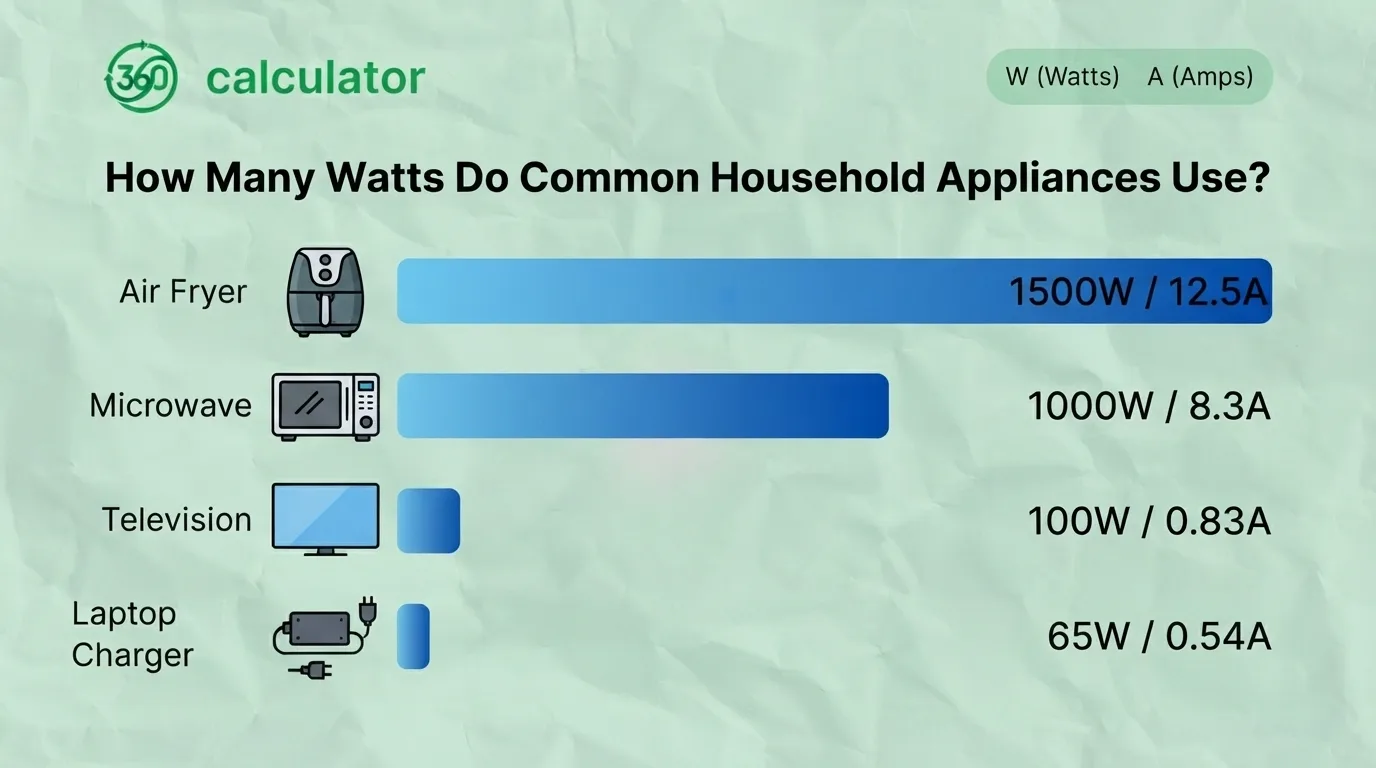
The table below lists typical wattage and amp draw for 4 common household appliances at 120 volts. Exact figures vary by model, and the nameplate rating should always be checked directly, though the U.S. Department of Energy publishes similar typical appliance wattage ranges for consumer reference.
Appliance | Typical Watts | Typical Amps (120V) |
Microwave | 1000W | 8.3A |
Air fryer | 1500W | 12.5A |
Television | 100W | 0.83A |
Laptop charger | 65W | 0.54A |
For a fuller appliance-by-appliance reference beyond this snapshot, see the Household Watt Calculator.
How Does Amps to Watts Conversion Change Between 120V and 230V Countries?
Standard household voltage differs by region, roughly 120 volts across the United States and Canada versus roughly 230 to 240 volts across the UK, Europe, and much of the rest of the world. The same amp rating produces a different watt result depending on which standard applies: 10 amps at 120 volts equals 1200 watts, while 10 amps at 230 volts equals 2300 watts. This matters when traveling with devices or using voltage converters.
The Volts to Watts Calculator compares regional voltage standards across a fuller range of amp values.
How Do You Convert Amp-Hours to Watts for Battery Systems?
Battery capacity is often listed in amp-hours (Ah), which describes current delivered over time rather than an instant rate, so a separate step is needed before applying the watts formula. Watt-hours, a battery's stored energy capacity, come from multiplying amp-hours by voltage, a related but distinct calculation from the instant amps to watts conversion this guide focuses on.
The full amp-hour to watt-hour explanation lives in the Amp Hours to Watts Calculator.
How Do Volts, Amps, and Watts Relate to Each Other in Full Detail?
The complete volt, amp, watt relationship, including all three rearranged formulas for solving voltage, current, or power, is covered in a dedicated foundational guide.
The Volts, Amps, and Watts Explained guide carries the basic relationship introduced earlier into full theoretical depth.