

Scientific notation writes very large or very small numbers as a coefficient between 1 and 10 multiplied by a power of 10. A scientific notation converter switches a number between this compact form and its full standard decimal form in either direction. This page covers how to convert numbers by hand, how e notation and normalized notation relate to scientific notation, how to add, subtract, multiply, divide, and apply powers and roots to numbers written this way, and which mistakes trip people up most often.
What Is Scientific Notation and How Is It Written?
Scientific notation is a way of writing a number as two parts: a coefficient and a power of 10. The general form is a × 10^n, where a is the coefficient and n is the exponent. For a number to be in proper scientific notation, the coefficient must be at least 1 and less than 10.
For example, the number 8,600,000 is written as 8.6 × 10^6. The number 0.000047 is written as 4.7 × 10^-5. In both cases the coefficient stays between 1 and 10, and only the exponent changes to show how large or small the original number is.
What Are the Rules for the Coefficient in Scientific Notation?
The coefficient in scientific notation must be at least 1 and less than 10. A number such as 45 × 10^3 is not in proper scientific notation because 45 is greater than 10. The correct form is 4.5 × 10^4. Likewise, 0.6 × 10^8 is not proper because 0.6 is less than 1. The correct form is 6 × 10^7.
Written form | Is it proper scientific notation? | Correct form |
45 × 10^3 | No, coefficient is above 10 | 4.5 × 10^4 |
0.6 × 10^8 | No, coefficient is below 1 | 6 × 10^7 |
7.2 × 10^-4 | Yes | 7.2 × 10^-4 |
Trailing zeros in the coefficient are not automatically removed. If a zero appears after the decimal point and was part of the original number's precision, it stays in the coefficient because it represents a significant figure. For example, 5.600 × 10^3 keeps its trailing zeros if the original number was recorded with that level of precision.
Why Can Zero Not Be Written in Scientific Notation?
Zero cannot be written in scientific notation because the coefficient rule requires a value that is at least 1 and less than 10, and zero does not fit that range. There is no power of 10 that turns 0 into a number between 1 and 10. For this reason, zero is simply written as 0 and treated as an exception to the format.
Is Standard Form the Same as Standard Notation in Scientific Notation?
The terms standard form and standard notation are used differently across sources, and this creates confusion. Some math resources use standard form to mean the same thing as scientific notation, written as a × 10^n. Other resources use standard form and standard notation to mean the plain, ordinary way of writing a number, such as 345,000.
On this page, standard form and standard notation both refer to the plain ordinary number, not the scientific notation form. Keeping this definition fixed avoids mixing up the two directions of conversion covered below.
How Do You Convert a Standard Number to Scientific Notation?
Converting a standard number to scientific notation follows a consistent method regardless of how large or small the number is.
First, find the first non-zero digit in the number. Move the decimal point so it sits right after that digit. Count how many places the decimal point moved. That count becomes the exponent.
If the decimal point moved to the left, the exponent is positive. If it moved to the right, the exponent is negative. Once the coefficient and exponent are set, write the number as coefficient × 10^exponent.
For example, converting 357,096 moves the decimal point 5 places to the left, giving 3.57096 × 10^5.
How Do You Convert a Large Number to Scientific Notation?
Take the number 86,000 as an example. The first non-zero digit is 8. Moving the decimal point from the end of the number to just after the 8 requires moving it 4 places to the left.
Because the decimal point moved left, the exponent is positive. The result is 8.6 × 10^4.
This method works the same way for any large whole number. Locate the first non-zero digit, move the decimal point there, count the places, and use that count as a positive exponent.
How Do You Convert a Small Decimal Number to Scientific Notation?
Take the number 0.0000272 as an example. The first non-zero digit is 2. Moving the decimal point from its starting position to just after that 2 requires moving it 5 places to the right.
Because the decimal point moved right, the exponent is negative. The result is 2.72 × 10^-5.
A common mistake here is forgetting to make the exponent negative. Since the decimal point moved right instead of left, the exponent sign must flip. Numbers smaller than 1 always end up with a negative exponent in scientific notation.
How Does the Direction You Move the Decimal Point Affect the Exponent Sign?

Decimal point direction | Exponent sign |
Moved left | Positive |
Moved right | Negative |
Did not move | Zero |
The direction the decimal point moves determines whether the exponent is positive or negative. This single rule causes more mistakes than any other part of scientific notation, so it is worth remembering on its own. Moving the decimal point left makes the exponent positive. Moving it right makes the exponent negative.
How Do You Convert Scientific Notation Back to Standard Form?
Converting scientific notation back to standard form reverses the process described above. To expand a × 10^n, multiply the coefficient by 10 raised to the power of n. In practice, this means moving the decimal point the number of places shown by the exponent.
A positive exponent moves the decimal point to the right. A negative exponent moves the decimal point to the left. Zeros are filled in wherever the decimal point passes an empty place.
For example, 3.456 × 10^4 expands to 34,560 by moving the decimal point 4 places to the right.
How Do You Expand a Positive Exponent Back to a Full Number?
Take 3.45 × 10^5 as an example. The exponent is positive 5, so the decimal point moves 5 places to the right. Starting from 3.45, moving the decimal point 5 places to the right gives 345,000. Zeros fill in the places where there were no digits left in the coefficient.
How Do You Expand a Negative Exponent Back to a Full Number?
Take 6.023 × 10^-6 as an example. The exponent is negative 6, so the decimal point moves 6 places to the left. Starting from 6.023, moving the decimal point 6 places to the left gives 0.000006023. Zeros are inserted after the decimal point before the first digit to hold each place.
How Do You Normalize a Number That Is Not in Proper Scientific Notation?
A number can be mathematically correct but still not be in proper, normalized scientific notation. For example, 32 × 10^4 equals the same value as 3.2 × 10^5, but only the second form follows the rule that the coefficient must be between 1 and 10.
To normalize a number, move the decimal point in the coefficient until it falls between 1 and 10. For every place the decimal point moves, adjust the exponent by the same number of places in the opposite direction.
In the example above, moving the decimal point in 32 one place to the left turns it into 3.2, so the exponent increases by 1, from 4 to 5. The normalized form is 3.2 × 10^5. The same fix works in the other direction. Take 0.5 × 10^6. Moving the decimal point one place to the right turns it into 5, so the exponent decreases by 1, from 6 to 5. The normalized form is 5 × 10^5.
What Is E Notation and How Does It Relate to Scientific Notation?

E notation is a way of typing scientific notation using a keyboard, calculator, or spreadsheet, where the letter e replaces × 10^. Instead of writing 3.45 × 10^5, e notation writes it as 3.45e5.
The letter e in this context has no connection to Euler's number, the mathematical constant used in calculus. This overlap in symbols is a common source of confusion, especially when a number is entered without an exponent, since some tools may then treat the letter e as the constant instead of as notation.
E notation is used because many calculators, programming languages, and spreadsheets cannot display a raised exponent, so the letter e is used as a stand in for the times ten to the power of part of the expression.
How Do You Read and Write Numbers in E Notation?
Scientific notation | E notation |
3.57096 × 10^5 | 3.57096e5 |
1.247 × 10^2 | 1.247e2 |
5.6 × 10^-3 | 5.6e-3 |
9.8 × 10^-4 | 9.8e-4 |
Both a capital E and a lowercase e are accepted by most calculators and software, and they mean the same thing. To read 3.57096e5 aloud, say three point five seven zero nine six times ten to the fifth. To write a number in e notation, first put it in proper scientific notation, then replace × 10^ with the letter e followed by the exponent.
How Do You Perform Calculations With Numbers in Scientific Notation?
Numbers in scientific notation can be added, subtracted, multiplied, and divided, but each operation follows its own rule.
Addition and subtraction require the exponents to match before the coefficients can be combined. Multiplication and division do not require matching exponents. Instead, the coefficients and exponents are handled separately, and the coefficients are combined normally while the exponents are added or subtracted.
How Do You Add and Subtract Numbers in Scientific Notation?
Before adding or subtracting numbers in scientific notation, the exponents must be made equal. Take 1.432 × 10^2 and 8.00 × 10^1 as an example. Since 8.00 × 10^1 is the same value as 0.8 × 10^2, it can be rewritten with the same exponent as the first number.
Once both numbers share the exponent 10^2, the coefficients can be added directly: 1.432 + 0.8 = 2.232. The result is 2.232 × 10^2.
A common error at this step is a simple mistake in the addition or subtraction itself, not in the concept of matching exponents. Double check the arithmetic once the exponents are aligned.
How Do You Multiply Numbers in Scientific Notation?
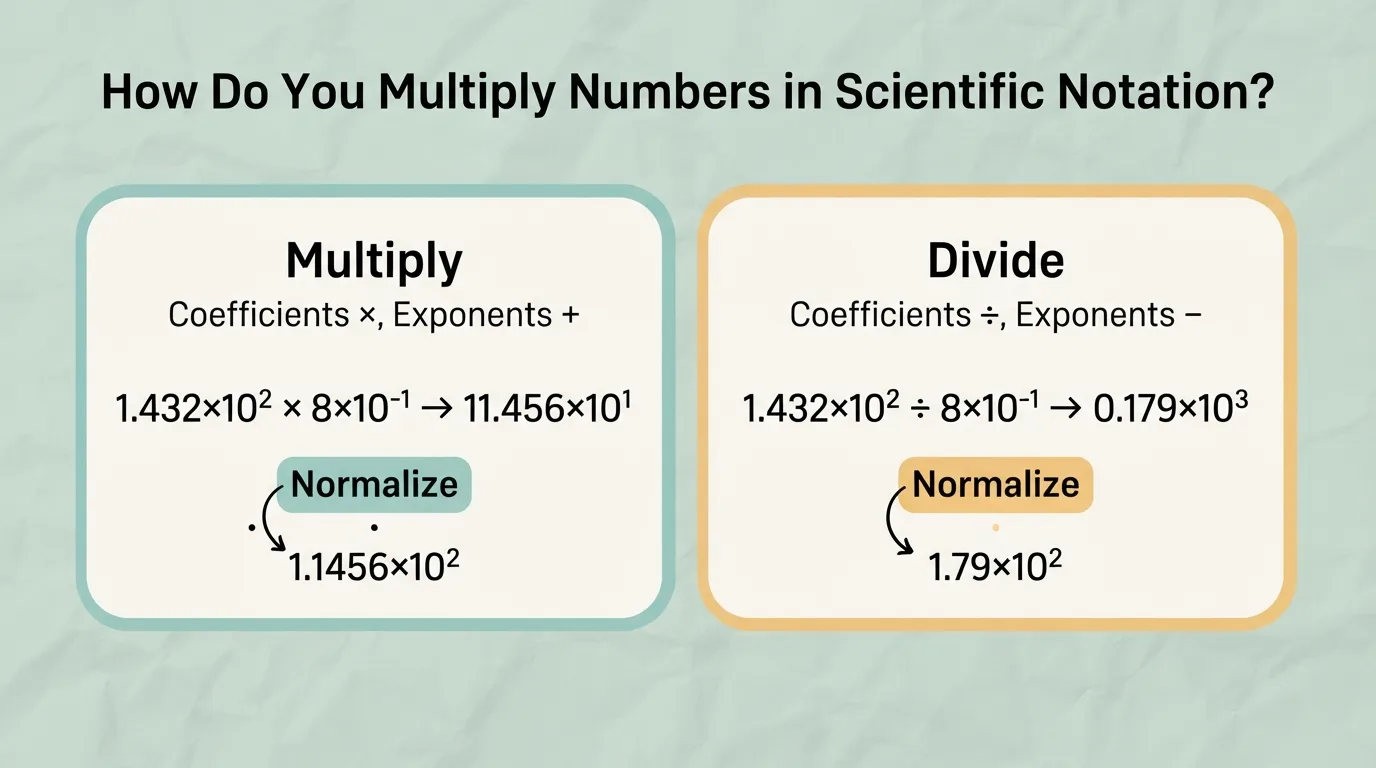
To multiply numbers in scientific notation, multiply the coefficients together and add the exponents together. Take 1.432 × 10^2 and 8 × 10^-1 as an example.
Multiply the coefficients: 1.432 × 8 = 11.456. Add the exponents: 2 + (-1) = 1. The raw result is 11.456 × 10^1.
Since 11.456 is greater than 10, this result is not yet normalized. Move the decimal point one place to the left to get 1.1456, and increase the exponent by 1. The final answer is 1.1456 × 10^2.
How Do You Divide Numbers in Scientific Notation?
To divide numbers in scientific notation, divide the coefficients and subtract the exponents. Take 1.432 × 10^2 divided by 8 × 10^-1 as an example.
Divide the coefficients: 1.432 ÷ 8 = 0.179. Subtract the exponents: 2 - (-1) = 3. The raw result is 0.179 × 10^3.
Since 0.179 is less than 1, this result also needs normalizing. Move the decimal point one place to the right to get 1.79, and decrease the exponent by 1. The final answer is 1.79 × 10^2.
How Do You Raise a Number in Scientific Notation to a Power or Find Its Square Root?
To raise a number in scientific notation to a power, raise the coefficient to that power and multiply the exponent by the same power. For example, squaring 2 × 10^3 means squaring the coefficient, 2^2 = 4, and multiplying the exponent by 2, 3 × 2 = 6. The result is 4 × 10^6.
To find the square root of a number in scientific notation, first check that the exponent is even. If it is not, shift the decimal point in the coefficient by one place and adjust the exponent by 1 to make it even. Then take the square root of the coefficient and divide the exponent by 2.
For example, the square root of 9 × 10^4 is the square root of 9, which is 3, with the exponent divided by 2, giving 3 × 10^2.
What Are Some Common Scientific Notation Examples and Practice Problems?

The table below lists several numbers side by side with their scientific notation form, covering large numbers, small decimals, negative numbers, and numbers close to 1.
Original number | Scientific notation |
579,000,000,000,000,000 | 5.79 × 10^17 |
127.5 | 1.275 × 10^2 |
0.0027 | 2.7 × 10^-3 |
10 | 1 × 10^1 |
-5,000,000,000 | -5 × 10^9 |
3.2 | 3.2 × 10^0 |
What Common Mistakes Do People Make When Converting to Scientific Notation?

A few errors come up again and again when people convert numbers to scientific notation. Knowing them in advance makes it easier to catch a mistake before it becomes a wrong answer.
• Using the wrong exponent sign. The fix is to remember that moving the decimal point left gives a positive exponent, and moving it right gives a negative exponent.
• Miscounting decimal places. The fix is to count place by place rather than just counting zeros, since not every large or small number is made only of zeros.
• Leaving the coefficient outside the 1 to 10 range. The fix is to normalize the result before treating it as final.
• Confusing the e in e notation with Euler's number. The fix is to remember that e notation is only a typing shortcut and has nothing to do with the mathematical constant.
• Rounding the coefficient too early. The fix is to keep extra decimal places until the final step, then round only once at the end.
• Trusting a result without a quick sanity check. The fix is to compare the size of the answer to the size of the original number before accepting it.
How Do You Use a Scientific Notation Converter Tool Correctly?
Most scientific notation converters accept two common input formats. A number can be typed using a caret to show the exponent, such as 3.45^5, or using the letter e, such as 3.45e5. Either format should give the same result.
To convert a number, enter it in the input field and choose the direction: standard to scientific, or scientific to standard. Some converters also let you set the number of significant figures the answer should keep, which is useful when the input number has a specific level of precision.
If you are checking a homework problem, solve it by hand first and form a rough estimate of what the answer should look like before you use the converter. Then enter the values and compare the result to your estimate. This catches typing mistakes and helps confirm that you understand the method, rather than only getting a final number.
Where Is Scientific Notation Used in Science, Engineering and Everyday Math?
Scientific notation shows up in several fields where numbers are either extremely large or extremely small. In astronomy, distances between stars and galaxies are measured in numbers with many digits, and scientific notation keeps these figures readable. In chemistry, quantities such as the number of atoms in a sample are expressed the same way.
In engineering, tiny measurements such as component tolerances or electrical currents are often written in scientific notation, though engineers frequently switch to a related format that matches standard measurement units. In computing, calculators and spreadsheets fall back to scientific or e notation automatically once a number is too long to display in full.
These real world uses connect to a few related tools and topics that go beyond plain scientific notation, covered below.
How Is Engineering Notation Different From Scientific Notation?
Engineering notation is closely related to scientific notation, but it restricts the exponent to multiples of 3, such as 0, 3, 6, or -3, instead of allowing any integer. Because of this restriction, the coefficient in engineering notation can range from 1 up to just under 1000, rather than the 1 to 10 range used in standard scientific notation.
This difference exists because engineering notation lines up with SI prefixes such as kilo, mega, and micro, which makes it easier to read a number aloud or convert it directly into a unit. For example, 1.234 × 10^8 in scientific notation becomes 123.4 × 10^6 in engineering notation, matching the mega prefix.
If you regularly work with electrical or measurement units, converting between the two formats directly with an engineering notation converter saves the extra normalization step described above.
How Do You Round Numbers Using Significant Figures Before Converting?
The number of digits kept in a coefficient depends on how many significant figures the original number has. Trailing zeros can count as significant figures depending on where they appear, which is why they are not automatically dropped when writing a number in scientific notation.
For example, rounding 8,647,000 to 3 significant figures gives 8,650,000, which is then written as 8.65 × 10^6.
If a number needs to be rounded before conversion, using a significant figures calculator first makes sure the rounding follows the correct rules before the exponent is calculated.
How Do You Calculate Powers of Ten and Exponents?
The exponent in scientific notation is simply a power of 10. Understanding basic exponent rules, such as adding exponents when multiplying and subtracting them when dividing, makes the multiplication and division steps covered earlier easier to follow.
Power of 10 | Value |
10^-3 | 0.001 |
10^-2 | 0.01 |
10^-1 | 0.1 |
10^0 | 1 |
10^1 | 10 |
10^2 | 100 |
10^3 | 1,000 |
10^6 | 1,000,000 |
For exponent problems beyond scientific notation, such as fractional or negative exponents on other bases, an exponent calculator covers those cases in more depth.
How Do You Convert Scientific Notation Into Word Form?
A number in scientific notation can also be written out fully in words. For example, 3.456 × 10^11 can be written as three hundred forty five billion six hundred million. This form is sometimes required in formal writing or accessibility contexts where digits are avoided.
A shorter alphabetic form is also common in casual writing and data dashboards, using a single letter after the number, such as 3.2M for 3,200,000 or 5.6B for 5,600,000,000. This short form is convenient but is not usually accepted in formal documents.
For longer numbers, a numbers to words converter handles the full word form automatically.
How Do You Use a Scientific Calculator for Notation Conversions?
Physical and app based scientific calculators usually include a display mode, often labeled SCI or ENG, that automatically shows results in scientific or engineering notation. Switching this mode changes how a result is displayed, not the actual value being calculated.
Calculator brands such as Casio and Texas Instruments each have their own menu for reaching this mode, usually found under a setup or mode button, though the exact steps vary by model.
If you want to explore these display modes directly, a scientific calculator lets you switch between standard, scientific, and engineering display without changing your input.
How Do You Convert Between Fractions, Decimals and Scientific Notation?
A number sometimes needs to move between fraction, decimal, and scientific notation depending on the task at hand. Since scientific notation is based on a decimal coefficient, a fraction usually needs to be converted to a decimal first.
For example, the fraction 1/8 converts to the decimal 0.125, which then converts to scientific notation as 1.25 × 10^-1.
If you are starting from a fraction, a decimal to fraction converter handles the first step of that chain before you convert the decimal into scientific notation.
What Is Order of Magnitude and How Is It Determined From Scientific Notation?
The order of magnitude of a number is the exponent in its scientific notation form. It gives a quick sense of how large or small a number is without reading every digit.
For example, 3.4 × 10^5 has an order of magnitude of 5, while 3.4 × 10^2 has an order of magnitude of 2, meaning the first number is about a thousand times larger than the second, even though both start with the same coefficient.
To compare several numbers by size quickly, an order of magnitude page covers how this comparison works across a wider range of values.
Frequently Asked Questions
What is the correct format for scientific notation?
Scientific notation is written as a × 10^n, where the coefficient a is between 1 and 10, and n is an integer exponent.
How do you convert e notation to standard scientific notation?
Replace the letter e with × 10^ and keep the same coefficient and exponent. For example, 3.45e5 becomes 3.45 × 10^5.
Why is my coefficient greater than 10 after multiplying?
This happens when the raw multiplication result is not normalized yet. Move the decimal point one place to the left and increase the exponent by 1 until the coefficient is between 1 and 10.
Can scientific notation be negative?
Yes. A negative number in scientific notation keeps the negative sign in front of the coefficient, such as -5 × 10^9.
Is scientific notation the same as engineering notation?
No. Scientific notation restricts the coefficient to between 1 and 10, while engineering notation restricts the exponent to multiples of 3, allowing a coefficient up to just under 1000.