

This fraction calculator adds, subtracts, multiplies, divides, simplifies, and converts fractions in one place. Type in your numbers, choose an operation, and you'll get a fully simplified answer along with the steps behind it. It handles proper fractions, improper fractions, mixed numbers, and negative values, so whether you're checking a homework problem, scaling a recipe, or measuring a board, you can just enter the numbers and go.
What Is a Fraction and How Does This Calculator Work?
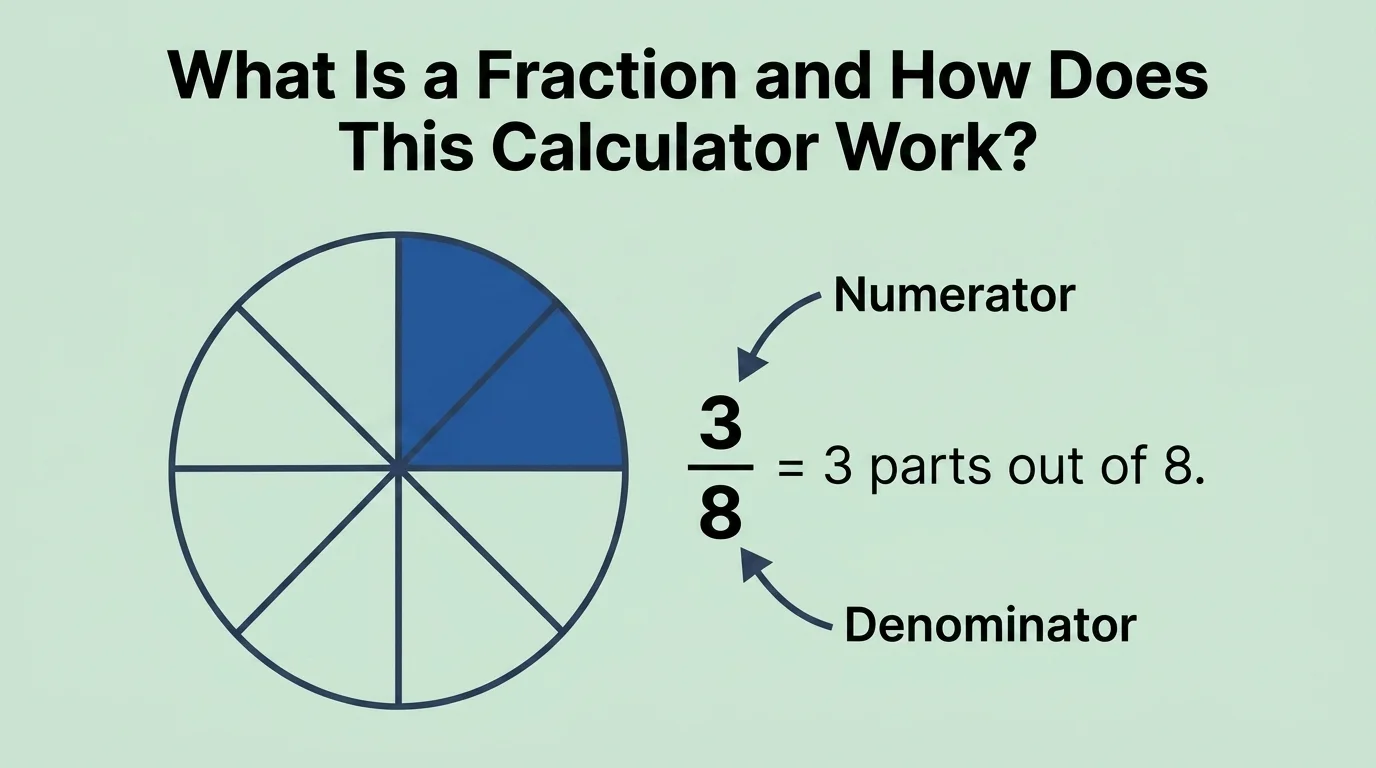
A fraction is a way of writing part of a whole. The top number is the numerator, the bottom number is the denominator, and together they tell you how many parts you have out of how many equal parts exist. In 3/8, you have three parts out of a possible eight.
Enter a simple fraction, a mixed number like 2 1/4, or a negative value, and the calculator runs it through whichever operation you've selected. Once it lands on an answer, it reduces that answer to its lowest terms on its own, and if the result comes out as an improper fraction, it converts that into a mixed number automatically.
How Do You Add and Subtract Fractions With Different Denominators?
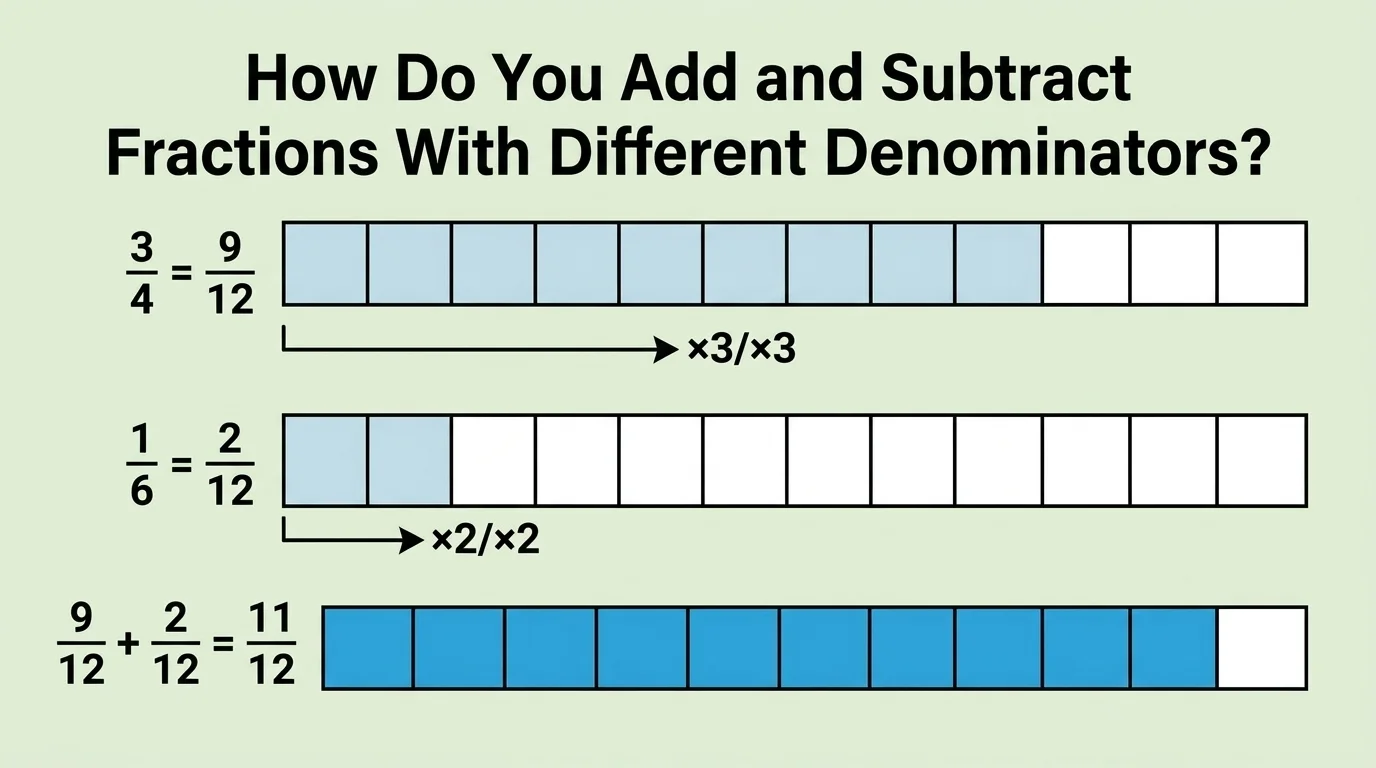
You can't add or subtract fractions until the denominators match. If they're already the same, just combine the numerators and leave the denominator alone. When the denominators are different, you need a common one first, usually the smallest one that works, known as the least common denominator, or LCD.
Take 3/4 plus 1/6. The LCD of 4 and 6 is 12, so rewrite both fractions over 12: 3/4 becomes 9/12, and 1/6 becomes 2/12. With matching denominators, add the numerators: 9 plus 2 is 11, so the answer is 11/12. Subtraction follows the same setup, just subtract instead of add, so 3/4 minus 1/6 becomes 9/12 minus 2/12, or 7/12.
Step | Addition (3/4 + 1/6) | Subtraction (3/4 - 1/6) |
Find the LCD | 12 | 12 |
Rewrite both fractions | 9/12 and 2/12 | 9/12 and 2/12 |
Combine the numerators | 9 + 2 = 11 | 9 - 2 = 7 |
Result | 11/12 | 7/12 |
One thing worth watching for: if a subtraction answer turns out negative, it should carry only one negative sign, either in front of the whole fraction or on the numerator, never on the numerator and denominator at the same time.
How Do You Multiply and Divide Fractions?
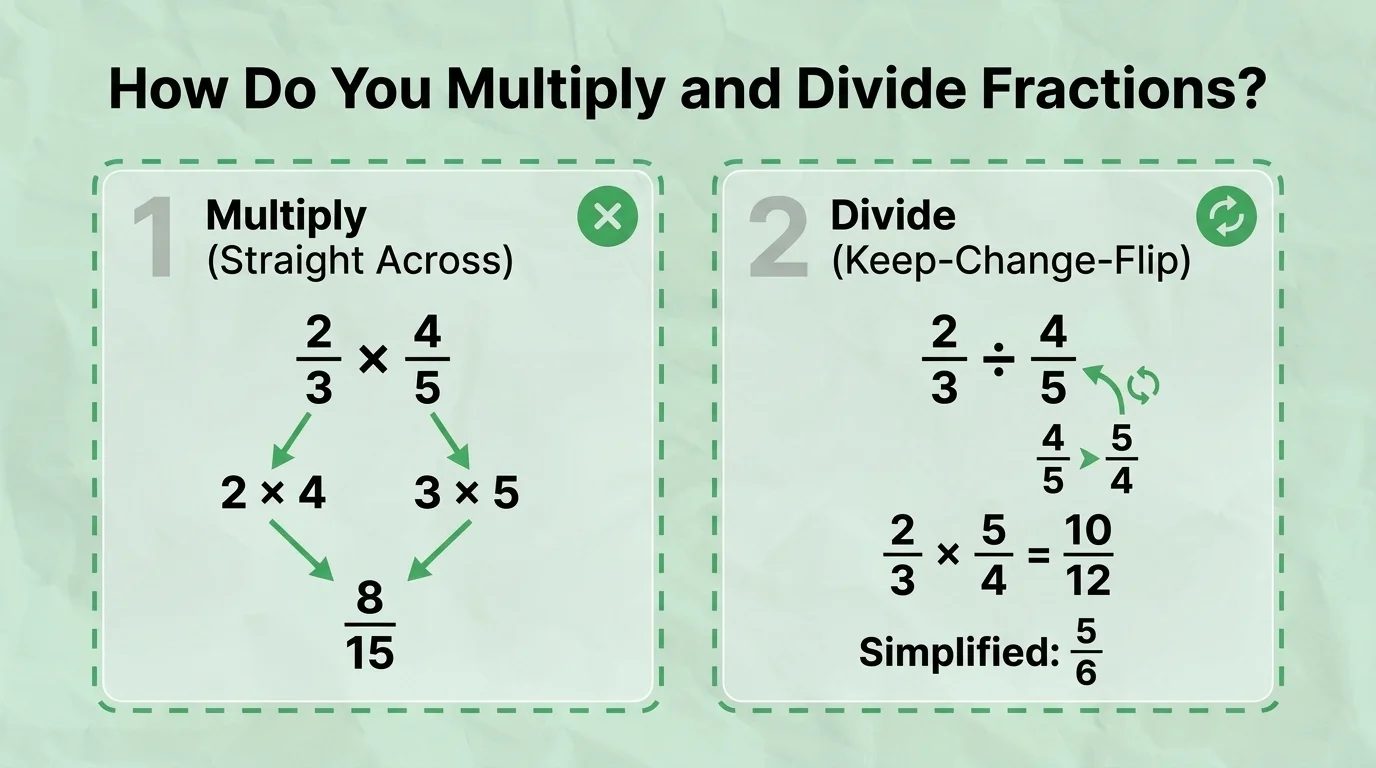
Multiplying fractions is the simplest of the four operations because there's no common denominator to worry about. Multiply the two numerators together, multiply the two denominators together, and simplify if the result allows it. 2/3 times 4/5 works out to 8/15. If either number is a mixed number, convert it to an improper fraction first, then multiply as usual.
Dividing fractions uses a method some people call Keep-Change-Flip: keep the first fraction as it is, change the division sign to multiplication, and flip the second fraction upside down to get its reciprocal. Then multiply the two fractions normally. 2/3 divided by 4/5 becomes 2/3 times 5/4, which is 10/12, and that simplifies down to 5/6.
Step | Multiplication (2/3 x 4/5) | Division (2/3 ÷ 4/5) |
Setup | Multiply straight across | Flip the second fraction, then multiply |
Working | 2 x 4 = 8, 3 x 5 = 15 | 2/3 x 5/4 = 10/12 |
Result | 8/15 | 5/6 |
How Do You Simplify a Fraction to Its Lowest Terms?
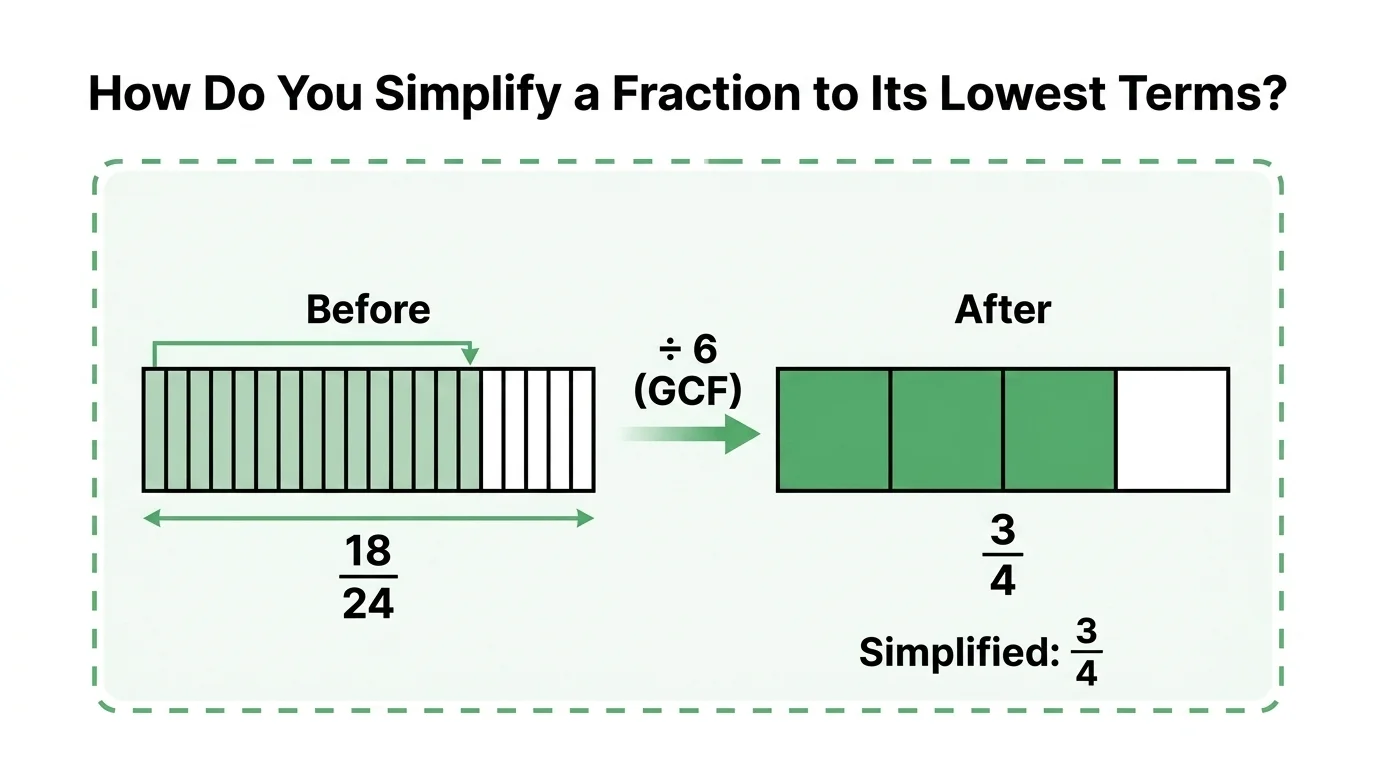
A fraction is fully simplified once the numerator and denominator share no common factor besides 1. To get there, find the greatest common factor, or GCF, of the two numbers and divide both of them by it. Take 18/24. The GCF of 18 and 24 is 6, so 18 divided by 6 is 3, and 24 divided by 6 is 4, leaving you with 3/4, which can't be reduced any further.
This calculator simplifies every result on its own, so you won't need to work through this step by hand, but it's worth knowing why the final answer looks the way it does, especially if you're comparing it against homework or your own math.
How Do You Convert Between Fractions, Decimals, and Mixed Numbers?
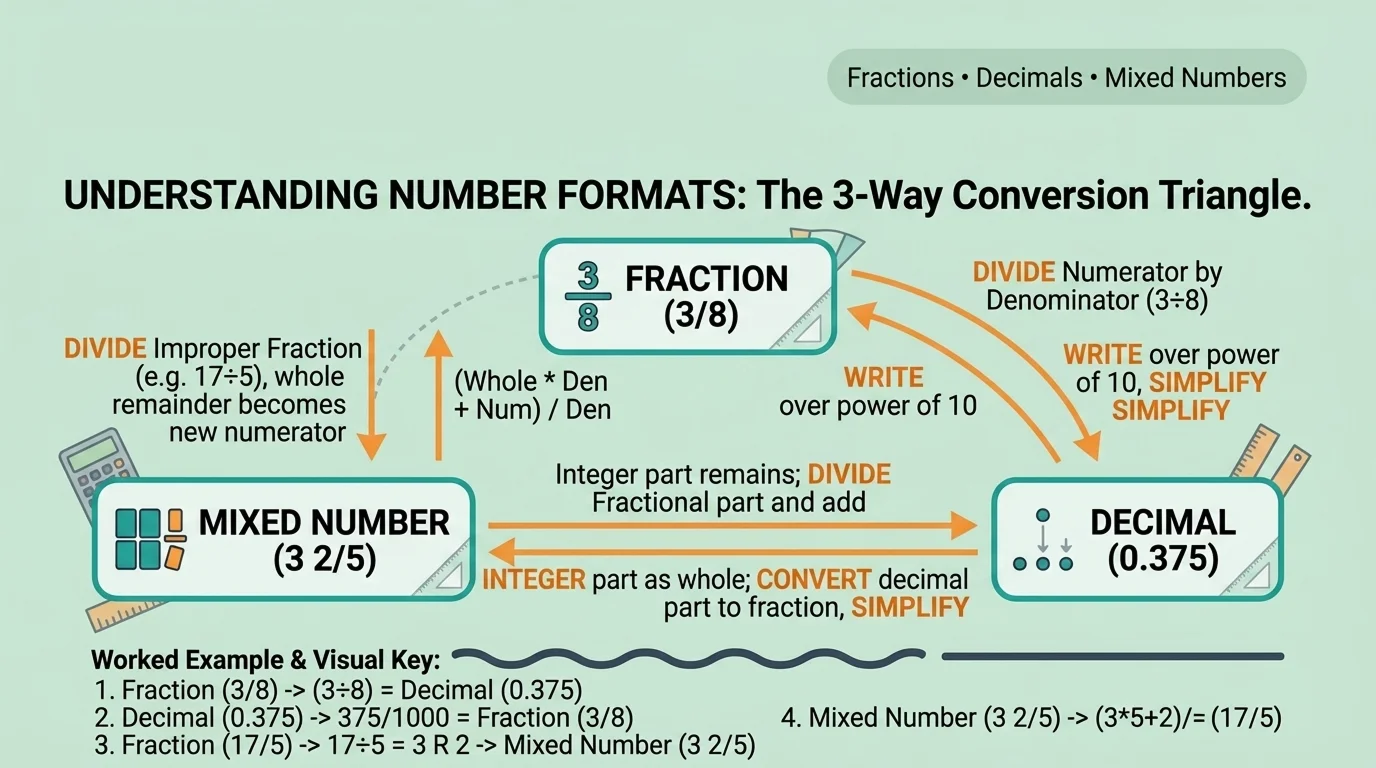
A few conversions come up constantly alongside basic fraction math, so it helps to know how each one works. To turn an improper fraction into a mixed number, divide the numerator by the denominator: the whole number part is the quotient, and the remainder becomes the new numerator over the same denominator. 17/5 divides out to 3 with a remainder of 2, giving you 3 2/5.
To turn a decimal into a fraction, write it over the matching power of ten based on how many digits sit after the decimal point, then simplify. 0.75 becomes 75/100, which reduces to 3/4. Going the other way, from a fraction to a decimal, just divide the numerator by the denominator. 3/8 divided out is 0.375.
Conversion | Example | Result |
Improper fraction to mixed number | 17/5 | 3 2/5 |
Decimal to fraction | 0.75 | 3/4 |
Fraction to decimal | 3/8 | 0.375 |
Where Else Do Fractions Show Up?
Fractions rarely stay confined to one type of problem. The same numbers you're working with here tend to reappear as percentages, as ratios, and in everyday measuring tasks, whether that's a recipe in the kitchen or a cut of wood in the garage.
How Is a Fraction Converted Into a Percentage?
Divide the numerator by the denominator to get a decimal, then multiply that by 100. A student who answers 4 out of 5 questions correctly has a fraction of 4/5, which comes out to 0.8, or 80 percent.
If you're working mostly in percentages rather than fraction form, percentage calculator handles those conversions and comparisons directly.
How Is a Fraction Different From a Ratio?
A fraction shows a part out of a whole, like 3 slices out of an 8 slice pizza. A ratio compares two separate amounts to each other instead, like 3 cups of flour to 2 cups of sugar. The two ideas look alike on paper, but the relationship the numbers describe isn't the same thing.
For problems built around comparing two quantities rather than parts of a single whole, take a look at ratio calculator.
How Do You Use Fractions for Recipe and Measurement Conversions?
Scaling a recipe up or down usually comes down to multiplying a fraction. If a recipe calls for 2/3 cup of flour and you're making half a batch, multiply 2/3 by 1/2 to land on 1/3 cup.
The same math shows up with physical measurements too. A board that's 7/8 inch thick, once you trim off 1/4 inch, leaves you with 7/8 minus 2/8, or 5/8 inch remaining.
For everyday conversions between cups, tablespoons, inches, and other common units, you can use measurement calculator directly.
Frequently Asked Questions
Can This Calculator Handle Mixed Numbers and Negative Fractions?
Yes to both. Mixed numbers get converted to improper fractions behind the scenes before any operation runs, then converted back if the result works out to more than one whole. For negative values, a negative sign on just the numerator or just the denominator makes the whole fraction negative, while negative signs on both cancel each other out.
What Is the Difference Between GCF and LCD?
The greatest common factor, or GCF, is used to simplify a fraction, it's the largest number that divides evenly into both the numerator and denominator. The least common denominator, or LCD, is used to add or subtract fractions that don't share a denominator, it's the smallest number both denominators divide into evenly. The names sound alike, but they solve two different problems.
How Do You Compare Two Fractions?
Give both fractions a common denominator, then compare the numerators directly, whichever is larger wins. Or skip that step entirely and convert both fractions to decimals, then compare those instead.
Why Isn't My Fraction Automatically Simplified?
It actually is. This calculator reduces every result by default. The confusion usually comes from comparing an in-between step, like 9/12, with the final simplified answer, like 3/4, before the calculation has fully played out.
Does This Calculator Show Step-by-Step Work?
Yes. Each calculation shows the common denominator step where one is needed, the working itself, and the simplified result, so you can see exactly how the answer was reached instead of just getting a final number.