

Find your dog’s daily water requirement using the Dog Water Intake Calculator based on veterinary hydration formulas and metabolic standards. The calculator uses inputs such as the dog’s weight, activity level, and diet type to calculate hydration needs. It delivers the final output in millilitres (ml) or ounces (oz) for simple daily hydration tracking. This calculator simplifies pet health management by converting biological and dietary variables into a clear, measurable daily requirement for better hydration.
What formula does the dog water intake calculator use?
The dog water intake calculator uses a base requirement of 50 to 60 millilitres per kilogram of body weight per day. This calculation logic is from veterinary hydration standards. According to the Merck Veterinary Manual and National Research Council, daily water intake matches metabolic requirements at 1 ml per kcal, which confirms the linear range as physiologically perfect.
How does your dog's weight influence the hydration calculation?

Dogs weight directly influences the hydration calculation because the water intake calculator applies weight-based scaling to find daily hydration needs. If a dog’s weight increases, its water requirement also rises because larger bodies have higher metabolic activity and greater fluid requirement. The calculator adjusts output using a per-kilogram baseline. This ensures that a 5 kg dog and a 30 kg dog are not given the same hydration estimate, but instead receive scaled values based on their size.
The following table shows different outputs according to body weight:
Dog Weight (lbs) | Dog Weight (kg) | Daily Water (ml) | Daily Water (oz) |
10 | 4.5 | 225 to 315 | 7.6 to 10.6 |
30 | 13.6 | 680 to 952 | 23.0 to 32.2 |
50 | 22.7 | 1,135 to 1,589 | 38.4 to 53.7 |
70 | 31.8 | 1,590 to 2,226 | 53.8 to 75.3 |
90 | 40.8 | 2,040 to 2,856 | 69.0 to 96.6 |
How does the calculator account for dry vs wet dog food?

The calculator accounts for dry vs wet dog food by applying a moisture deduction variable based on the moisture amount in a diet. Wet dog food contains 75% to 80% water, and dry kibble contains 10% moisture. Selecting the “Wet Food” variable reduces the recommended bowl amount by the total fluid volume provided by the food-type moisture offset.
Why is activity level a variable in the hydration estimator?
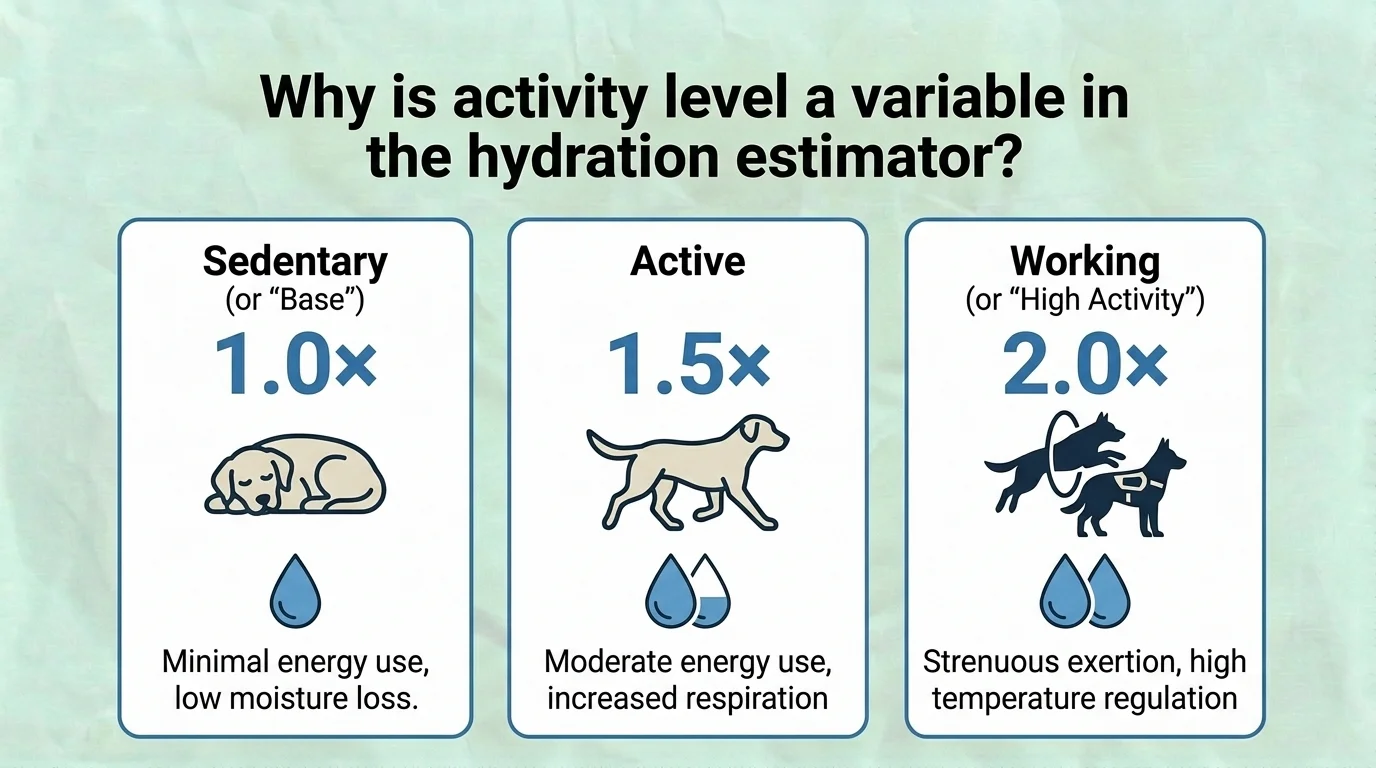
Activity level is a variable in hydration calculation because physical activity increases the activity multiplier. High metabolic rate and respiratory evaporation require higher fluid replacement. Active dogs need hydration 1.5 times the base volume, while working or dogs need 2.0 times the base requirement. This variable adjusts the total to account for thermoregulation and water loss during exercise.
What are the measurement units for daily water tracking?

The dog water intake calculator performs unit conversions between US ounces (oz), millilitres (ml), and litres (L). One US fluid ounce equals 29.57 millilitres. The tool gives these multiple formats for different measuring types and international standards for fluid volume finding.
How often should you recalculate your dog's water needs?
You should recalculate your dog’s water needs depending on physiological or environmental change. Recalculation if a dog experiences a weight change of 5% or during seasonal weather changes. High surrounding temperatures increase evaporation rates, requiring a seasonal adjustment to the daily hydration target to maintain homeostasis.
How accurate is the estimated water intake for different breeds?
Mathematical formulas give high accuracy for average dog metabolic rates, though different breeds affect specific needs because of the differences in their body shapes. Sighthounds have higher muscle mass, while brachycephalic breeds have different thermoregulation patterns. According to the Ohio State University Veterinary Medical Centre research, these formulas serve as baseline estimates and require individual observation.
Integrating Hydration Data with Other Pet Health Calculators

Hydration data functions as one metric within a dog’s Maintenance Energy Requirement (MER). Complete pet health management involves integrating water intake with caloric needs, weight assessments, and vital sign monitoring. Using different health calculators ensures all metabolic variables remain within good physiological ranges for the pet.
How many calories should your dog eat?
Dogs’ caloric intake correlates directly with hydration needs. Most dogs need 1 ml of water for every 1 kcal of food consumed. Calculating daily calories gives the primary baseline for finding the total fluid volume required for digestion and metabolic processing.
Is your dog at a healthy weight?
A healthy body weight ensures the accuracy of hydration calculations. Excess fat or underweight conditions change metabolic water requirements. Check the Body Condition Score (BCS) to calculate precise hydration needs based on lean body mass.
How much wet food should you feed?
Wet food portions change the required water in the bowl. Calculating specific wet food grams or ounces gives a more accurate moisture deduction in the hydration calculator. Precise feeding prevents over-hydration or under-hydration from food sources.
How old is your dog in human years?
Dog life stages influence total daily hydration requirements. Puppies and senior dogs have different hydration needs compared to healthy adults. Use a dog age calculator to find the specific life stage, which helps in adjustments to the base metabolic hydration formula.
What is your dog's respiratory and heart rate?
Heart rate monitoring helps provide feedback on hydration status. Dehydration causes an increase in heart rate as blood volume decreases. Checking heart and respiratory rates with water intake helps pet owners detect early signs of physiological fluid deficits.
How much chocolate is toxic to your dog?
Chocolate toxicity is a medical emergency and needs immediate calculation. While hydration can support recovery, the chocolate toxicity calculator calculates risk by measuring the amount of theobromine consumed. Checking these values helps avoid serious metabolic problems.
How much will your puppy weigh?
Adult weight calculation gives the future hydration requirements of growing puppies. Puppies have higher water-to-body-mass ratios and need frequent recalculations. Predicting adult size helps owners to scale hydration needs throughout the growth phase.