
Use this calculator to measure your dog's current shoulder height and estimate how tall a puppy may become as an adult. Dog height is normally measured at the withers (the highest point of the shoulders), which is the standard reference used by veterinarians, breeders, and kennel clubs.
The calculator uses key details such as:
Current height
Withers measurement
Age
Breed
Current measurements
Growth stage
Genetics
Estimated adult height
Prediction range
Enter your dog's information to get a quick estimate. The calculator is the main tool, while the details above help improve the accuracy of the prediction.
What Does a Dog Height Calculator Measure?
Dog height calculator measures a dog's current shoulder height and estimates a puppy's adult height. Dog height is measured at the withers, the highest point of the shoulders. This is the standard reference used in official breed standards and height measurements. According to the American Kennel Club (AKC), the withers are the highest point of a dog's shoulders, and height is measured from the withers to the ground.
A measured height represents the dog's actual height at the time of measurement. A predicted height represents an estimate of the puppy's expected adult height based on the information entered into the calculator.
The table below summarizes the key measurements used by a dog height calculator.
Attribute | Description |
Current height | The dog’s actual shoulder height at the time of measurement. |
Withers | The highest point of the dog’s shoulders is used as the standard measurement point. |
Measured height | The recorded height from a physical measurement. |
Predicted height | The estimated adult shoulder height for a growing puppy. |
What Information Does the Calculator Need to Estimate Adult Height?
The calculator needs to estimate adult height from a few basic details about the puppy. The exact information depends on the calculator. Most calculators use age, current height if it is available, breed or size group, current weight if the calculator uses it, and parent information when it is available. Each detail helps improve the adult height estimate.
The table below shows the common information used to estimate a puppy's adult height.
Information | Purpose |
Age | Shows the puppy’s stage of growth. |
Current height | Shows the puppy’s present shoulder height. |
Breed or size group | Match the puppy with dogs of a similar size. |
Current weight | Adds more growth information in calculators that use weight. |
Parent information | Uses the parents’ height as a guide for expected adult height. |
How Does a Puppy’s Age Affect Its Estimated Adult Height?
A puppy's age affects its estimated adult height because it shows the puppy's stage of growth. The calculator compares the puppy's age with its breed or size group to estimate how much growing remains. Small dogs usually reach their adult height sooner than large and giant dogs. Large and giant dogs continue growing for a longer time. For this reason, the same age does not mean the same stage of growth for every puppy.
The table below shows the general growth pattern by size group.
Size group | General maturity range |
Small | Around 6 to 12 months |
Medium | Around 12 months |
Large | Around 12 to 18 months |
Giant | Around 18 to 24 months |
The growth ranges above are based on guidance from the American Kennel Club (AKC), which notes that smaller breeds mature earlier, while large and giant breeds take longer to reach full physical maturity.
How Does Current Shoulder Height Contribute to the Prediction?
Current shoulder height contributes to the prediction by giving the calculator a direct height measurement instead of relying only on breed or other details. Shoulder height is the distance from the floor to the withers, which are the highest point of the shoulders. For an accurate measurement, the puppy should stand naturally with all four feet flat on the ground. This measurement helps the calculator compare the puppy's current height with its expected growth to estimate adult height.
The table below shows how current shoulder height helps with the estimate.
Measurement | Purpose |
Current shoulder height | Shows the puppy’s present height from the floor to the withers. |
Standing position | Keeps the height measurement consistent and accurate. |
Direct height input | Uses an actual height measurement instead of relying only on breed or other information. |
How Does Breed Affect a Dog’s Expected Adult Height?
Breed affects a dog's expected adult height because each breed has its own typical size and growth pattern. A dog height calculator uses breed information to compare a puppy with the normal adult height range for that breed. Breed standards provide a helpful guide, but individual dogs may grow taller or shorter than the typical range because of genetics and other natural differences.
The American Kennel Club (AKC) notes that breed helps estimate adult size, although individual dogs still vary.
The table below shows examples of adult height ranges from AKC breed standards.
Breed | Adult height at the withers |
Labrador Retriever | 21.5 to 24.5 inches |
Golden Retriever | 21.5 to 24 inches |
German Shepherd Dog | 22 to 26 inches |
Beagle | Two height classes: under 13 inches and 13 to 15 inches. |
Chihuahua | No height standard specified by the AKC |
How Do Genetics and Parent Size Affect Adult Height?
Genetics and parent size affect adult height because puppies inherit growth traits from their parents. A dog height calculator uses parent height and breed information to make a better estimate when those details are available. Parent size improves the estimate, but it does not guarantee the puppy's final adult height. Individual dogs from the same litter still vary in size.
Purebred dogs usually have more predictable adult height because their breed standards and family history are better documented. Mixed-breed dogs have a wider genetic background, so their adult height is less certain and the prediction range is usually broader. The American Kennel Club and PetMD both recognize that breed, parent information, and genetics help estimate a dog's adult size.
The table below shows how genetics and parent information affect adult height estimates.
Information | How it helps |
Parent height | Gives a guide to the puppy’s expected adult height. |
Genetics | Influences the puppy's overall growth and mature size. |
Purebred dogs | Usually provides a more predictable adult height estimate. |
Mixed-breed dogs | Usually have a wider prediction range because of mixed ancestry. |
How Does Current Weight Relate to a Puppy’s Height Prediction?
Current weight relates to a puppy's height prediction as a supporting growth indicator in calculators that include weight as an input. Weight does not measure height, and a heavier puppy does not always become a taller adult dog. Growth rate and adult size vary between breeds and size groups. They are also influenced by genetics, nutrition, and the puppy's stage of development.
A current shoulder height measurement remains the most direct way to estimate adult height, while weight provides additional growth information when used with age, breed, and other measurements.
The table below shows the role of current weight in height prediction.
Information | Role in the estimate |
Current weight | Provides additional growth information in calculators that use weight. |
Current shoulder height | Provides the direct height measurement for the estimate. |
Breed or size group | Helps compare the puppy with dogs of a similar size. |
Age | Shows the puppy’s stage of growth. |
Sources: Merck Veterinary Manual and VCA Animal Hospitals describe puppy growth as varying with breed, genetics, nutrition, and developmental stage.
How Do You Measure a Dog’s Height at the Withers?
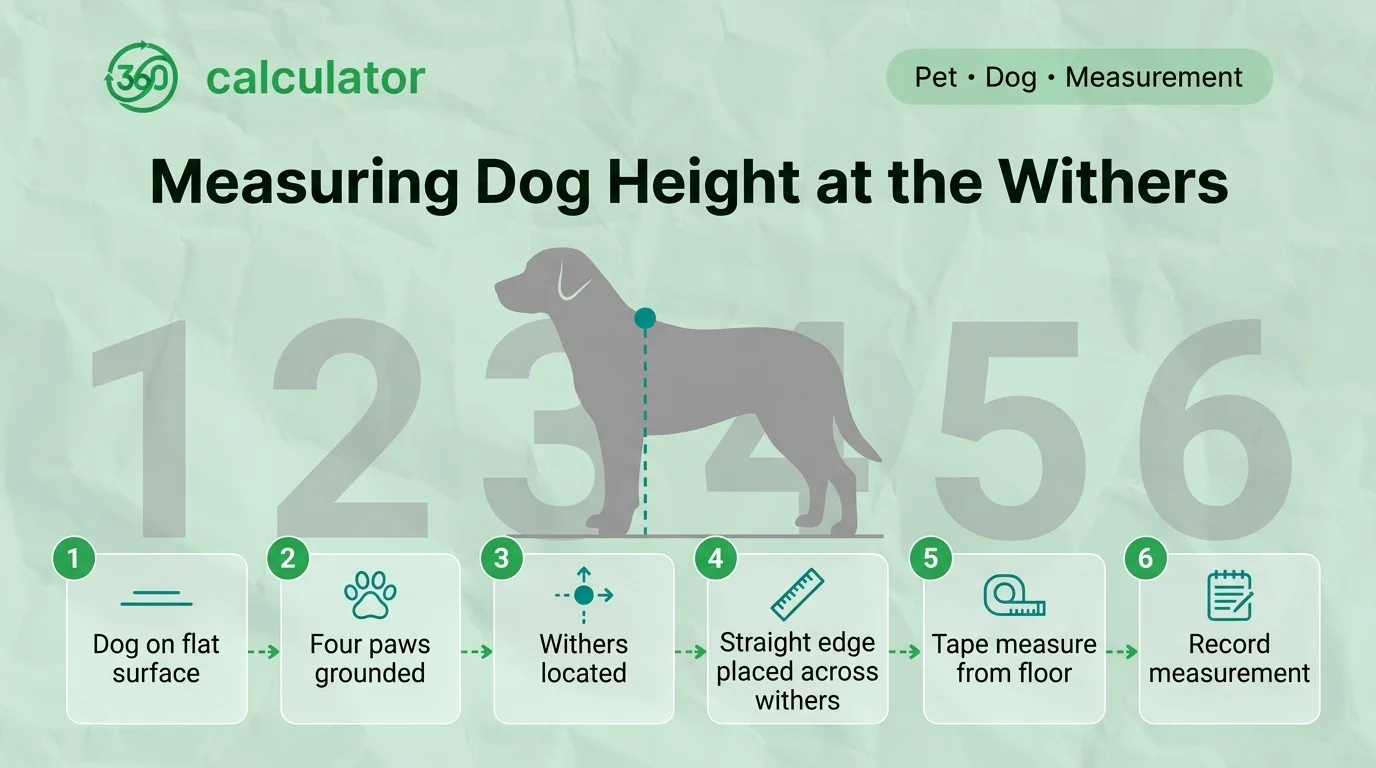
Measure a dog's height at the withers by taking a vertical measurement from the floor to the highest point of the shoulders. The American Kennel Club (AKC) defines the withers as the highest point of a dog's shoulders. Do not measure to the top of the head, ears, or tail.
Steps:
1. Place your dog on a flat, level surface.
2. Make sure your dog is standing naturally with all four feet flat on the ground.
3. Find the withers, which are the highest point of the shoulders.
4. Place a ruler, book, or other straight edge flat across the withers.
5. Measure the vertical distance from the floor to the bottom of the straight edge with a tape measure.
6. Record the measurement as your dog's shoulder height.
Source: The American Kennel Club defines the withers as the highest point of a dog's shoulders and uses this point as the standard reference for measuring height.
What Equipment Can You Use to Measure Dog Height at Home?
Equipment to measure dog height at home includes a few simple tools that help you measure the height from the floor to the withers accurately.
Simple Tools:
Rigid ruler or yardstick to mark the height at the withers.
Tape measure to measure the distance from the floor to the marked height.
Level to keep the ruler straight and parallel to the floor.
Wall or other vertical surface to provide a stable reference while measuring.
A wicket for professional or dog show height measurements. The American Kennel Club (AKC) identifies a wicket as a device used to measure a dog's height at the withers
Source: American Kennel Club Glossary. The AKC defines a wicket as a device used to measure a dog's height at the withers.
How Should Your Dog Stand During a Height Measurement?
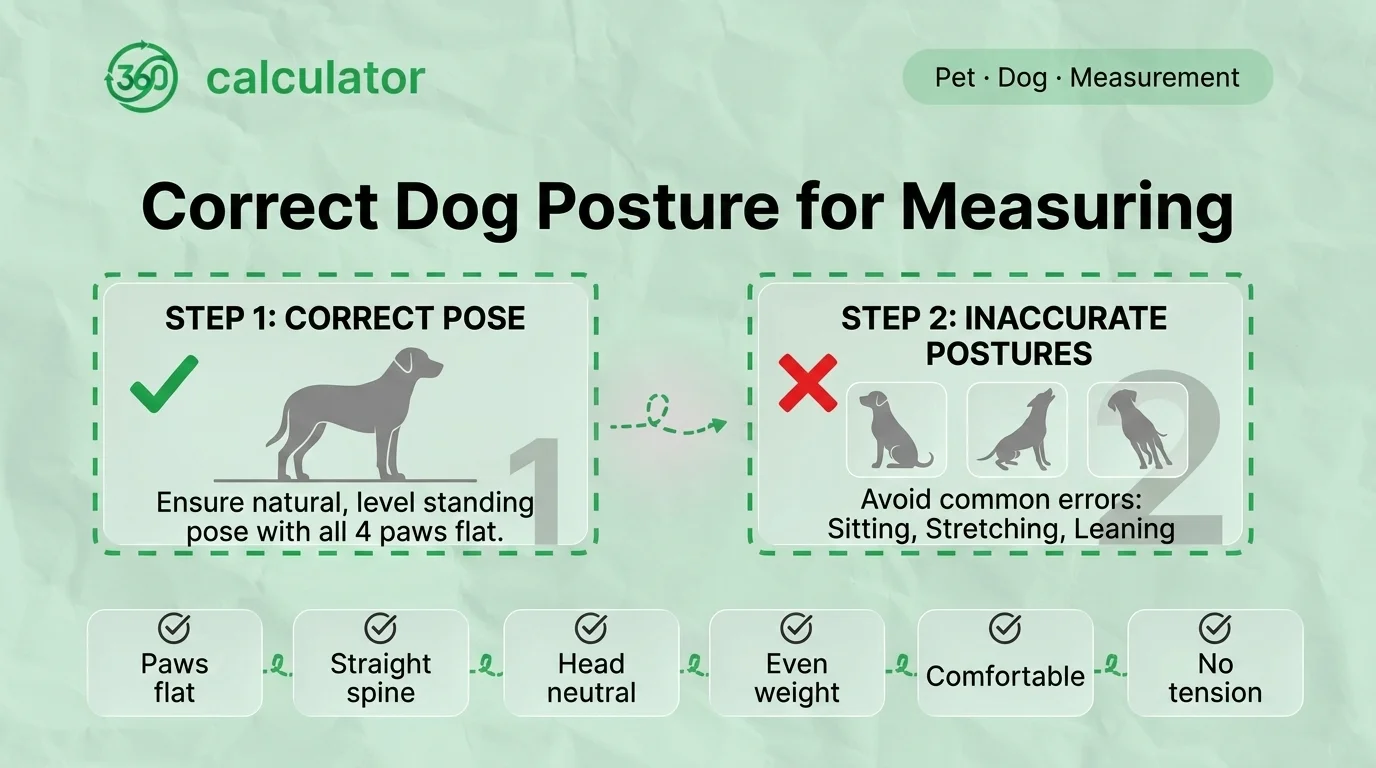
Your dog should stand naturally during a height measurement, with all four paws on a level, stable surface. Keep the dog's head and body in a normal position rather than asking it to stretch upward. The measurement is taken from the floor to the withers, the highest point of the shoulders. Sitting, leaning, stretching, or standing on uneven ground changes the dog's position and may affect the measurement.
Use this checklist before measuring:
☐ All four paws are on the ground.
☐ The dog is standing naturally.
☐ The surface is level and stable.
☐ The dog is not sitting, leaning, or stretching upward.
☐ The measurement is taken to the withers, not the head, ears, or tail.
☐ The measuring tool is held vertically from the floor to the withers.
What Measurement Mistakes Can Change the Result?
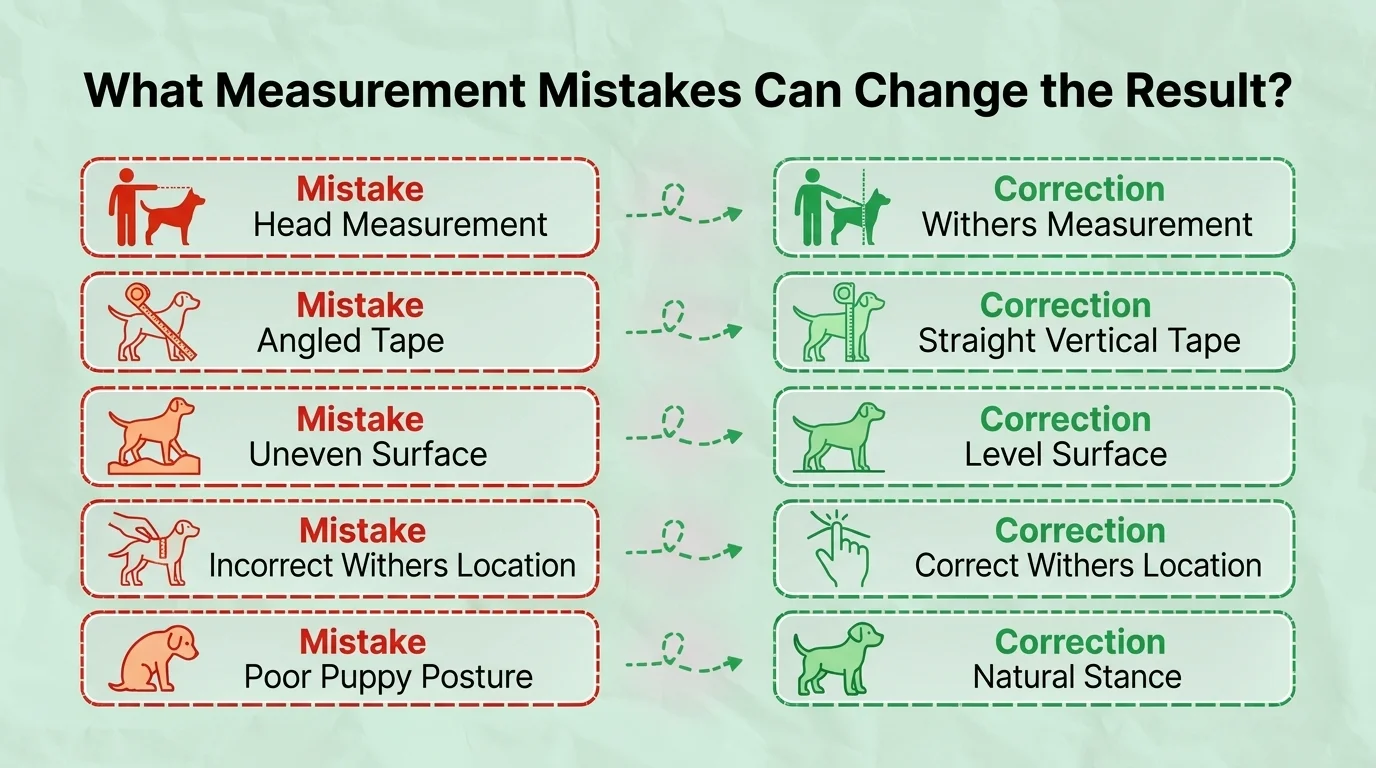
Measurement mistakes can change a dog's recorded height and make the result different from the dog's true shoulder height. The correct measurement runs from the level floor to the withers. Small changes in the dog's position or measuring tool also affect the result.
The table below shows common height measurement errors and their corrections.
Error | Correction |
Measuring to head | Measure the highest point of the shoulders, called the withers. |
Using an angled tape | Keep the measuring tool straight and vertical. |
Measuring on an uneven surface | Place the dog on a level, stable surface. |
Finding the wrong withers location | Identify the highest point of the shoulders before measuring. |
Poor posture | Keep the dog standing naturally with all four paws on the ground. |
A measured value comes from a correct measurement. A value affected by one of these errors is a bad measurement, so it does not accurately represent the dog's shoulder height.
How Does the Calculator Estimate a Puppy’s Adult Height?
The calculator estimates a baby's adult height by combining the information you enter with a growth model. The exact calculation depends on the calculator. Different calculators use different methods, so there is no single formula that every calculator follows.
Information such as age, current height, and other available inputs helps the calculator compare the child's current growth with expected growth patterns to estimate an adult height range rather than one exact height.
The table below shows the common information used to estimate adult height.
Information | How It Helps |
Age | Shows the child’s stage of growth. |
Current height | Provides the child’s present height. |
Sex | Matches the child with the appropriate growth pattern. |
Parents’ heights | Adds genetic information when available. |
Growth information | Compares the child’s growth with established growth patterns to estimate an adult height range. |
Why Does the Calculator Show a Height Range Instead of One Number?
The calculator shows a height range because a puppy's final adult height cannot be known with complete certainty. Dogs of the same breed may reach different adult heights because individual growth varies. Mixed-breed dogs are often harder to predict because their genetic background includes more than one breed. A range gives a more realistic estimate than presenting one height as a guaranteed result. According to PetMD, the adult size cannot be known with certainty and predicting the size of mixed-breed dogs is more complicated.
The table below shows why a height range is useful.
Factor | Effect on the estimate |
Individual variation | Dogs of the same breed may reach different adult heights . |
Breed | Provides a general guide to expected adult size. |
Mixed ancestry | Makes adult height more difficult to predict. |
Growth difference | Puppies do not all grow at the same rate. |
How Accurate Is a Dog Height Calculator?
A dog height calculator is more reliable for recording an actual measured height than predicting a puppy's final adult height. A measured adult height comes directly from the dog's height at the withers, while a puppy's adult height is an estimate based on information such as age, current height, breed, size, and other available details. The quality of these inputs affects the estimate.
According to PetMD, a puppy's final adult size cannot be known with complete certainty, and mixed-breed dogs are more difficult to predict because of their varied genetic background. For this reason, a calculator is best used as a height estimate or range, not as a guaranteed final measurement. Different calculators may also produce different results because they use different inputs or calculation methods.
The table below shows the difference between measured height and predicted height.
Type of result | What it means |
Measured adult height | The dog’s actual height is measured at the withers. |
Predicted puppy height | An estimate of the dog’s expected adult height. |
Height range | A more realistic result that allows for normal differences in growth. |
How Does Breed Size Change the Puppy Growth Timeline?
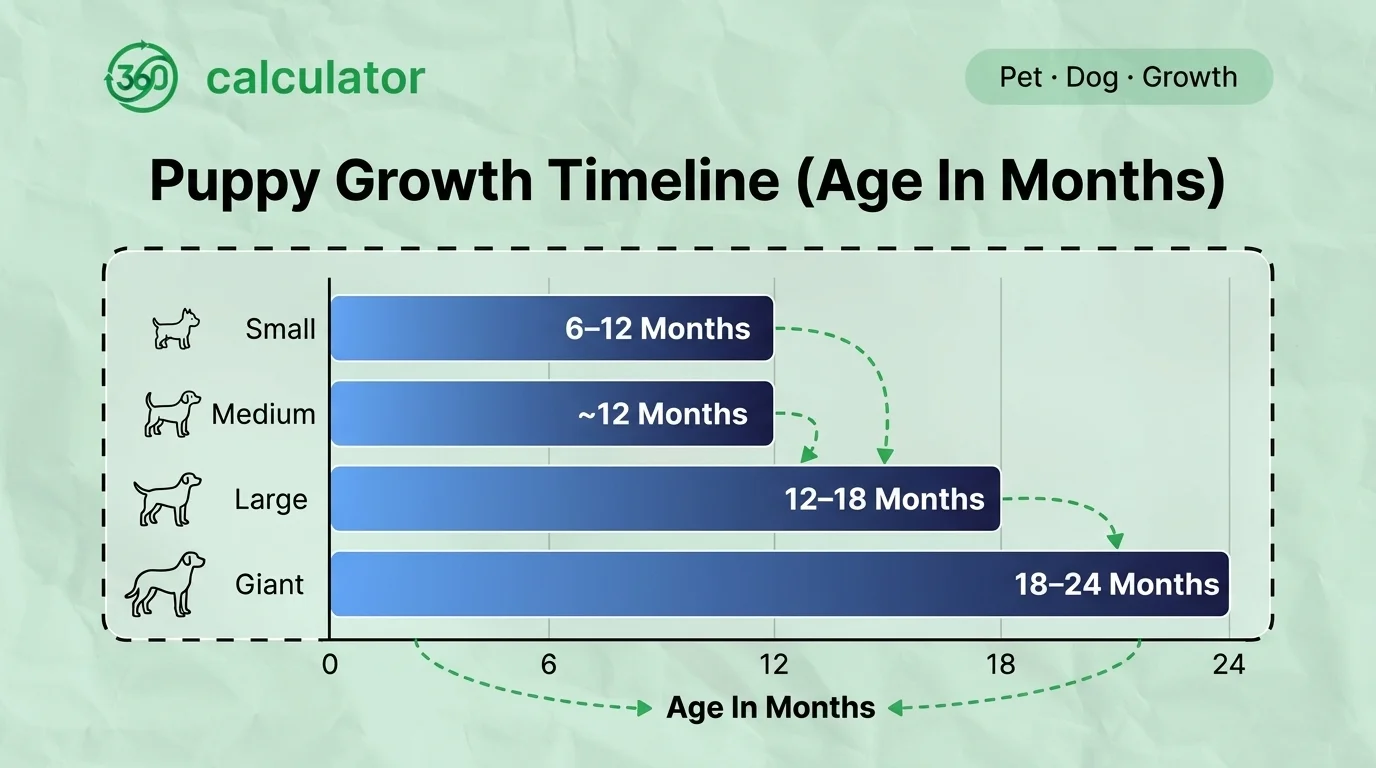
Breed size changes the puppy growth timeline because smaller dogs generally reach adult size earlier, while large and giant breeds continue growing for longer. According to AKC, small breeds may reach maturity around 6 to 12 months, while large and giant breeds may continue growing until 18 to 24 months. VCA gives a similar pattern, noting that growth varies by breed and expected adult size.
The calculator uses this difference in growth duration when estimating a puppy's adult height. A puppy's age therefore has different meanings depending on its expected adult size.
Table: Puppy Growth Timeline by Size Group
Size group | General growth pattern |
Small | Usually reaches adult size earlier |
Medium | Usually reaches adult size around the first year |
Large | Often continues growing beyond one year |
Giant | May continue growing up to 18 to 24 months |
According to AKC and VCA, these are general patterns, not fixed rules for every individual dog.
How Can You Track Your Puppy’s Height as It Grows?
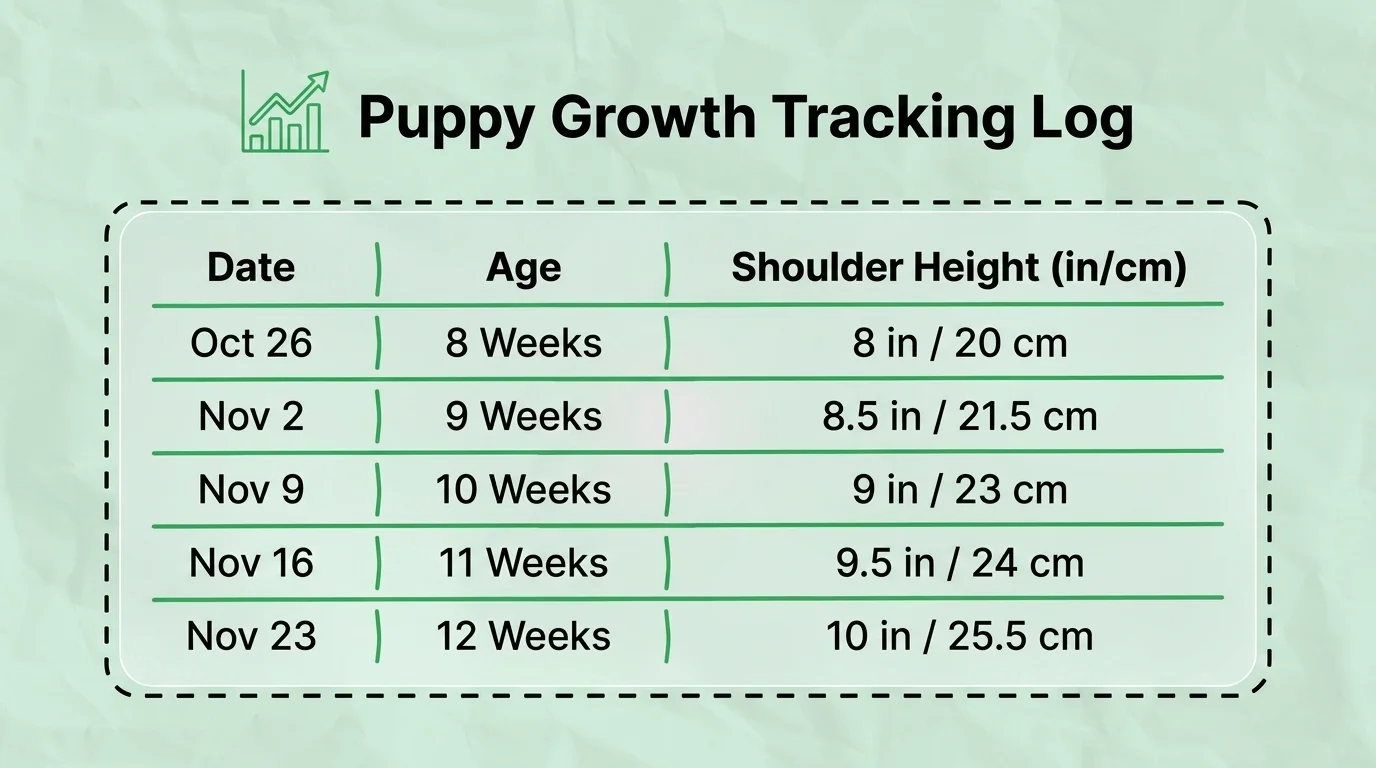
Track your puppy's height by measuring from the floor to the withers using the same method each time. Record the puppy's age and height after each measurement. According to the AKC, tracking puppy growth over time helps you follow development. The purpose is to observe the puppy's growth pattern rather than treat each measurement as a new adult height prediction.
How Should You Interpret Your Dog’s Estimated Adult Height?
Your dog’s estimated adult height is a prediction, not an exact final measurement. Interpret it based on the dog’s breed, age, current height, and growth stage. Since puppies grow at different rates, the estimate may change as you record new measurements over time.
Use the result as a general guide to your dog’s expected size, rather than a fixed number. For more answers about your dog’s size and growth, explore related Pet Calculator tools.
How Can You Estimate Your Puppy’s Adult Weight?
You can estimate your puppy’s adult weight using its age, current weight, breed or expected size, and growth information. These factors help predict your puppy’s likely weight when fully grown, but the result is only an estimate.
To get a personalized estimate based on your puppy’s details, you can check the Puppy Weight Calculator.
How Can You Check Your Dog’s Weight Against Its Height?
Your dog’s weight and height measure different aspects of body size, so one cannot directly replace the other. Height shows how tall your dog is, while weight shows how heavy it is. Comparing both can give you a better picture of your dog’s overall size.
For a more specific comparison, the Dog Weight and Height Calculator can give related information.
How Can You Estimate Your Dog’s Adult Size?
Your dog’s expected adult size depends on a combination of height, weight, breed, age, and growth stage. Looking at these factors together gives you a more useful estimate than relying on height or weight alone.
For a broader estimate of your dog’s expected adult size, Dog Size Calculator is helpful to find a dog's adult size.
How Do You Choose the Right Crate Size for Your Dog?
The right crate size is based on your dog’s body measurements, especially its length and height. These measurements help determine the crate dimensions your dog needs for a suitable fit.
For the detailed measurements and sizing calculation, you can visit the Dog Crate Size Calculator.
How Can You Estimate Your Dog’s Age From Its Life Stage?
A dog’s life stage can give you a general idea of its age, but life stage and chronological age are not the same. Puppy growth stages can help indicate whether a dog is young, while the exact age is better estimated using age-specific information.
For a more specific age estimate, the Dog Age Calculator is effective.
FAQs
What does a dog height calculator measure?
A dog height calculator measures a dog's current shoulder height and estimates a puppy's adult height. Height is measured at the withers, the highest point of the shoulders, which is the standard reference used in official breed standards.
How do you measure a dog's height at the withers?
Place the dog on a flat, level surface with all four feet grounded, locate the withers, place a straight edge flat across them, then measure the vertical distance from the floor to the bottom of the straight edge with a tape measure.
What information does the calculator need to estimate a puppy's adult height?
Most calculators use age, current height if available, breed or size group, current weight if the calculator uses it, and parent information when available. Each detail helps improve the accuracy of the adult height estimate.
Why does the calculator show a height range instead of one exact number?
A puppy's final adult height cannot be known with complete certainty because individual dogs of the same breed grow at different rates, and mixed-breed dogs are especially hard to predict due to their varied genetic background. A range gives a more realistic estimate than one guaranteed number.
How does breed size affect a puppy's growth timeline?
Smaller breeds generally reach adult size earlier, often around 6 to 12 months, while large and giant breeds continue growing for longer, sometimes up to 18 to 24 months, so the same age can represent different growth stages depending on expected adult size.