The ml to cups conversion calculator turns a milliliter value into cups in a single step. Enter a number into the calculator above and the result appears immediately, so there is no need to work through the math by hand.
The rest of this page covers the conversion formula, how many milliliters make up a cup under different measurement standards, the most commonly searched ml amounts, and the mistakes people run into when converting between the two units.
How Do You Convert Milliliters to Cups?
Converting milliliters to cups is a division problem. The milliliter value is divided by the number of milliliters in one cup, and the result is the equivalent in cups. Going the other direction works the same way in reverse: a cup value is multiplied by the number of milliliters in one cup. The sections below walk through the formula, the exact ml value of a cup under each standard, and why that value is not the same everywhere.
What Is the Formula for Converting ML to Cups?
The formula is: cups = milliliters ÷ milliliters per cup. Using the US customary cup, which equals 236.588 ml, the formula becomes cups = milliliters ÷ 236.588.
For example, to convert 500 ml to US cups: 500 ÷ 236.588 = 2.113 cups. Keeping the full decimal before rounding matters here, because rounding the conversion factor itself, for instance using 240 instead of 236.588, produces a result that drifts further from the correct answer as the ml amount gets larger.
How Many ML Are in One Cup?
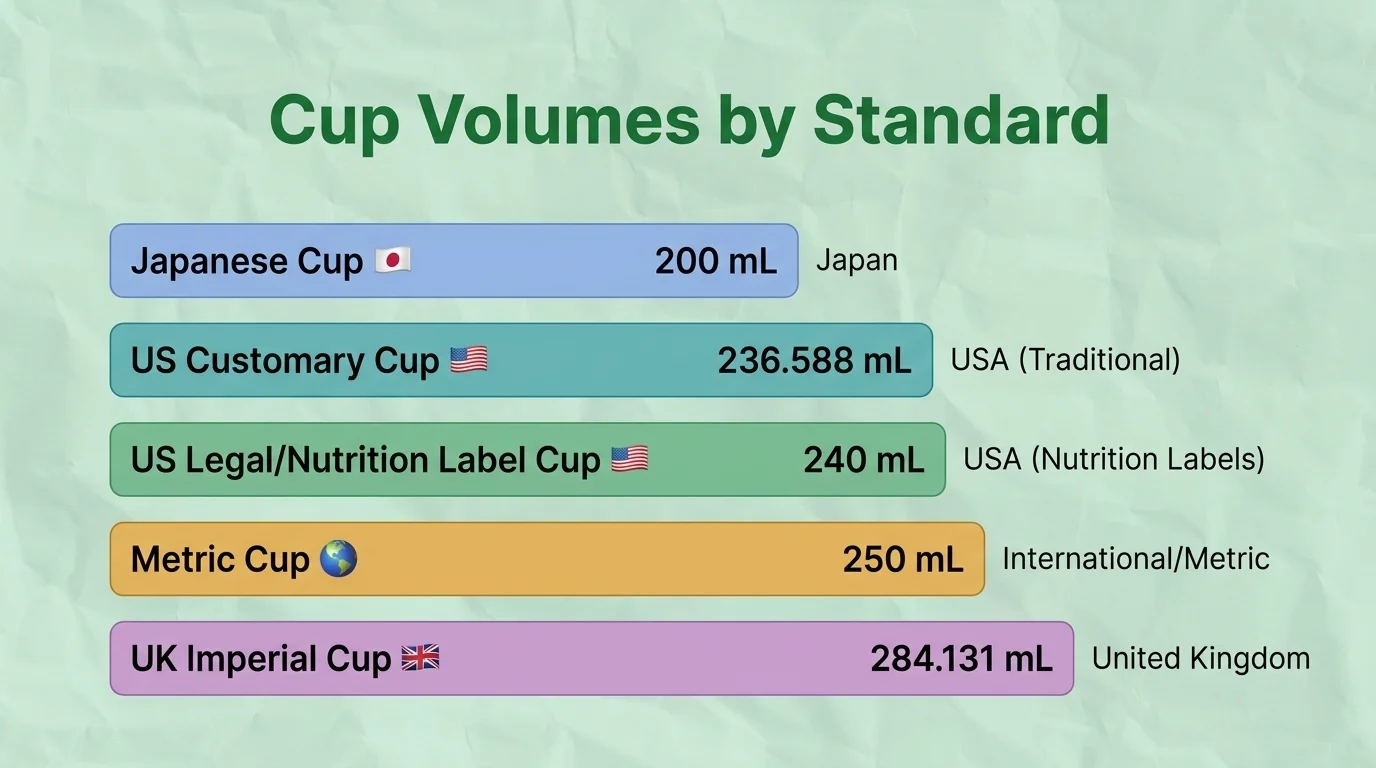
There is no single worldwide answer to this question. The ml value of one cup depends on which standard is being used, as shown below.
Cup Standard | ML per Cup |
US customary cup | 236.588 ml |
US legal (nutrition label) cup | 240 ml |
Metric cup | 250 ml |
UK imperial cup | 284.131 ml |
Japanese cup | 200 ml |
Why Do US, Metric, Imperial, and Japanese Cup Sizes Differ?
The cup is a household measure, not an internationally standardized unit like the milliliter. The US customary system descends from older English units, while most other countries adopted the metric system, which defines a cup as 250 ml for convenience. The UK imperial cup comes from a separate pre-metric British system, and Japan uses its own 200 ml standard. Because each system developed independently, the cup value was never unified the way the milliliter was.
How Many Cups Are Common ML Amounts?
Some ml amounts come up far more often than others, whether from a recipe, a bottle label, or a medicine dropper. All results below use the US customary cup unless a metric cup value is given separately.
How Many Cups Is 100 ML, 250 ML, and 500 ML?

Is 250 ml the same as 1 cup? Not exactly. 250 ml is exactly 1 metric cup, but it is slightly more than 1 US customary cup, which equals about 236.6 ml. So 250 ml works out to roughly 1.06 US cups.
Is 500 ml 1 cup or 2 cups? 500 ml is close to 2 cups. In US customary cups it equals about 2.11 cups, and in metric cups it equals exactly 2 cups.
100 ml converts to about 0.42 US cups, which is close to but not exactly two fifths of a cup.
ML | US Cups | Metric Cups |
100 ml | 0.42 cups | 0.40 cups |
250 ml | 1.06 cups | 1.00 cup |
500 ml | 2.11 cups | 2.00 cups |
How Many Cups Is 1 ML, 5 ML, 10 ML, or 50 ML?

At the smaller end of the scale, 1 ml equals about 0.004 cups, 5 ml equals about 0.021 cups, 10 ml equals about 0.042 cups, and 50 ml equals about 0.21 cups. These amounts usually come from medicine droppers, oral syringes, or supplement labels rather than recipes, so a cup is rarely the practical tool for measuring them. A calibrated dropper, syringe, or measuring spoon gives a far more accurate result at this scale.
ML | US Cups |
1 ml | 0.004 cups |
5 ml | 0.021 cups |
10 ml | 0.042 cups |
25 ml | 0.106 cups |
50 ml | 0.211 cups |
How Many Cups Is 750 ML and 1000 ML?
750 ml, the size of a standard wine bottle, equals about 3.17 US cups. 1000 ml, or 1 liter, equals about 4.23 US cups, or exactly 4 metric cups. These larger volumes are common on milk cartons, water bottles, and beverage jugs, where the label is often the starting point rather than a recipe.
ML | US Cups | Metric Cups |
750 ml | 3.17 cups | 3.00 cups |
1000 ml (1 liter) | 4.23 cups | 4.00 cups |
What Mistakes Do People Make When Converting ML to Cups?

A few specific errors come up repeatedly when people convert between ml and cups.
Common Mistake | Correct Approach |
Using 240 as the ml-per-cup value for every calculation | Use 236.588 for a US customary cup, and reserve 240 for US nutrition label figures specifically |
Rounding the conversion factor before dividing | Divide using the full decimal, then round only the final result |
Multiplying instead of dividing when converting ml to cups | Divide ml by the ml-per-cup value; multiply only when converting cups back to ml |
Misplacing the decimal point on the result | Check that the answer is a reasonable size, a 1000 ml bottle should be about 4 cups, not 42 |
Assuming 1 cup always equals 250 ml | Confirm which cup standard the recipe or label is using before converting |
Confusing cups with fluid ounces, for example treating half a cup as 5 fluid ounces | Remember that 1 cup equals 8 fluid ounces, so half a cup equals 4 fluid ounces |
How Can You Measure ML Without a Measuring Cup?

A measuring cup with ml markings is not always on hand. A few substitutes work reasonably well:
● A teaspoon holds about 5 ml, and a tablespoon holds about 15 ml, which is enough for small liquid amounts.
● A standard drinking glass holds about 240 to 250 ml when full, and about half that when filled halfway.
● A kitchen scale can be used for water specifically, since 1 gram of water equals 1 ml. This shortcut does not hold for thicker liquids such as oil or honey, since their density is different from water.
● An empty bottle or container with a known volume printed on the label can also be used as a rough measure.
How Accurate Do You Need to Be When Measuring in Cups?
How much precision matters depends on what is being measured. For liquids such as water, milk, or stock, small rounding differences between cup standards rarely change the outcome of a recipe. For baking that depends on precise hydration, such as bread dough or delicate cakes, the same 5 to 10 percent gap between a US cup and a metric cup can noticeably change the result. This is part of why many bakers weigh dry ingredients instead of measuring them by volume, since a gram of flour is the same regardless of how it settles in a cup.
What Other Measurement Conversions Do You Need When Cooking with Cups and Milliliters?
Once ml and cups are lined up, most recipes still involve a few other units, including grams, tablespoons, teaspoons, fluid ounces, and liters. The sections below cover each of these in the specific context of converting to or from cups.
How Do You Convert Grams to Cups for Flour and Sugar?
Grams measure weight while cups measure volume, so unlike ml to cups, which is a fixed ratio, converting grams to cups depends on the density of the ingredient. A cup of flour weighs less than a cup of sugar, because flour is lighter and less tightly packed. Rather than listing every ingredient weight here, the grams to cups conversion calculator gives exact gram values for individual ingredients.
How Do You Convert Cups to Tablespoons and Teaspoons?
After converting ml to cups, the next step is often portioning that amount with spoons. One cup equals 16 tablespoons, and one tablespoon equals 3 teaspoons. For a full breakdown of fractional cups, such as a third or two thirds of a cup, in tablespoons, the cups to tablespoons conversion calculator covers each fraction individually.
How Do You Convert ML to Tablespoons and Teaspoons Directly?
Some recipes list small liquid amounts directly in milliliters rather than cups, which makes it faster to convert straight to spoons instead of going through cups first. One tablespoon is about 15 ml, and one teaspoon is about 5 ml. The ml to tablespoons and teaspoons conversion calculator handles this direct route for smaller quantities.
How Do You Convert Cups to Fluid Ounces?
One US cup equals 8 fluid ounces, so any cup amount converts to fluid ounces by multiplying by 8. Half a cup equals 4 fluid ounces, not 5, which is where this conversion is most often mixed up. The cups to ounces conversion calculator includes the full fluid ounce table across other volumes as well.
How Do You Convert Liters to Cups for Larger Volumes?
For bottles, jugs, or batch recipes measured in liters rather than milliliters, the same logic applies at a larger scale, since 1 liter equals 1000 ml. One liter works out to about 4.23 US cups, or exactly 4 metric cups. The liters to cups conversion calculator covers gallons and quarts as well for even larger volumes.
How Do You Scale a Recipe That Uses Cup Measurements?
Scaling a recipe up or down means multiplying every ingredient by the same factor, which is easier once all the amounts are in consistent units such as ml or grams. The recipe serving size scaler recalculates a full ingredient list automatically once the target number of servings is entered.
How Does a Cup Compare to Pints, Quarts, and Gallons?
One cup equals 0.5 pint, 0.25 quart, and 0.0625 gallon in the US customary system. These relationships come up when a recipe or container is labeled in a larger unit than cups. The volume converter covers the full chart across pints, quarts, gallons, liters, and fluid ounces.
How Do You Convert Milk, Oil, and Water Measurements Between ML and Cups?
Because ml and cups both measure volume, the conversion ratio is the same for water, milk, or any other liquid, unlike the grams to cups conversion, where density changes the answer for each ingredient. A full glass estimate of about 240 to 250 ml applies reasonably well to water and milk, but not to thicker liquids such as honey or condensed milk, where volume and pour behavior differ. The cooking measurement converter covers ingredient specific conversions beyond ml and cups.