
A nursing dosage calculation conversion chart is a reference tool nursing students and nurses use to convert measurement units and calculate a medication dose accurately. Nursing students use it while studying and testing, and working nurses use it during medication administration to avoid a units mismatch. This page covers the metric prefix scale, the weight, volume, length, and temperature conversion factors, apothecary and household units, common nursing abbreviations, the three calculation methods (dimensional analysis, ratio and proportion, and desired over have), IV drip rate and drop factor, milliequivalent conversion, the rounding rules, and the most common calculation mistakes, including decimal point errors, mg and mcg confusion, and rounding too early.
What Units Does a Nursing Dosage Calculation Conversion Chart Cover?
A nursing dosage calculation conversion chart covers 6 unit categories: metric prefixes, weight, volume, length, temperature, and apothecary and household units. The metric system serves as the primary system in modern nursing, since most drug labels and IV orders use grams, milligrams, micrograms, milliliters, and liters. Apothecary and household units still appear on some drug labels and in home care instructions, so nurses recognize them without relying on them for daily calculations.
What Is the Metric Prefix System Used in Nursing Conversions?

The metric prefix system used in nursing conversions has 7 levels, from largest to smallest: kilo, hecto, deca, base unit, deci, centi, and milli.
1. Kilo, equal to 1000 times the base unit
2. Hecto, equal to 100 times the base unit
3. Deca, equal to 10 times the base unit
4. Base unit
5. Deci, equal to 0.1 times the base unit
6. Centi, equal to 0.01 times the base unit
7. Milli, equal to 0.001 times the base unit
Hecto and deca rarely appear in nursing practice, they exist mainly to complete the scale. Nursing students use the memory aid King Henry Died Unusually Drinking Chocolate Milk to hold the order, standing for kilo, hecto, deca, base, deci, centi, and milli. The shortcut moves the decimal point 3 places when converting between kilo, base, and milli.
What Is the Weight Conversion Chart for Nursing Dosage Calculations?
The weight conversion chart for nursing dosage calculations lists 6 unit pairs and their exact equivalent. The table below states each unit on the left and its equivalent value on the right.
Unit | Exact Equivalent |
1 kilogram | 1000 grams and 2.2 pounds |
1 gram | 1000 milligrams |
1 milligram | 1000 micrograms |
1 pound | 16 ounces and 0.45 kilograms |
1 ounce | 28.35 grams |
1 grain | 60 milligrams |
A patient weighing 154 pounds converts to 70 kilograms, calculated as 154 divided by 2.2.
What Is the Volume Conversion Chart for Nursing Dosage Calculations?
The volume conversion chart for nursing dosage calculations lists 9 unit pairs and their exact equivalent. The table below states each unit on the left and its equivalent value on the right.
Unit | Exact Equivalent |
1 milliliter | 1 cubic centimeter |
1 liter | 1000 milliliters |
1 teaspoon | 5 milliliters |
1 tablespoon | 15 milliliters and 3 teaspoons |
1 fluid ounce | 30 milliliters |
1 cup | 240 milliliters and 8 fluid ounces |
1 pint | 480 milliliters and 2 cups |
1 quart | 946 milliliters and 32 fluid ounces |
1 gallon | 3840 milliliters and 4 quarts |
Some references round the quart to 960 milliliters, a rounding difference rather than a separate correct value. A fluid intake of 6 fluid ounces converts to 180 milliliters, calculated as 6 multiplied by 30.
What Is the Length Conversion Chart Used in Nursing?
The length conversion chart used in nursing states 2 factors: 1 inch equals 2.54 centimeters and 1 foot equals 30 centimeters.
Unit | Exact Equivalent |
1 inch | 2.54 centimeters |
1 foot | 30 centimeters |
Nurses use these length conversions mainly for wound measurement and pediatric growth tracking, not for dose calculation itself.
What Is the Temperature Conversion Formula Used in Nursing Practice?
The temperature conversion formula used in nursing practice converts Celsius to Fahrenheit as (C multiplied by 9/5) plus 32, and Fahrenheit to Celsius as (F minus 32) multiplied by 5/9. Nurses convert temperature to match a thermometer reading against a chart or reference that uses the other scale.
37 degrees Celsius converts to 98.6 degrees Fahrenheit, calculated as (37 multiplied by 9/5) plus 32.
What Apothecary and Household Units Still Appear on a Nursing Conversion Chart?
The apothecary system, grain, minim, and dram, is mostly retired but still appears on a small number of older drug labels, including aspirin and some thyroid medications. Nursing references commonly round the grain to 60 milligrams for quick conversion, an approximation, since the precise chemical equivalent is closer to 64.8 milligrams. Nurses do not memorize the full apothecary system, they only recognize a grain measurement and convert it when it appears. The household system, teaspoon, tablespoon, and cup, is the version patients use at home.
Many nursing students find this topic confusing. It stays a small and shrinking part of practice, so recognizing the few remaining units matters more than memorizing the full historical system.
Unit | Metric Equivalent |
1 grain (apothecary) | 60 milligrams (approximate) |
1 teaspoon (household) | 5 milliliters |
1 tablespoon (household) | 15 milliliters |
1 cup (household) | 240 milliliters |
What Do Common Nursing Abbreviations on a Conversion Chart Mean?

Common nursing abbreviations on a conversion chart fall into 4 groups: frequency, route and order, eye and ear, and rate. The table below lists the abbreviations in each group and their meaning.
Category | Abbreviations and Meaning |
Frequency | QD (once daily), BID (twice daily), TID (three times daily), QID (four times daily), HS (at bedtime), PRN (as needed), AC (before meals), PC (after meals) |
Route and order | IVP (IV push), IVPB (IV piggyback), VO (verbal order), TO (telephone order) |
Eye and ear | OD (right eye), OS (left eye), OU (both eyes), AD (right ear), AS (left ear), AU (both ears) |
Rate | mL/hr (milliliters per hour), gtt/min (drops per minute), mg/kg/day (milligrams per kilogram per day), gtt/mL (drops per milliliter, the tubing drop factor) |
The abbreviation gtt comes from the Latin word for drop, gutta, which is why it stands in for the word drop itself.
How Do You Use a Conversion Chart to Calculate a Nursing Dosage?
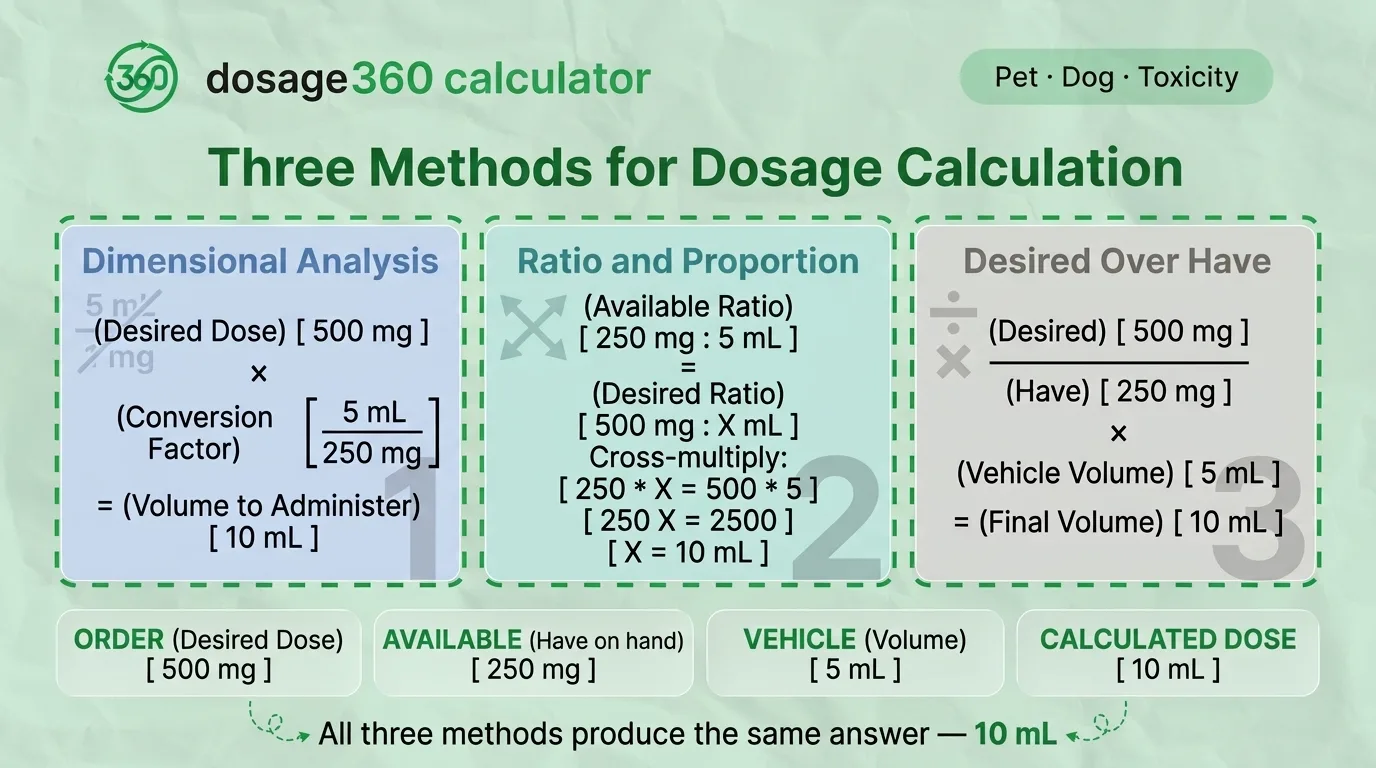
A nurse uses a conversion chart with 3 standard calculation methods: dimensional analysis, ratio and proportion, and the desired over have formula. All three methods produce the same answer. A nurse typically picks one method for the initial calculation and uses a second method to double check a high-risk dose.
What Are the Different Types of Nursing Dosage Calculations by Medication Form?
Nursing dosage calculations fall into 5 categories by medication form: solid oral medication, liquid oral medication, injectable medication, weight-based dosing, and IV infusion rate.
• Solid oral medication resolves to a number of tablets
• Liquid oral medication resolves to a volume in milliliters
• Injectable medication resolves to a volume in milliliters
• Weight-based dosing resolves to milligrams or milliliters based on patient weight
• IV infusion rate resolves to milliliters per hour or drops per minute
What Is the Dimensional Analysis Method for Nursing Dosage Calculation?
Dimensional analysis arranges units in a fraction so they cancel out until only the wanted unit remains. For an order of 500 milligrams with a label reading 250 milligrams per 5 milliliters, the units cancel to leave 10 milliliters as the amount to give. Dimensional analysis stands as the method taught most commonly today, since it reduces the chance of a units mismatch.
What Is the Ratio and Proportion Method for Nursing Dosage Calculation?
The ratio and proportion method compares two ratios, have to want, and solves the unknown by cross multiplication. Using the same order, 250 milligrams over 5 milliliters equals 500 milligrams over an unknown volume, and cross multiplication again gives 10 milliliters. Ratio and proportion stands as one of the oldest dosage calculation methods still taught.
What Is the Desired Over Have Formula Method for Nursing Dosage Calculation?
The desired over have formula divides the desired dose by the have dose, then multiplies the result by the quantity, to equal the amount to give. Using the same order, 500 milligrams divided by 250 milligrams, multiplied by 5 milliliters, again gives 10 milliliters. Some nursing programs discourage this method for complex problems, since it can raise the chance of error compared with dimensional analysis, though this varies by program rather than standing as a universal rule.
How Do You Calculate IV Drip Rate Using a Nursing Conversion Chart?

IV drip rate in drops per minute equals the volume in milliliters multiplied by the drop factor in drops per milliliter, divided by the time in minutes. Infusion pumps instead use the milliliters per hour formula, volume divided by time in hours. Macrodrip tubing carries a drop factor of 10, 12, 15, 18, or 20 drops per milliliter depending on the manufacturer label, and microdrip tubing carries a fixed drop factor of 60 drops per milliliter, used for pediatric or precise dosing.
An order for 1000 milliliters over 8 hours with a drop factor of 15 gives a rate of 125 milliliters per hour, and a drip rate of 31 drops per minute, calculated as 1000 multiplied by 15, divided by 480 minutes.
How Do You Convert Milliequivalents in a Nursing Dosage Calculation?
A milliequivalent measures the amount of an electrolyte, such as potassium chloride, present in a solution. A milliequivalent value cannot convert directly into milligrams or milliliters without knowing the drug's specific concentration in milliequivalents per milliliter.
An order for 40 milliequivalents of potassium chloride, at a concentration of 2 milliequivalents per milliliter, gives a volume of 20 milliliters, calculated with the ratio and proportion method.
What Are the Rounding Rules for Nursing Dosage Calculations?
Nursing dosage calculations round doses under 1.0 to the nearest hundredth, round doses of 1.0 or greater to the nearest tenth, and round drops per minute to the nearest whole number, since a partial drop cannot be given. The safety rule states plainly, never round an intermediate step, only round the final answer.
What Are the Most Common Mistakes When Using a Nursing Dosage Conversion Chart?
Unit conversion stands as one of the most common places nursing students lose points on dosage exams, according to a retrospective study published in BMC Nursing. The 3 mistakes covered below account for a large share of these lost points.
How Does a Misplaced Decimal Point Cause a Tenfold Dosing Error?
Moving a decimal point one place changes a dose by a factor of 10. Writing or reading 0.5 milligrams as 5 milligrams delivers 10 times the intended dose. Writing out every conversion step in full, instead of doing the math mentally, guards against this error.
Why Does Confusing Mg and Mcg Lead to a Dangerous Dosing Error?

Confusing milligrams and micrograms produces an error 1000 times larger than intended, since 1 milligram equals 1000 micrograms, a bigger gap than a simple decimal shift. Clinical documentation always spells out mcg instead of using the Greek micro symbol, specifically to prevent this kind of misreading.
Why Is Rounding Too Early in a Nursing Calculation a Risk?
Rounding a weight conversion, then rounding a daily total, then rounding a single dose compounds small errors into a meaningfully wrong final number. The safety rule carries extra decimal places through every step and rounds only the final answer, matching the rounding rule given earlier on this page.
Where Do Nursing Students Make the Most Dosage Calculation Errors, According to Research?
Nursing students answer basic single-step dose calculations correctly most of the time, but accuracy drops sharply on problems involving maximum concentration or dilution limits, based on a retrospective study of nursing exam papers published in BMC Nursing. A separate scoping review published by AHRQ PSNet adds that discomfort with math itself is a documented contributor to calculation errors, a factor separate from gaps in knowledge.
How Does a Nursing Dosage Conversion Chart Connect to Other Nursing Math and Dosing Tools?
The conversion chart above serves as the starting point for several more specific calculations nurses perform daily, and for the printable and practice resources many readers look for next. The sections below cover pediatric dosing, body surface area dosing, continuous IV infusion rates, insulin and heparin dosing, adult weight-based dosing, and downloadable practice resources.
What Is the Correct Formula for a Pediatric Mg to Kg Dosing Calculator?
Pediatric dosing multiplies a child's weight in kilograms by the ordered milligrams per kilogram. The weight and mg to mcg conversions already covered on this page feed directly into the Mg to Kg Pediatric Dosing Calculator, since both inputs come from the same conversion chart.
How Do You Calculate Body Surface Area for Pediatric Drug Dosing?
Some high potency drugs, especially chemotherapy agents, dose by body surface area instead of weight alone, and this method still relies on the same kilogram conversion covered earlier on this page. The Mosteller formula, used on the Body Surface Area to Pediatric Dose Calculator, combines height and weight into a single surface area value.
How Do You Calculate IV Drip Rate for a Continuous Infusion Drug?
Continuous weight-based drips extend the drops per minute formula covered earlier to a rate measured in micrograms per kilogram per minute, used for drugs such as pressors. This continuous infusion case is covered on the Volume to Drip Rate Calculator, which adds a rate over time component the basic conversion chart does not cover alone.
How Do You Convert Pounds to Kilograms for a Medical Calculation?
The pound to kilogram factor already given in the weight conversion table above answers most single conversion needs directly. This conversion comes up often enough on its own that the Pounds to Kilograms Calculator serves readers who only need that one number.
How Do You Convert Mcg to Mg for a Medication Dose?
The microgram to milligram factor already given above answers most medication dose conversions directly. This conversion runs especially error prone for small doses, such as certain hormones, which makes the Mcg to Mg Calculator worth using for that specific case.
How Do You Calculate a Weight-Based Insulin Dosage?
Insulin doses in units, not milligrams or micrograms, and units cannot convert into other systems, they only measure with an insulin syringe. This distinct measurement system makes the Weight to Insulin Dosage Calculator a dedicated page rather than an extension of the standard conversion chart.
How Do You Calculate a Weight-Based Heparin Dosage?
Heparin commonly follows a weight-based protocol with frequent lab-guided rate adjustments, making it one of the more complex weight-based drips nurses manage. Given the drug's high alert status, the Weight to Heparin Dosage Calculator covers this in full.
How Do You Apply the Same Weight-Based Formula to Adult Dosage Calculations?
The weight multiplied by dose per kilogram formula covered throughout this page applies beyond pediatric dosing, it also applies to select adult medications and to obese patient dosing, where actual weight compares against ideal body weight. These adult-specific cases are covered on the Weight to Dosage Calculator for Adults.
How Do You Practice Nursing Dosage Calculation Questions for the NCLEX?
NCLEX dosage questions test the same conversions and methods already covered on this nursing dosage calculation conversion chart. Repeated practice with the Practice NCLEX Dosage Calculation Questions stands as the standard way to reduce both errors and math anxiety before the exam.
Frequently Asked Questions
How Many Milliliters Are in a Tablespoon?
1 tablespoon equals 15 milliliters and 3 teaspoons.
Is 1 Ml the Same as 1 Cc?
Yes, 1 milliliter equals 1 cubic centimeter, the two units measure the same volume.
How Many Micrograms Are in a Milligram?
1 milligram equals 1000 micrograms.
What Is the Safest Way to Avoid a Decimal Point Error?
Writing out every conversion step in full, instead of calculating mentally, reduces the chance of a decimal point error.
Do All Three Dosage Calculation Methods Give the Same Answer?
Yes, dimensional analysis, ratio and proportion, and desired over have all produce the same correct dose when applied correctly.