
A binary to octal converter takes a number written in base 2 and returns its equivalent in base 8. This page covers how the conversion works using the grouping method, how to convert through decimal as an alternative, how to handle fractional binary numbers and large binary strings, and the mistakes people run into most often, along with a full reference table and worked examples.
What Is the Binary to Octal Conversion Process?
Binary uses base 2, which means only the digits 0 and 1 are available to represent a number. Octal uses base 8, which means eight digits, 0 through 7, are available. These two systems line up neatly because 8 is equal to 2 raised to the third power. That relationship is the reason binary to octal conversion works by splitting a binary number into groups of three digits rather than any other size. Once a number is grouped this way, each group can be read as a single octal digit without needing any other calculation in between.
What Is a Binary Number in the Base-2 System?
A binary number is written using only two symbols, 0 and 1. Each symbol in a binary number is called a bit, and its position determines how much it contributes to the overall value, since binary is a positional system just like decimal. The rightmost bit represents 2 to the power of 0, the next bit to the left represents 2 to the power of 1, and so on. This structure is why binary maps directly onto electronic circuits, since each bit corresponds to one of two physical states, off or on. A binary number such as 1011 is simply four bits arranged in this positional pattern.
What Is an Octal Number in the Base-8 System?
An octal number is written using eight symbols, the digits 0 through 7. It does not use 8 or 9 as digits, and it never needs letters the way hexadecimal does. Octal became useful early in computing because certain machines used word sizes that divided evenly into groups of three bits, such as 6-bit, 12-bit, 24-bit, and 36-bit systems. Modern computing has largely moved to hexadecimal since most systems use word sizes divisible by four instead, but octal is still encountered today, most commonly in Unix and Linux file permission codes such as 755.
Why Do Three Binary Digits Equal One Octal Digit?
The number 8 is equal to 2 cubed, meaning three binary digits can represent exactly the same range of values as one octal digit, 0 through 7. This is why grouping binary digits in sets of three, then converting each set separately, produces a correct and complete octal number without losing any information. The table below shows every possible 3-bit combination and the octal digit it corresponds to.
Binary Group | Octal Digit |
000 | 0 |
001 | 1 |
010 | 2 |
011 | 3 |
100 | 4 |
101 | 5 |
110 | 6 |
111 | 7 |
How Do You Convert Binary to Octal Step by Step?

The direct grouping method converts a binary number to octal without needing a decimal step in between. Take the binary number 110101011. Since it already has 9 digits, a clean multiple of three, it can be split straight into three groups: 110, 101, and 011. Each group is then converted individually using the 3-bit mapping above: 110 becomes 6, 101 becomes 5, and 011 becomes 3. Reading the results in the same order gives the final answer, 653. So 110101011 in binary equals 653 in octal.
How Do You Group Binary Digits Into Sets of Three?
Grouping always starts from the rightmost digit, since that is the ones place, and moves left from there. Using the same number, 110101011, the rightmost three digits form the first group, 011, the next three form the second group, 101, and the remaining three form the last group, 110. At this stage nothing has been converted yet, the number has simply been broken into three sets of three digits each: 110, 101, 011.
How Do You Convert Each Three-Digit Group Into an Octal Digit?

Each group can be converted using the 4-2-1 weighting method, where the three bit positions in a group carry the weights 4, 2, and 1 from left to right. Multiply each bit by its weight and add the results. For the group 110: 1 times 4, plus 1 times 2, plus 0 times 1, equals 6. For the group 101: 1 times 4, plus 0 times 2, plus 1 times 1, equals 5. For the group 011: 0 times 4, plus 1 times 2, plus 1 times 1, equals 3. Combining these in order gives 653, matching the result from the mapping table directly.
How Do You Add Leading Zeros When a Group Is Incomplete?

When the total number of binary digits is not divisible by three, the leftmost group ends up short. The fix is to add zeros to the left of that group, never the right, since adding zeros on the left does not change the value of the number. Take the binary number 11011100, which has 8 digits. Grouping from the right gives 100, then 011, then a leftover 11 on the left, which is only two digits. Adding one zero in front makes it 011. The full set of groups becomes 011, 011, 100, which convert to 3, 3, and 4. So 11011100 in binary equals 334 in octal.
Can You Convert Multiple Binary Numbers to Octal at Once?
Many converter tools accept more than one binary value in a single pass, usually separated by a space, comma, or line break, and return each octal result in the same order they were entered. This is useful when checking a batch of numbers from an assignment or a dataset rather than converting one value at a time. Most tools also place a practical limit on how long a single binary string can be, so an unusually long string may need to be split into smaller sections and converted separately before being combined back together.
What Is the Binary to Octal Conversion Table?
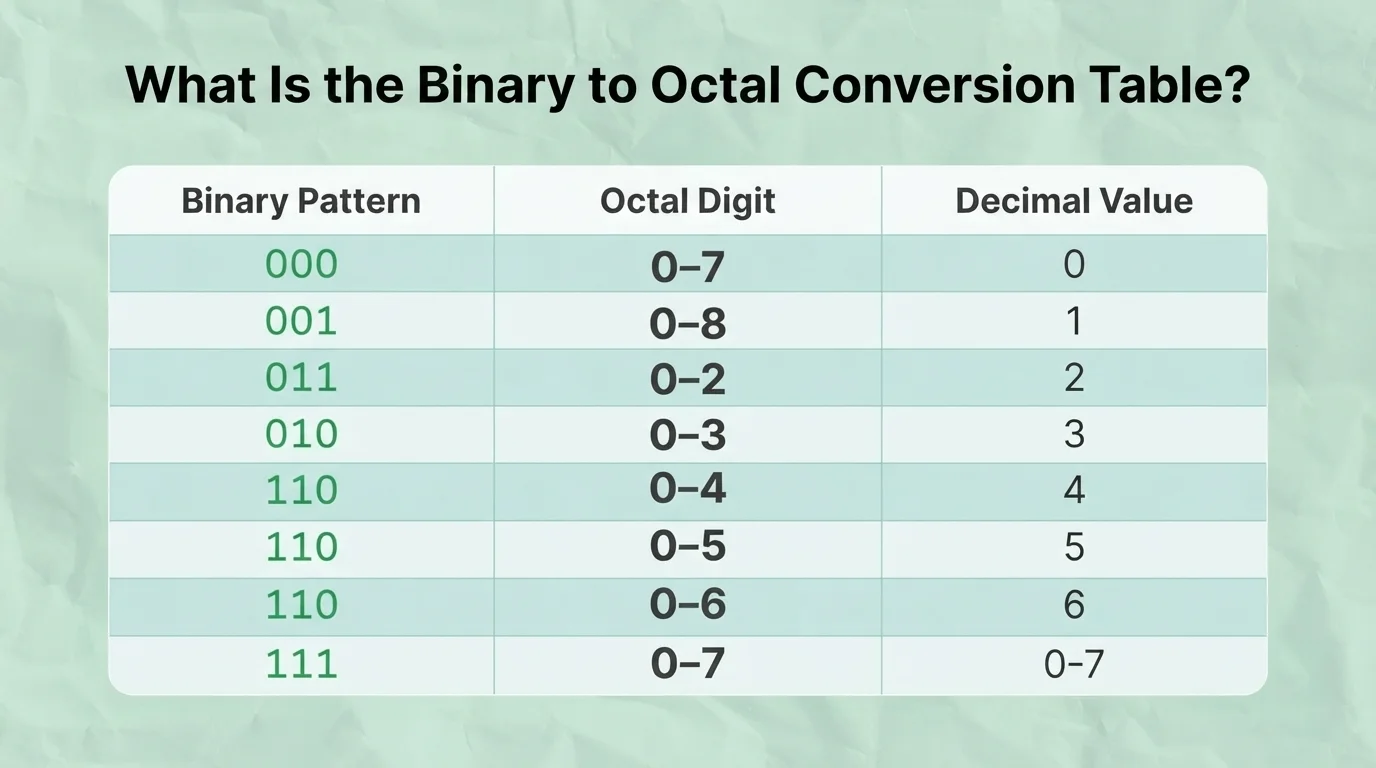
The table below lists every possible 3-bit binary group next to its matching octal digit and decimal value. It is meant as a quick lookup once the method itself is understood, rather than a teaching tool on its own.
Binary Group | Octal Digit | Decimal Value |
000 | 0 | 0 |
001 | 1 | 1 |
010 | 2 | 2 |
011 | 3 | 3 |
100 | 4 | 4 |
101 | 5 | 5 |
110 | 6 | 6 |
111 | 7 | 7 |
How Do You Convert Binary to Octal Through the Decimal Method?
The decimal method converts a binary number to octal in two stages instead of one. First, the binary number is converted to its decimal value by multiplying each bit by its power of two and adding the results. Second, that decimal value is converted to octal by dividing repeatedly by 8 and reading the remainders from the last division to the first.
Take the binary number 11010. Converting to decimal: 1 times 16, plus 1 times 8, plus 0 times 4, plus 1 times 2, plus 0 times 1, equals 26. Now convert 26 to octal by dividing by 8 repeatedly. 26 divided by 8 gives 3 with a remainder of 2. 3 divided by 8 gives 0 with a remainder of 3. Reading the remainders from bottom to top gives 32. So 11010 in binary equals 32 in octal, the same answer the grouping method gives for this number.
Which Method Is Easier, Grouping or the Decimal Method?
For most people, direct grouping is faster since it skips the decimal step entirely and works straight from the binary digits. The decimal method takes longer because it requires two separate calculations, but it is useful as a way to double check a grouping result, or as an option for someone who finds decimal arithmetic more familiar than working directly in threes.
It is worth noting that binary can be converted to octal directly, without ever passing through decimal. Some references present the decimal method as the only way to make this conversion, which is not accurate. The grouping method reaches the same answer without that extra step.
Method | Speed | Best Used For |
Direct Grouping | Faster, one pass | Everyday conversions and mental math |
Decimal Method | Slower, two stages | Double checking an answer or working from a decimal-first approach |
How Do You Convert Binary Fractions and Decimal Points to Octal?
When a binary number includes a point, the whole number part and the fractional part are grouped in opposite directions. The whole number part is grouped from right to left, exactly as before, and padded with zeros on the left if needed. The fractional part is grouped from left to right, starting immediately after the point, and padded with zeros on the right if needed.
Take the binary number 10111.01. The whole part, 10111, has 5 digits, so one zero is added on the left to make 010111, which splits into 010 and 111, giving octal digits 2 and 7. The fractional part, 01, has only 2 digits, so one zero is added on the right to make 010, giving octal digit 2. Combining both sides across the point gives 27.2. So 10111.01 in binary equals 27.2 in octal.
How Do You Convert Large Binary Numbers to Octal Accurately?
The grouping method does not change as a binary number gets longer, only the number of groups increases. Take the 12-digit binary number 101110011010. Grouped from the right in sets of three: 101, 110, 011, 010. Converting each group gives 5, 6, 3, and 2, combining to 5632. So 101110011010 in binary equals 5632 in octal.
The most common source of error with longer numbers is losing track of which digits belong to which group partway through, so it helps to mark the groups clearly before converting any of them, and to recount the digits in each group before finalizing an answer.
What Are the Most Common Mistakes in Binary to Octal Conversion?
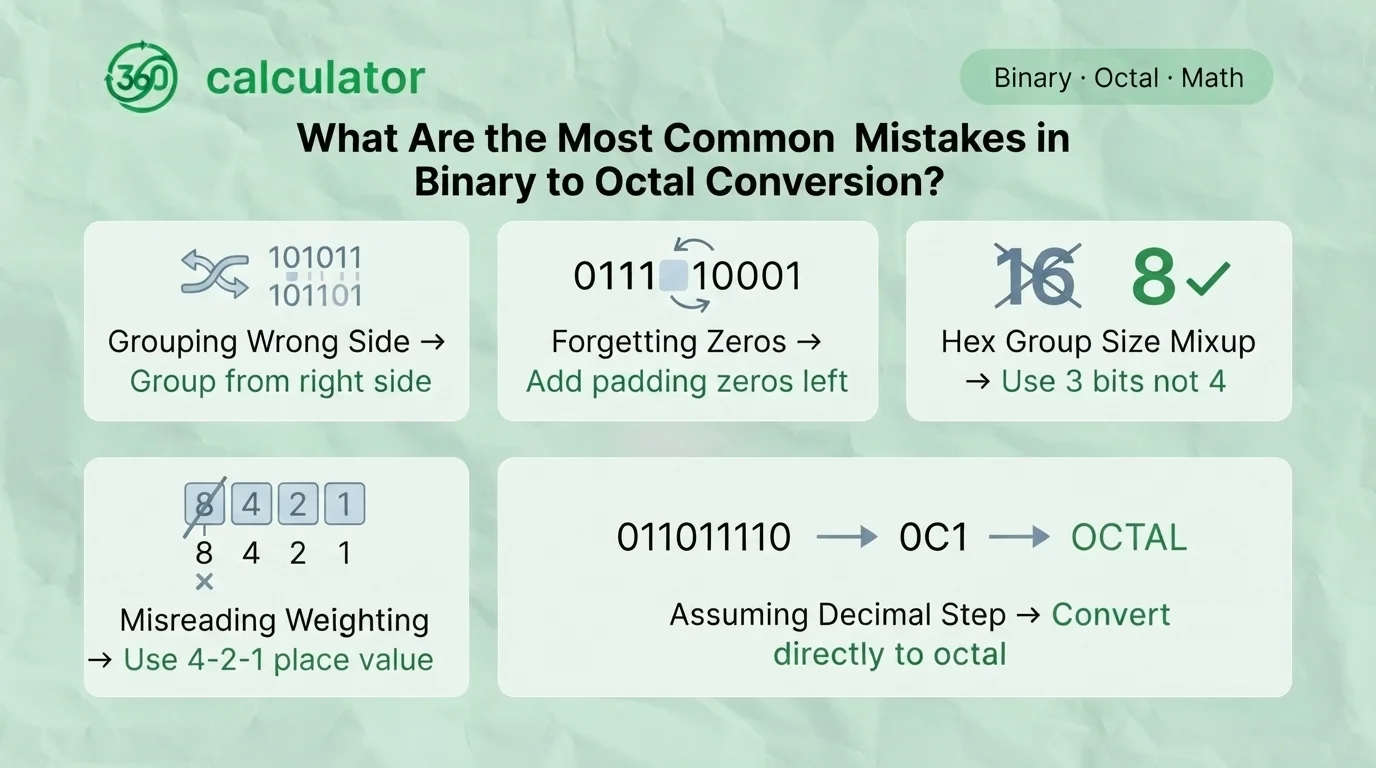
1. Grouping from the wrong side: for whole numbers, grouping always starts from the rightmost digit. Starting from the left produces incorrect groups and an incorrect result.
2. Forgetting to pad leading zeros: when the leftmost group has fewer than three digits, it needs zeros added to its left, not left as is and not padded on the right.
3. Mixing up group size with hexadecimal: hexadecimal groups binary digits in sets of four, not three. Applying the wrong group size is a common slip for anyone working with both systems in the same session.
4. Misreading a group's value: a small arithmetic slip in the 4-2-1 weighting, such as adding one weight twice or skipping one, produces a wrong octal digit even when the grouping itself was correct.
5. Assuming binary must pass through decimal first: direct grouping converts binary to octal without any decimal step. Believing otherwise adds an unnecessary stage and increases the chance of error.
What Are Solved Examples of Binary to Octal Conversion?
Example 1: Convert 110 to octal. This is already one complete group of three digits. Using the mapping table, 110 equals 6. So 110 in binary equals 6 in octal.
Example 2: Convert 101101 to octal. Grouped from the right: 101, 101. Converting each group gives 5 and 5. Combined, the result is 55. So 101101 in binary equals 55 in octal.
Example 3: Convert 110101 to octal. Grouped from the right: 110, 101. Converting each group gives 6 and 5. Combined, the result is 65. So 110101 in binary equals 65 in octal.
Example 4: Convert 111100001111 to octal. Grouped from the right: 111, 100, 001, 111. Converting each group gives 7, 4, 1, and 7. Combined, the result is 7417. So 111100001111 in binary equals 7417 in octal.
Example 5: Convert 11.101 to octal. The whole part, 11, needs one zero added on the left, making 011, which equals 3. The fractional part, 101, is already a complete group and equals 5. Combined across the point, the result is 3.5. So 11.101 in binary equals 3.5 in octal.
Where Does Binary to Octal Conversion Fit Within Number System Conversions?
Binary, octal, decimal, and hexadecimal are all positional number systems built on the same underlying logic, they simply use a different base and a different set of digits. Binary to octal conversion is one path within a much wider set of conversions between these four systems, each suited to a different context, whether that is raw computer memory, human-readable shorthand, everyday arithmetic, or compact addressing in programming. The sections below cover the related conversions and contexts that connect back to this one.
How Is Binary to Octal Conversion Different From Binary to Hexadecimal Conversion?
The core difference comes down to group size. Octal groups binary digits in sets of three because 8 equals 2 cubed, while hexadecimal groups them in sets of four because 16 equals 2 to the fourth power. A binary number that splits cleanly into octal groups will not split the same way into hexadecimal groups, so switching between the two means regrouping the original binary digits from scratch rather than converting one result into the other directly. Anyone who has learned the grouping method for octal can apply the same logic using a binary to hexadecimal converter, simply working in groups of four instead of three.
How Do You Convert Octal Back to Binary?
Converting octal back to binary reverses the process covered above. Each octal digit expands into its fixed 3-bit binary form using the same mapping shown earlier on this page, so the octal number 653 would expand back into 110, 101, and 011, giving the original binary number 110101011. Readers who want the full reverse walkthrough, including how to check their own answer, can use an octal to binary converter for a step by step breakdown.
How Do You Convert Binary to Decimal Numbers?
Converting binary straight to decimal uses the same power-of-two logic already used in the decimal method above, without the second step of dividing by 8. This is useful on its own whenever the goal is a familiar base-10 number rather than an octal one. A dedicated binary to decimal converter covers this conversion in full, including longer binary numbers and fractional values.
How Do You Convert Decimal Numbers to Octal?
Converting a decimal number to octal directly, without starting from binary, uses only the second half of the decimal method covered earlier: dividing the decimal number repeatedly by 8 and reading the remainders from bottom to top. A decimal to octal converter walks through this process on its own for readers who already have a decimal number in hand.
How Is Octal Used in Unix File Permissions?
Octal shows up in everyday computing through Unix and Linux file permissions, where a three-digit octal number such as 755 represents read, write, and execute access for the owner, group, and other users. Each of those three permission groups maps to a 3-bit binary value, which is exactly the same 3-bit logic used throughout this page. A Unix file permission calculator breaks down how each digit in a permission code like 755 translates into its binary and symbolic form.
How Does a General Base Converter Handle Binary, Octal, Decimal and Hex Together?
Readers working across several number systems in one task, rather than a single binary to octal conversion, may find it more convenient to use a base number system converter that handles binary, octal, decimal, and hexadecimal together in one place, rather than switching between separate tools for each pair of systems.
How Do You Convert Octal Numbers to Hexadecimal?
Going from octal to hexadecimal usually means passing through binary as a middle step, since octal groups binary digits in threes and hexadecimal groups them in fours, and neither grouping converts directly into the other. An octal to hexadecimal converter covers the full method for readers who already have an octal result from this page and need it in hexadecimal form.
How Do You Convert Hexadecimal Numbers to Octal?
Converting hexadecimal to octal works in reverse, expanding each hexadecimal digit into its 4-bit binary form first, then regrouping those bits into sets of three to read off the octal digits. A hexadecimal to octal converter walks through this conversion in full for readers starting from a hexadecimal value.
Frequently Ask Questions
1. What's the easiest way to convert binary to octal?
Split the number into groups of three, starting from the right side. Then swap each group with its matching octal digit (0 to 7). If the last group has less than three digits, just add zeros on the left.
2. Why does one octal digit equal three binary digits?
Because 8 is 2 cubed. That means every possible combo of 3 bits (000 to 111) gives you 8 values, which matches octal's 0 to 7 digits perfectly. That's why grouping is always done in threes.
3. What's the difference between the grouping method and the decimal method?
Grouping converts binary straight to octal, no decimal needed. The decimal method first turns binary into decimal, then divides that by 8 again and again to get octal. Grouping is quicker, decimal method is mostly good for checking your answer.
4. How do you convert binary numbers with a decimal point to octal?
The part before the point gets grouped right to left, add zeros on the left if needed. The part after the point gets grouped left to right, add zeros on the right if needed. Convert both parts then join them back with the point.
5. What mistakes do people usually make with this conversion?
The common ones are grouping from the wrong side, forgetting to pad zeros, mixing up octal's group size with hexadecimal's, and thinking you always have to go through decimal first when direct grouping works just fine on its own.