
A torque conversion calculator converts a torque value entered in one unit into its exact equivalent in another unit, such as Newton-meters (Nm), foot-pounds (ft-lb), inch-pounds (in-lb), or kilogram-force centimeters (kgf-cm). Mechanics, engineers, technicians, and students use it to match a torque specification to whichever unit their wrench, service manual, or datasheet displays. Below, you'll find the common torque units and unit systems, the conversion formula, a ready-to-scan conversion chart, and common real-world torque specs, covered in that order.
What Is Torque and How Is It Measured?
Torque is the rotational equivalent of force, equal to the product of an applied force and its perpendicular distance from a pivot point. Pushing down on a wrench handle 0.3 meters from a bolt with 50 newtons of force produces 15 Nm of torque, since torque equals force multiplied by distance. A longer wrench handle needs less force to produce the same amount of torque, which is why breaker bars extend a handle to loosen a stuck bolt.
What Are the Most Common Units Used to Measure Torque?
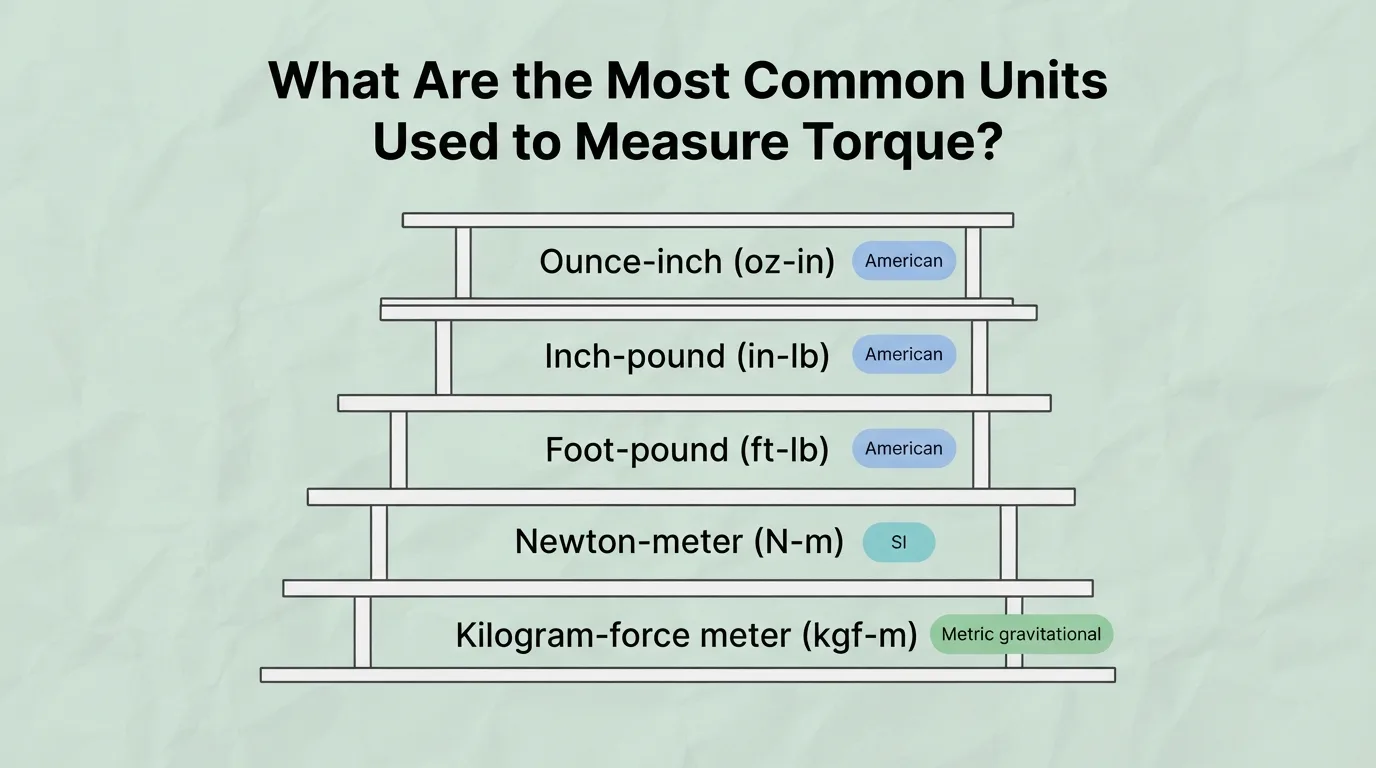
There are 5 common torque units, ranging from smallest to largest: ounce-inch, inch-pound, foot-pound, newton-meter, and kilogram-force meter. Each unit belongs to a broader measurement system that determines where it typically appears on a tool or spec sheet.
Unit | Abbreviation | Unit System |
Ounce-inch | ozf-in | American (imperial) |
Inch-pound | in-lb | American (imperial) |
Foot-pound (pound-foot) | ft-lb / lb-ft | American (imperial) |
Millinewton-meter / Centinewton-meter | mNm / cNm | SI (metric, small-scale) |
Newton-meter | Nm | SI (metric) |
Kilogram-force centimeter | kgf-cm | Metric (gravitational) |
Kilogram-force meter | kgf-m | Metric (gravitational) |
What Is the Difference Between American, SI, and Metric Torque Units?
American, SI, and metric torque units group into 3 distinct systems, and the correct one to use depends on the reader's tool or region, not on any technical requirement. A US-made torque wrench typically defaults to American units, while a European or Japanese tool defaults to SI units.
American Units | SI Units | Metric Units |
Ounce-inch (ozf-in) | Millinewton-meter (mNm) | Gram-force centimeter (gf-cm) |
Inch-pound (in-lb) | Centinewton-meter (cNm) | Kilogram-force centimeter (kgf-cm) |
Foot-pound (ft-lb) | Newton-meter (Nm) | Kilogram-force meter (kgf-m) |
What Is the Formula for Converting Newton-Meters to Foot-Pounds?
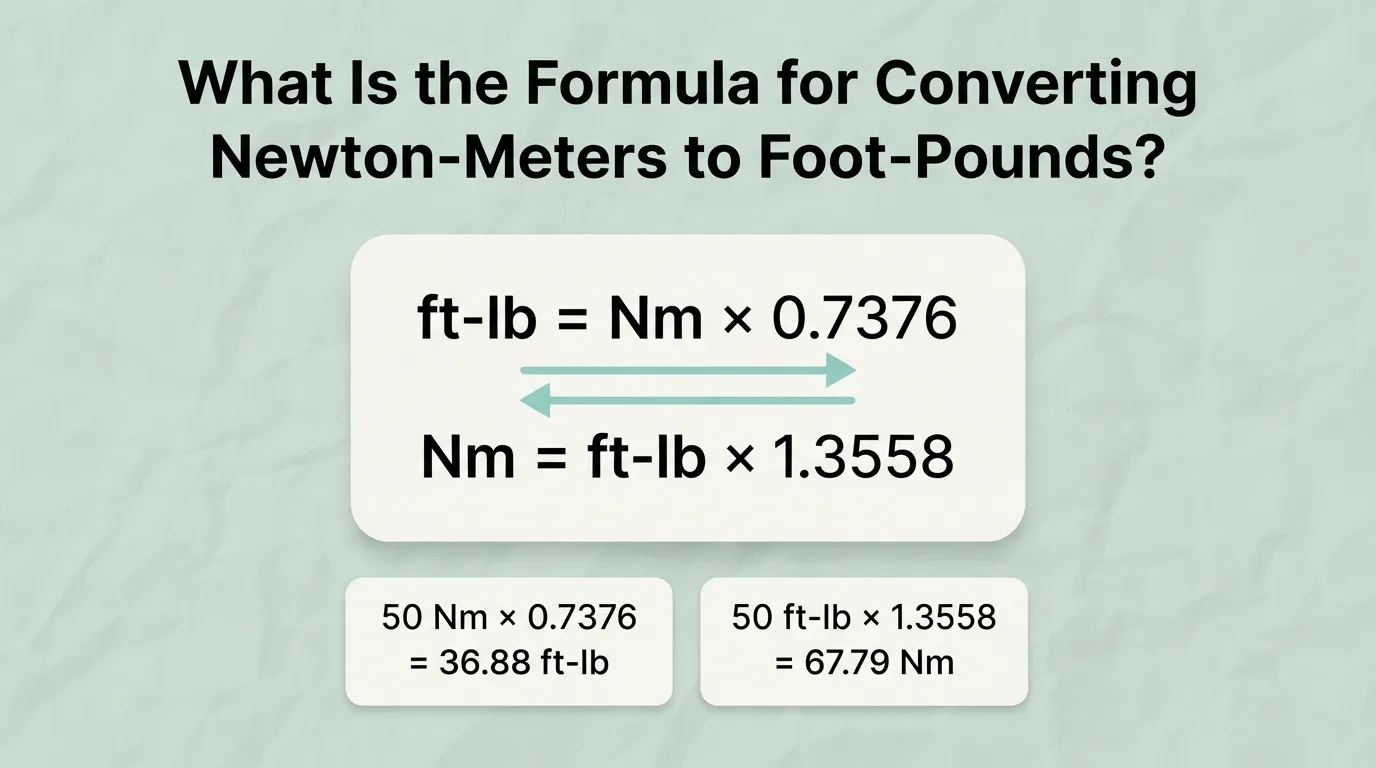
1 Nm equals approximately 0.7376 ft-lb, and 1 ft-lb equals approximately 1.3558 Nm. These two multipliers are exact reciprocals of one another, rounded to 4 decimal places for everyday use.
Direction | Formula |
Nm to ft-lb | ft-lb = Nm × 0.7376 |
ft-lb to Nm | Nm = ft-lb × 1.3558 |
How Do You Convert Newton-Meters to Foot-Pounds by Hand?
Multiply the Nm value by 0.7376 to get its foot-pound equivalent. Converting 50 Nm, a torque spec common on motorcycle engine bolts, works in 2 steps.
Step | Calculation | Result |
1 | Start with 50 Nm | 50 Nm |
2 | Multiply by 0.7376 | 36.88 ft-lb |
How Do You Convert Foot-Pounds Back to Newton-Meters?
Multiply the ft-lb value by 1.3558 to get its Newton-meter equivalent. This factor is the reciprocal of the Nm-to-ft-lb multiplier used earlier, not a separate conversion concept.
Step | Calculation | Result |
1 | Start with 50 ft-lb | 50 ft-lb |
2 | Multiply by 1.3558 | 67.79 Nm |
How Do You Convert Inch-Pounds and Ounce-Inches to Foot-Pounds and Newton-Meters?
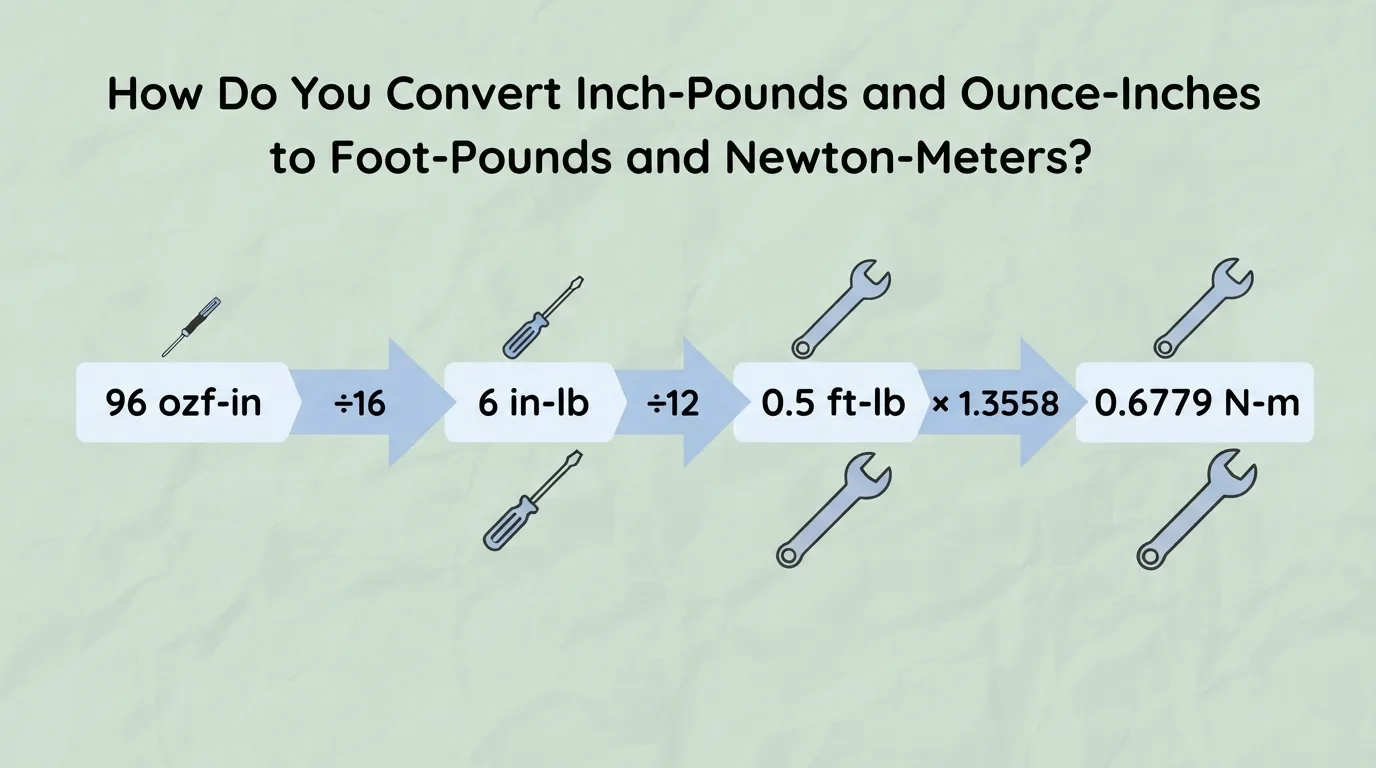
Inch-pounds convert to foot-pounds by dividing by 12, and ounce-inches convert to inch-pounds by dividing by 16, since 16 ounces make a pound. This 2-stage path handles the small torque units used in electronics assembly and fine adjustments, where a full foot-pound or Newton-meter reading would be too large to read precisely.
Step | Calculation | Result |
1 | Start with 96 ozf-in | 96 ozf-in |
2 | Divide by 16 | 6 in-lb |
3 | Divide by 12 | 0.5 ft-lb |
4 | Multiply by 1.3558 | 0.6779 Nm |
What Is the Difference Between Foot-Pound and Pound-Foot, and Why Do Some Units Add 'Force'?
Foot-pound is technically a unit of energy, while pound-foot (lb-ft) is the more precise term for torque, though foot-pound and ft-lb are still used in practice to mean the same thing. The SAE J1349 standard documents pound-foot as the more exact terminology for rotational force, even though foot-pound remains the common label on wrenches and spec sheets.
The word 'force' gets added to a unit name specifically to separate a measure of weight from a measure of mass. A kilogram-force meter (kgf-m) measures torque, while a plain kilogram measures mass, and the same distinction applies to ounce-force versus ounce.
• Foot-pound vs. pound-foot: same numeric value, different technical category. Foot-pound is the energy term in common use; pound-foot is the precise torque term per SAE J1349.
• '-force' naming: added to separate a weight-based unit (kgf-m) from a mass-based unit (kg).
What Is the Torque Conversion Chart for Common Values?
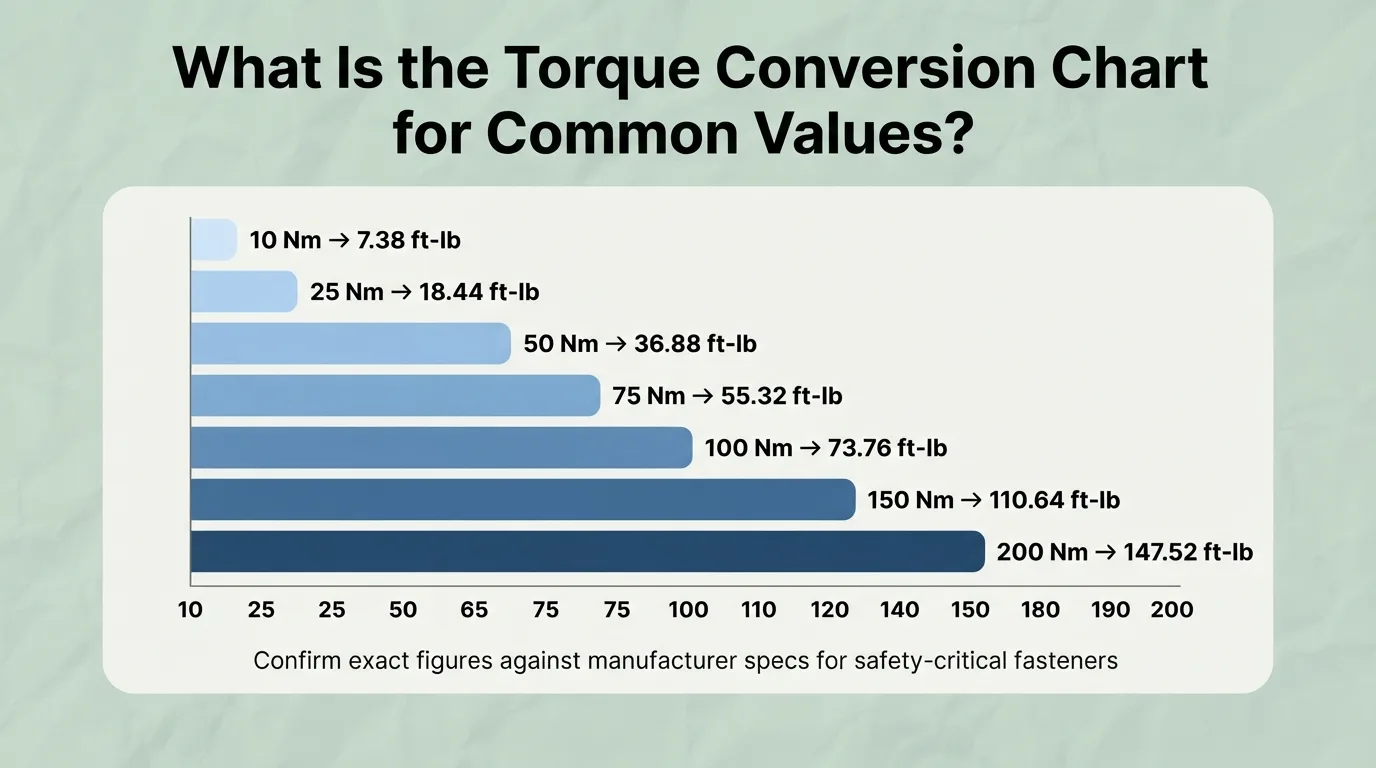
The table below lists 8 common Nm values next to their ft-lb equivalents, rounded to 2 decimal places. A printable PDF version of this chart is available right after the table for reference away from a screen.
Newton-meters (Nm) | Foot-pounds (ft-lb) |
10 | 7.38 |
20 | 14.75 |
30 | 22.13 |
50 | 36.88 |
70 | 51.63 |
100 | 73.76 |
150 | 110.64 |
200 | 147.52 |
These values are rounded for quick reference. Confirm the exact figure against the original manufacturer source before applying it to a safety-critical fastener, as the National Institute of Standards and Technology recommends when rounded conversion factors feed into load-bearing specifications.
Why Do Different Countries and Manufacturers Use Different Torque Units?
European and Japanese manufacturers typically specify torque in Nm because they use the metric system, while many American manufacturers and service manuals use ft-lb. This split is a regional convention rather than a technical requirement, since both units measure the same physical quantity.
What Mistakes Do People Make When Converting Torque Units?
There are 5 recurring mistakes in torque unit conversion, each with a straightforward fix.
1. Confusing foot-pound with pound-foot -remember both labels refer to the same torque value despite the technical energy-vs-torque distinction.
2. Letting rounding errors build up across repeated conversions -convert directly from the original unit each time instead of chaining already-rounded results.
3. Converting in the wrong direction -check which unit is larger before deciding whether to multiply or divide.
4. Mixing up ounce-inch with inch-pound in electronics work -confirm the label stamped on the torque driver before applying the divide-by-16 step.
5. Applying an online conversion to a safety-critical fastener without checking the OEM manual -treat a converted value as a reference point and confirm the exact spec against the manufacturer's documentation.
Where Does Torque Conversion Matter in Real-World Applications Like Automotive and Engineering Work?
Torque conversion applies directly to tightening lug nuts and wheel bolts, using a manual or hydraulic torque wrench correctly, working with related units like kilogram-force meters, and understanding how torque connects to horsepower and force. Each of these areas has its own dedicated guide with more detail than fits here.
What Torque Should You Use for Lug Nuts and Wheel Bolts?
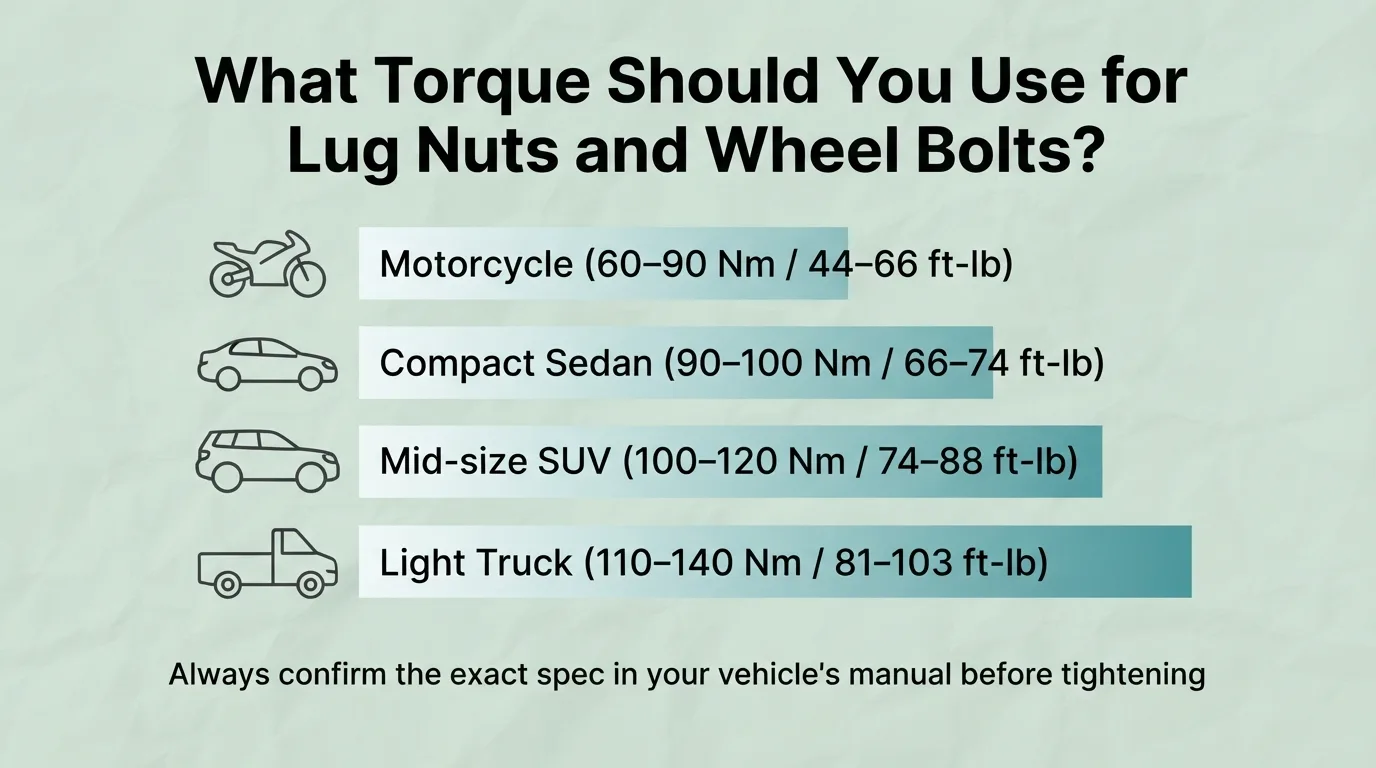
Lug nut torque specs commonly fall between 80 and 120 Nm, or about 59 to 88 ft-lb, though the exact figure depends on the vehicle. Confirm the exact spec in the vehicle manual before tightening, since this range is a general reference rather than a vehicle-specific value.
Vehicle Type | Typical Range (Nm) | Typical Range (ft-lb) |
Compact sedan | 90 - 100 | 66 - 74 |
Mid-size SUV | 100 - 120 | 74 - 88 |
Light truck | 110 - 140 | 81 - 103 |
Motorcycle | 60 - 90 | 44 - 66 |
For the exact torque value on a specific make and model, rather than a general range, see the Lug Nut and Wheel Bolt Torque Specification guide.
How Do You Use a Torque Wrench Correctly?
Set the wrench to the target torque value, then tighten slowly until it clicks or reaches the marked point. Stopping immediately at the click avoids the most common error, which is continuing to tighten past the signal and over-torquing the fastener.
For wrench setup, storage, and calibration checks in full, see the How to Use a Torque Wrench guide.
What Is the Difference Between a Digital and an Analog Torque Wrench?
A digital torque wrench displays a direct numeric reading and often switches between units like Nm and ft-lb at the press of a button, while an analog or click-type wrench must be manually set to a value using its dial or scale before use. Unit conversion accuracy matters more on a manual wrench, since it has no built-in display to double-check the setting against.
Accuracy, cost, and calibration differences between the two types are broken down in the Digital vs Analog Torque Wrench comparison guide.
How Do You Convert Torque Wrench Pressure Readings From PSI or Bar to Torque Output?
Hydraulic and pneumatic torque wrenches apply torque based on a pressure setting, commonly measured in PSI or bar, rather than a direct torque unit. This conversion depends on the tool's own calibration chart rather than a single universal factor, unlike the Nm-to-ft-lb conversion explained earlier.
For the tool-specific charts this calculation needs, see the Hydraulic Torque Wrench Pressure to Torque Conversion guide.
How Do You Convert Kilogram-Force Meters or Kilogram-Centimeters to Newton-Meters?
Multiply a kgf-m value by 9.807, or a kgf-cm value by 0.09807, to get the Newton-meter equivalent. These units still appear on some industrial and older equipment. For example, 50 kgf-cm multiplied by 0.09807 equals 4.90 Nm.
For both directions of this conversion with a full reference chart, see the Kilogram-Force Meter / Centimeter to Newton-Meter Converter.
What Is the Formula for Calculating Torque From Force and Distance?
Torque equals force multiplied by the perpendicular distance from the pivot point. For example, 40 newtons of force applied 0.25 meters from a pivot produces 10 Nm of torque.
To calculate a raw torque value directly from force and distance inputs, use the Torque Calculator (force and distance).
How Does Torque Relate to Horsepower and Power Output?
Torque and rotational speed together determine power output, commonly expressed in horsepower for engines. This is a distinct calculation from a simple unit conversion, since it also depends on RPM.
To turn a torque and RPM pair directly into a horsepower figure, use the Torque to Horsepower Calculator.
How Do You Convert Force Units Used in Torque Calculations, Such as Newtons to Pounds-Force?
Torque calculations often start with a force value that needs its own unit conversion, such as newtons to pounds-force, before the torque formula gets applied.
This step is handled separately from the torque unit conversions covered here, by the Newtons to Pounds-Force Converter.