

A cat BMI calculator is a Feline Body Mass Index tool that uses two body measurements, rib cage circumference and leg length, to estimate whether a cat is at a healthy weight. This page explains how to take the measurements correctly, the formula behind the score, and what the resulting range means. It also covers how the score compares to a vet exam and what to do next once you have a result. The calculator gives an estimate only, it does not replace a professional veterinary assessment.
What Do You Need to Measure to Calculate a Cat's BMI?
The calculator needs two measurements, the circumference of the rib cage and the length of a back leg. These two numbers were chosen instead of weight and height because they reflect the cat's actual body structure rather than raw body mass alone. Before measuring either one, the cat should be standing upright with its head level, since a hunched or crouched posture can change both readings.
How Do You Measure a Cat's Rib Cage Circumference Correctly?
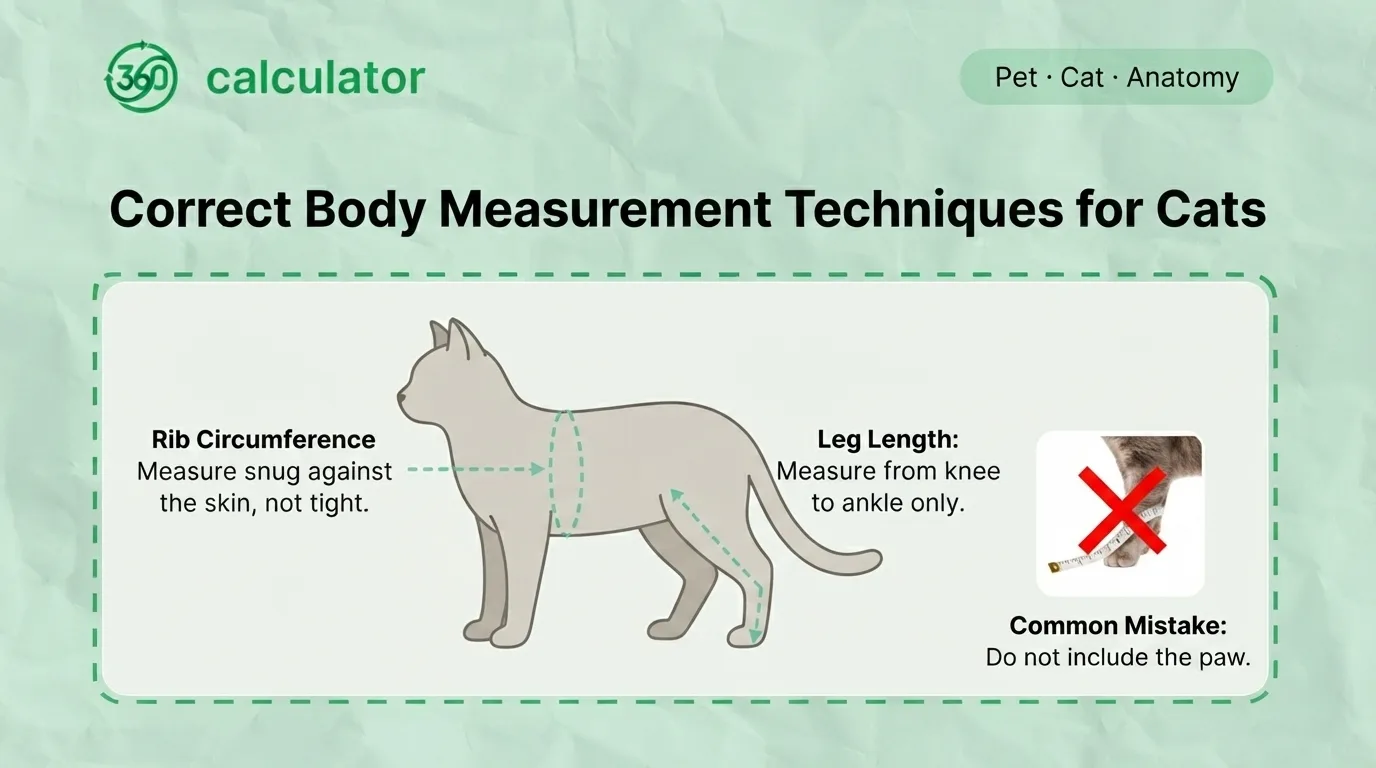
Wrap a soft tape measure around the cat's rib cage at the level of the 9th rib, which sits roughly level with the back of the front legs. The tape should sit snug against the body without pulling tight enough to compress the ribs. The cat should be standing normally rather than sitting or curled up, since either position changes the girth reading. Thick winter fur can also inflate the number slightly, so measuring close to the skin gives a more consistent result.
How Do You Measure a Cat's Leg Length Without Common Mistakes?
Leg length is measured from the knee down to the ankle on a back leg, not down to the paw. Including the paw in the measurement is the most common mistake owners make, and it throws off the entire calculation. The cat should be standing normally, not stretched out, and the tape should run straight along the bone rather than around the soft tissue around the joint.
Is a Cat's Leg Length the Same as Its Body Length?
No. Leg length, measured from knee to ankle, is only used in the rib and leg formula. Body length is a separate measurement taken from the base of the neck to the base of the tail, and it is closer to 18 inches on an average adult cat. Some other cat weight tools use body length instead of leg length, along with the cat's total weight. These two measurements are not interchangeable, and using the wrong one in the wrong calculator produces a result that does not mean anything.
What Formula Does a Cat BMI Calculator Use?
The Feline Body Mass Index compares rib cage circumference against leg length to estimate body fat. In simple terms, a rib cage measurement that is large relative to leg length points toward a heavier cat, while a smaller ratio points toward a leaner one. The formula used is shown below.
FBMI = (rib cage circumference divided by 0.70622, minus leg length) divided by 0.9156, minus leg length
This is not the same formula used for human BMI, it was built specifically around feline body proportions. Some calculators also let you enter a target FBMI to see what rib cage measurement would be needed to reach it.
Why Do Different Cat BMI Calculators Give Different Results?
Not every cat BMI calculator uses the same method. Some use rib cage circumference and leg length, as described above. Others use the cat's current weight and body length, adjusted for breed group, age group, and body frame size. The same cat can score differently on two different tools simply because the tools are measuring different things, not because one of them is wrong. It is best to pick one calculator and one method, then stick with it when tracking a cat's weight over time, rather than comparing results across different tools.
What Do Cat BMI Score Ranges Mean?
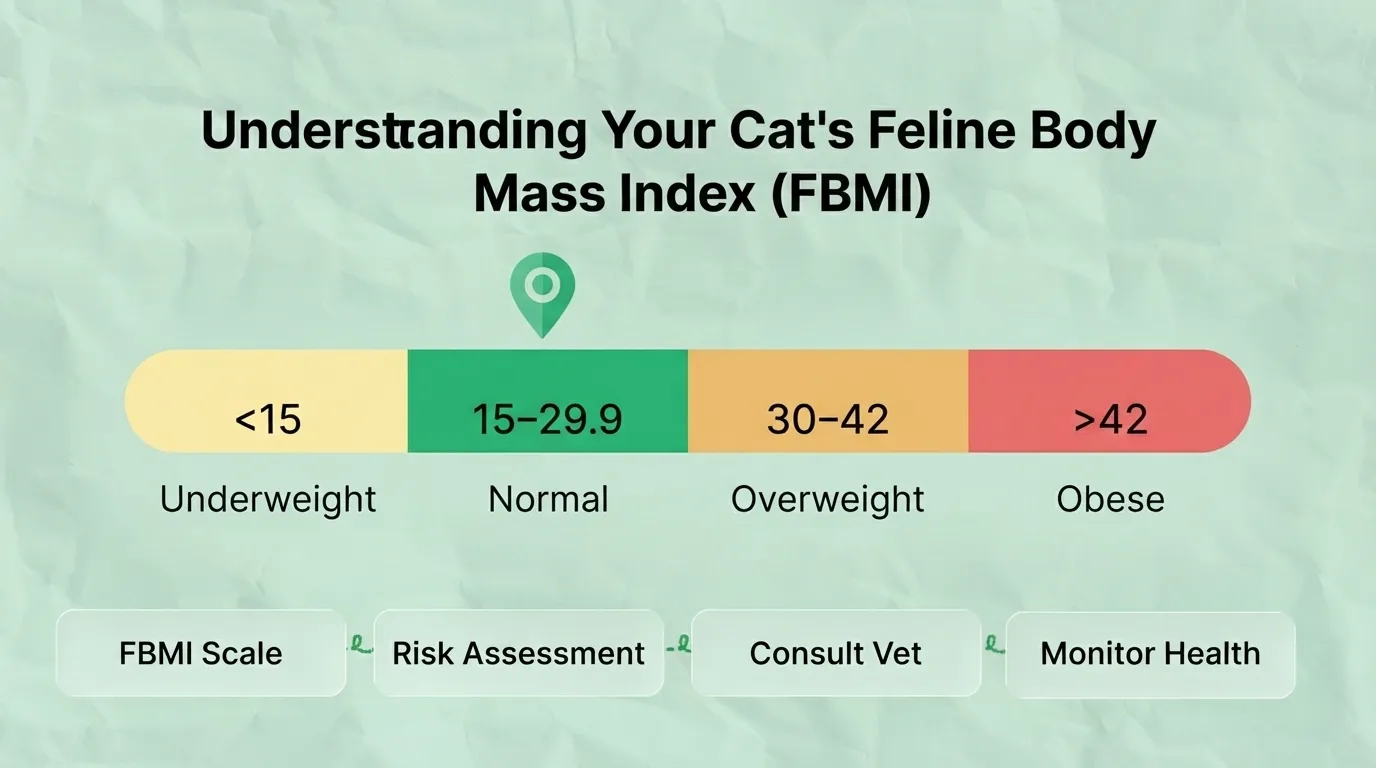
Once the FBMI is calculated, it falls into one of four categories.
FBMI Range | Category |
Under 15 | Underweight |
15 to 29.9 | Normal weight |
30 to 42 | Overweight |
Above 42 | Obese |
Some calculators describe a healthy range as roughly 15 to 25 instead, since ranges can shift slightly depending on the tool and the cat's breed. A cat in the normal range usually has a visible waist and ribs that can be felt without much pressure. A cat scoring overweight or obese usually has a rounder middle and a waist that is hard to see from above.
How Accurate Is a Cat BMI Calculator Compared to a Vet Exam?
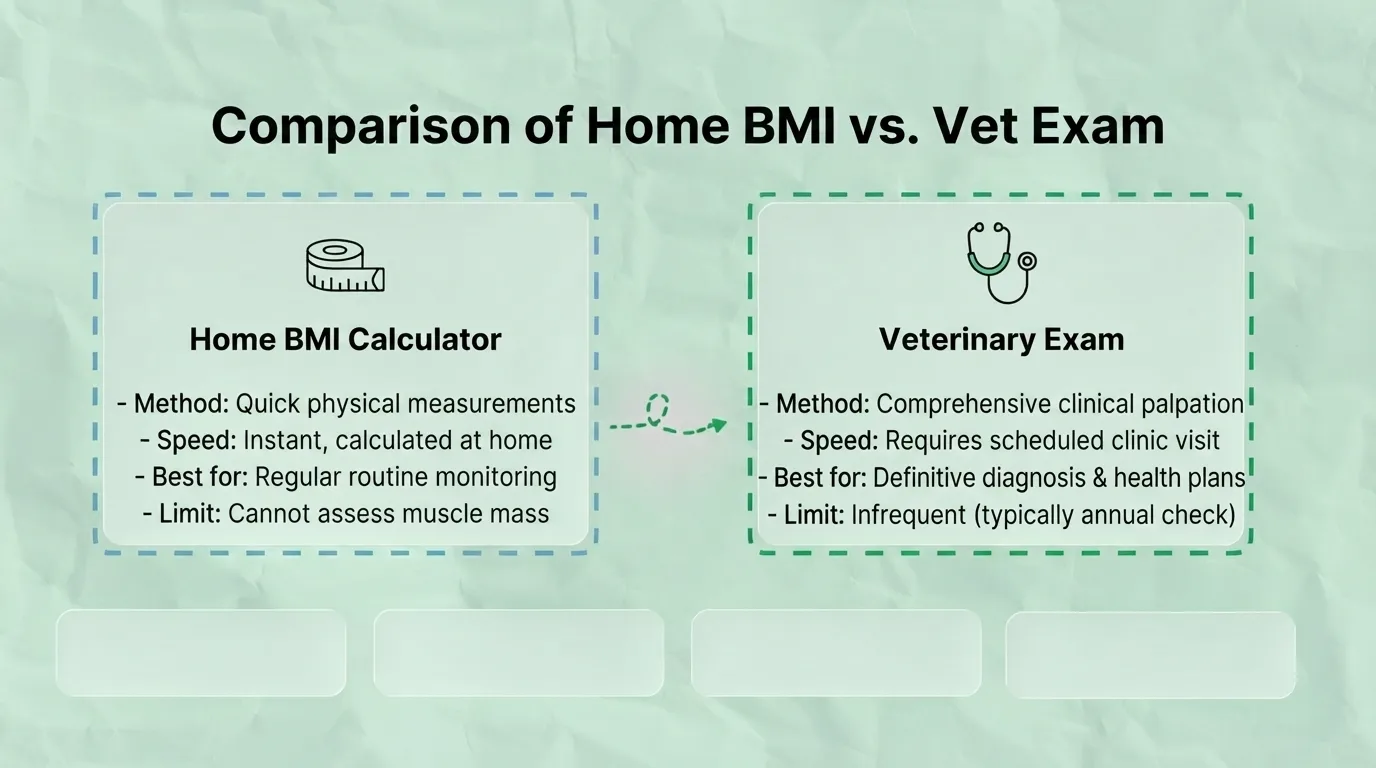
A BMI calculator gives a quick estimate based on two measurements taken at home. A vet exam combines hands-on palpation of the ribs, spine and hips, a visual assessment of body shape, knowledge of the cat's breed, and its full health history. The table below shows the difference.
Factor | Home BMI Calculator | Veterinary Exam |
Method | Two body measurements plugged into a formula | Hands-on palpation, visual check, and health history |
Speed | Instant | Requires an appointment |
Best used for | Tracking changes at home over time | Confirming a diagnosis and creating a treatment plan |
Limitation | Cannot account for muscle mass or individual health conditions | Not something you can repeat daily on your own |
A calculator is a useful screening tool for spotting changes early. It is not a substitute for a professional exam, especially if the result is unexpected or the cat's weight has changed suddenly.
Why Might a Cat's BMI Result Not Match What a Vet Says?
A mismatch usually comes down to one of a few things, a small error in how the measurements were taken, a breed with a naturally lean or naturally stocky build, muscle mass being mistaken for fat, or thick fur affecting the rib cage reading. Owners also tend to score their own cat's body condition lower than a veterinary team would, especially once weight has crept up gradually and become the new normal in the household. If the two results disagree, treat the vet's in-person assessment as the more reliable one.
What Is a Primordial Pouch and Why Shouldn't It Be Mistaken for Fat?
Most cats have a small, loose pouch of skin and fat that hangs below the belly. This is normal anatomy called a primordial pouch, and it is not, by itself, a sign that a cat is overweight. Judging a cat's weight from the belly alone is unreliable. Ribs, waist and belly should always be checked together rather than relying on belly shape alone.
How Often Should a Cat's BMI Be Rechecked?
A cat that is already at a healthy weight can be rechecked about once a month to catch small changes early. For most owners simply keeping an eye on things, checking every 3 to 4 months is a reasonable general guideline. A cat that is actively on a weight management plan should be checked more often so progress can be tracked and adjusted. What matters more than any single reading is the trend over several checks.
What Factors Can Skew a Cat's BMI Result?
Even with correct measurements, a few physical traits can shift a cat's BMI result away from what it actually reflects about their health. Breed, age, neuter status, and coat thickness all play a role, and each is worth understanding on its own.
Does Breed Affect a Cat's Healthy BMI Range?
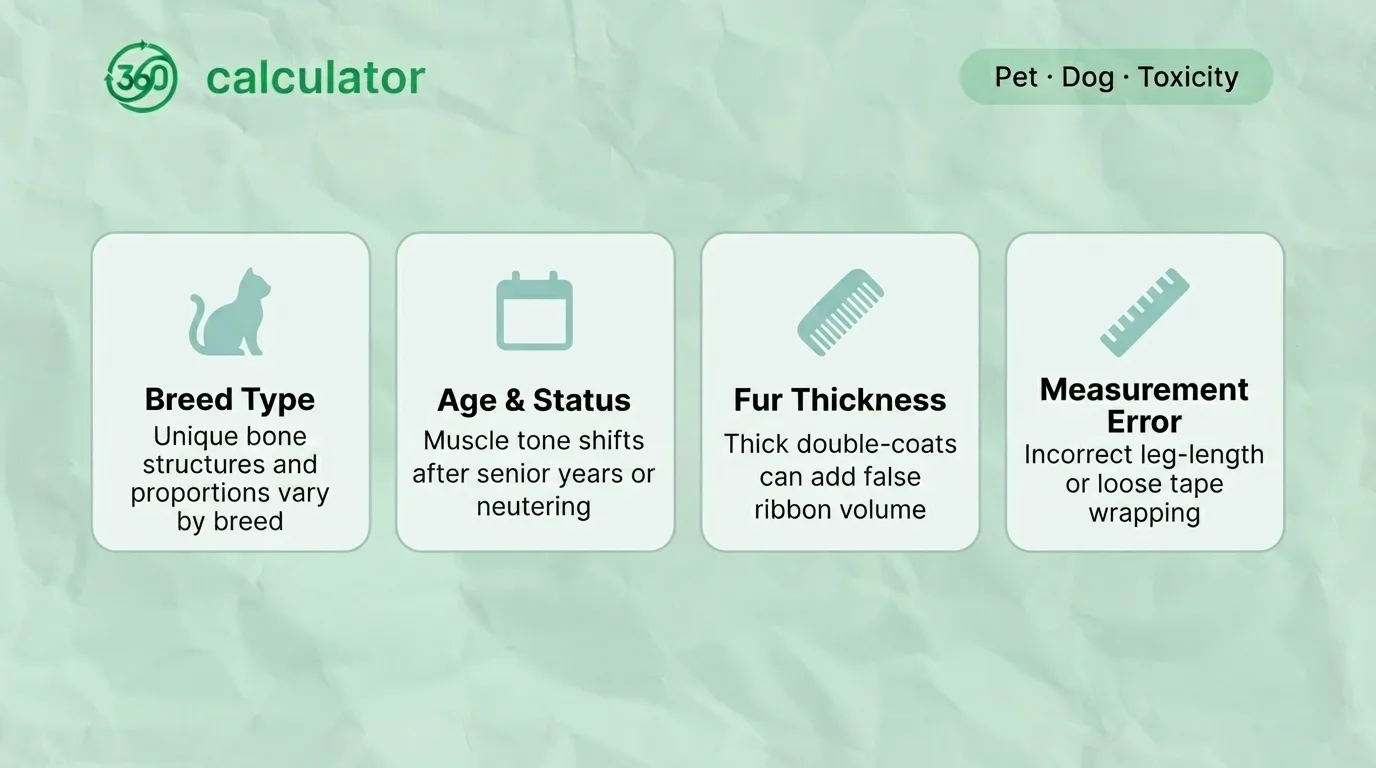
Some breeds are naturally leaner, including Siamese and other Oriental breeds, while others such as Maine Coons have a naturally larger frame. Both can be perfectly healthy despite producing different BMI numbers. The calculator gives a general estimate, and breed should be factored in when interpreting what the number actually means for an individual cat.
Do Age and Neuter Status Change a Cat's Healthy BMI Range?
Many professional calculators split cats into age brackets, because metabolism and ideal weight shift across life stages.
Age Bracket | Typical Note |
Kitten (under 1 year) | Still growing, weight expected to increase steadily |
Young adult (1 to 6 years) | Generally the most active stage |
Mature or neutered adult (7 to 11 years) | Metabolism often slows, especially after neutering |
Senior (12 to 15 years) | Weight should be watched for unexplained loss or gain |
Geriatric (15 years and older) | Small changes in weight are worth discussing with a vet |
Spaying or neutering commonly slows a cat's metabolism, so a neutered adult cat may need fewer calories to sit at the same healthy BMI as an intact cat of the same breed and size.
Does Long Hair or Fur Thickness Distort BMI Measurements?
Thick or long fur can make the rib cage circumference read larger than the cat's actual body size, which can push the BMI score toward overweight even when the cat is not. Measuring close to the skin, with the coat gently compressed rather than fluffed up, gives a more accurate reading.
What Should You Do After Getting a Cat's BMI Result?
A BMI result is a starting point, not a final verdict. A specific number is often more useful in a vet conversation than a general worry, since bringing an exact reading to an appointment tends to prompt a clearer discussion about the cat's weight than simply asking how things look. From here, the next step depends on the result. An overweight or obese reading might mean it is worth checking body condition and muscle condition together, then working out a calorie and feeding plan. An underweight reading is worth discussing with a vet before making feeding changes, since sudden weight loss can point to a health problem rather than just diet.
What Is a Cat Body Condition Score and How Does It Differ From BMI?
Body condition score, or BCS, is a hands-on and visual system vets use to judge a cat's body fat by feeling the ribs, spine and waist rather than plugging numbers into a formula. Some sources use a 1 to 5 scale, while others, including veterinary and pet obesity organizations, use a 1 to 9 scale. BCS and BMI are two different tools that usually agree but are not identical, since one is based on touch and appearance and the other on two measurements. For a full walkthrough of how to score your own cat step by step, see the cat body condition score guide.
What Is Muscle Condition Score and How Does It Differ From Body Condition Score?
Muscle condition score, or MCS, is a separate measure vets check alongside BCS, assessing muscle over the spine, hips, shoulder blades and thighs by touch. A cat can be carrying extra body fat and losing muscle mass at the same time, which is why BCS and MCS together give a fuller picture than either one on its own. The muscle condition score guide explains how each area is checked in more detail.
How Many Calories Does an Overweight Cat Need to Lose Weight Safely?
A BMI result showing overweight or obese usually points to a calorie reduction, but the pace matters. The safe weight loss rate for cats is roughly 0.5 to 1 percent of body weight per week, and going faster than this raises the risk of a serious complication. Treats should generally stay under 10 percent of a cat's total daily calories while working toward a healthy weight. For an exact daily calorie target based on your cat's current and ideal weight, use the cat calorie calculator.
What Is the Ideal Weight for a Cat's Breed?
Breed plays a real role in what counts as a healthy weight. Most adult cats fall somewhere between about 8 and 12 pounds, though Maine Coons are a clear exception and can normally weigh up to around 25 pounds while still being lean. Smaller breeds tend to sit toward the lower end of the range, and larger breeds toward the higher end. For a full breakdown by breed, see the ideal cat weight by breed guide.
How Do You Help an Overweight Cat Lose Weight Safely?
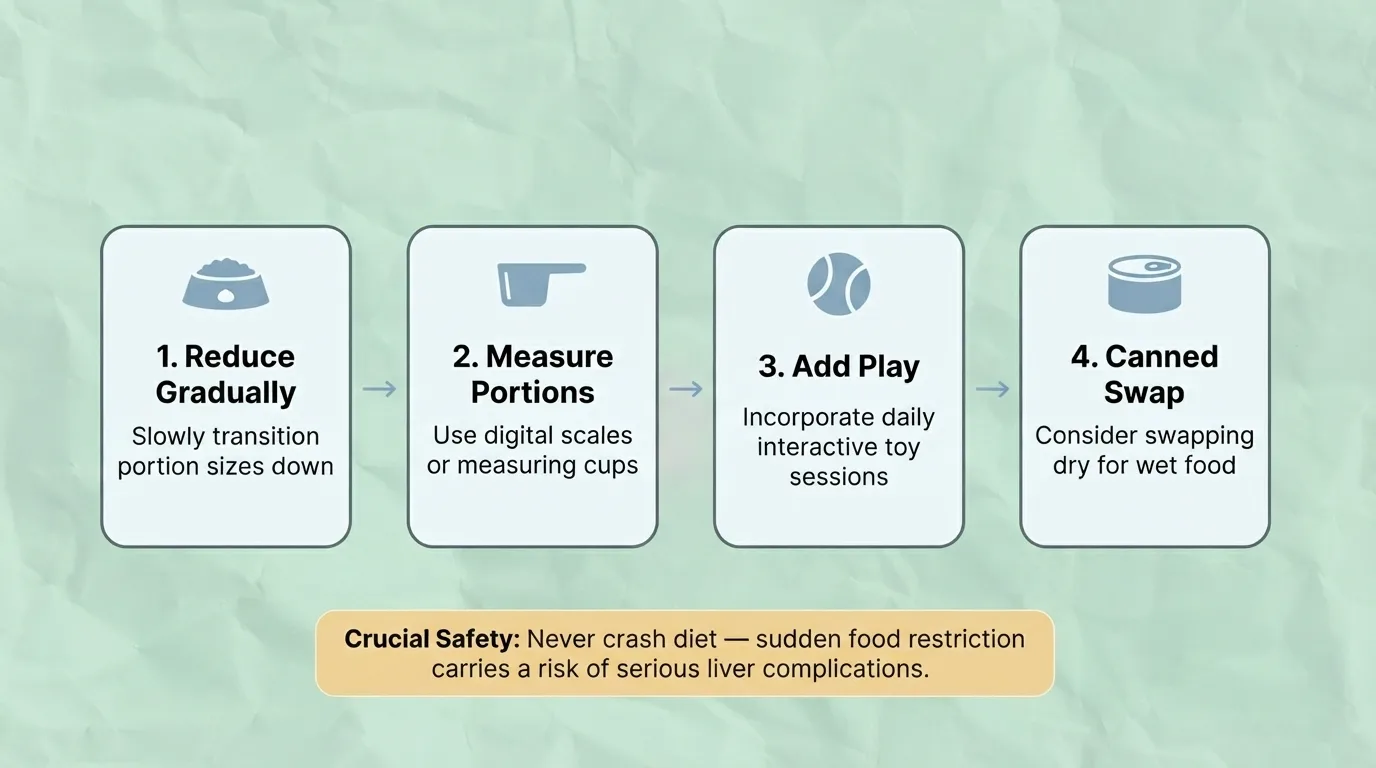
Safe weight loss for cats comes down to a few consistent habits, reducing calories gradually at the safe weekly rate, measuring portions instead of free feeding, and adding more play and activity through the day. Swapping some dry food for canned food can help too, since canned food tends to be less calorie-dense for the same amount of fullness. In a multi-cat household, feeding the overweight cat separately can stop it from finishing another cat's portion. Rapid weight loss or skipped meals can trigger a dangerous liver condition called hepatic lipidosis, so cats should never be put on a crash diet or left without food. The cat weight loss guide covers a full step-by-step plan.
What Are the Health Risks of an Overweight or Obese Cat?
Extra weight raises the risk of several health problems in cats, including diabetes, arthritis, and added strain on the heart, along with a shorter lifespan overall. Diabetes risk rises because excess fat affects how the body responds to insulin. Arthritis becomes more likely as joints carry more weight than they are built for. The cat obesity health risks guide covers each of these conditions in more detail.
How Do You Recognize Signs a Cat Is Underweight or Unwell?
An underweight reading can point to simple underfeeding, but in older cats, unexpected weight loss is more often a sign of an underlying illness than of normal aging, since age alone usually causes only mild muscle thinning along the spine. Any unexplained weight loss is worth a vet visit rather than assuming more food alone will fix it. The underweight cat warning signs guide lists the signs to watch for.
What Should You Feed a Cat on a Weight Management Plan?
Feeding for weight management comes down to measured portions based on the kcal listed on the food's label, consistent feeding times rather than free access to food all day, and a weight management formula if a vet recommends one. Exact portion sizes depend on the individual cat, so the cat weight management diet guide walks through how to work out a full feeding plan.
How Much Water Should a Cat Drink Each Day?
Water intake is another simple metric worth tracking alongside weight and BMI, since a noticeable change in how much a cat drinks can flag a health issue early, sometimes before a weight change shows up at all. The cat water intake calculator gives a daily amount based on your cat's weight and diet.
Is Chocolate or Other Treats Dangerous for Cats During Weight Loss?
Owners cutting back on regular food sometimes reach for treats to make up for it, but chocolate and several other human foods are toxic to cats regardless of how few calories they contain. Treat choice matters just as much as treat quantity during a weight loss plan. The cat chocolate toxicity calculator explains which foods to avoid and why.
Frequently Asked Questions
What is a healthy BMI for a cat?
Most calculators consider an FBMI between 15 and 29.9 to be a normal, healthy weight, though the exact range can shift slightly by breed and by which calculator is used.
How do I measure my cat's leg length correctly?
Measure from the knee down to the ankle on a back leg while the cat is standing normally. Do not measure down to the paw, since that is the most common mistake and it changes the result.
How often should I check my cat's BMI?
About once a month if your cat is already at a healthy weight, or every 3 to 4 months as a general guideline. Check more often while actively working on a weight change.
Why does my cat's BMI not match what my vet says?
Small measurement errors, a naturally lean or stocky breed, muscle mass, or thick fur can all cause a mismatch. When the two disagree, the vet's hands-on assessment should be treated as the more reliable one.
What should I do if my cat's BMI shows overweight?
Start with a gradual calorie reduction at a safe rate, around 0.5 to 1 percent of body weight per week, measured portions, and more playtime, and check in with your vet before making any big changes to food or feeding schedule.