

Litter box size is one of the most common reasons a cat stops using its litter box. Most adult cats need an interior length of at least 1.5 times their body length, measured from the nose to the base of the tail. Large breed cats such as Maine Coons often need closer to 1.7 to 1.8 times that length because of their wider build. Commercial litter boxes are grouped into a few standard categories, from small to jumbo, and most cats end up needing a box larger than what stores sell by default. The sections below explain how to measure your cat, apply the sizing formula, and check whether your current box already fits.
How Do You Calculate the Right Litter Box Size for Your Cat?
Getting the right litter box size comes down to three steps. First, measure your cat's body length. Second, apply the 1.5x rule to find the minimum interior length the box needs. Third, check that number against the box's actual interior space, not the size printed on the packaging. Many boxes look larger on the outside than they really are once the walls and any lid are taken into account. The sections below walk through each step in order.
How Do You Measure Your Cat's Body Length for Litter Box Sizing?
Measure your cat from the tip of the nose to the base of the tail, not including the tail itself. Do this while your cat is standing naturally, or in a relaxed stretched position if your cat will not hold still while standing. A soft tape measure works better than a rigid ruler for this.
For example, if your cat measures 18 inches from nose to tail base, that 18 inch figure is what you carry into the sizing formula in the next section.
What Is the 1.5x Rule for Litter Box Length and Width?
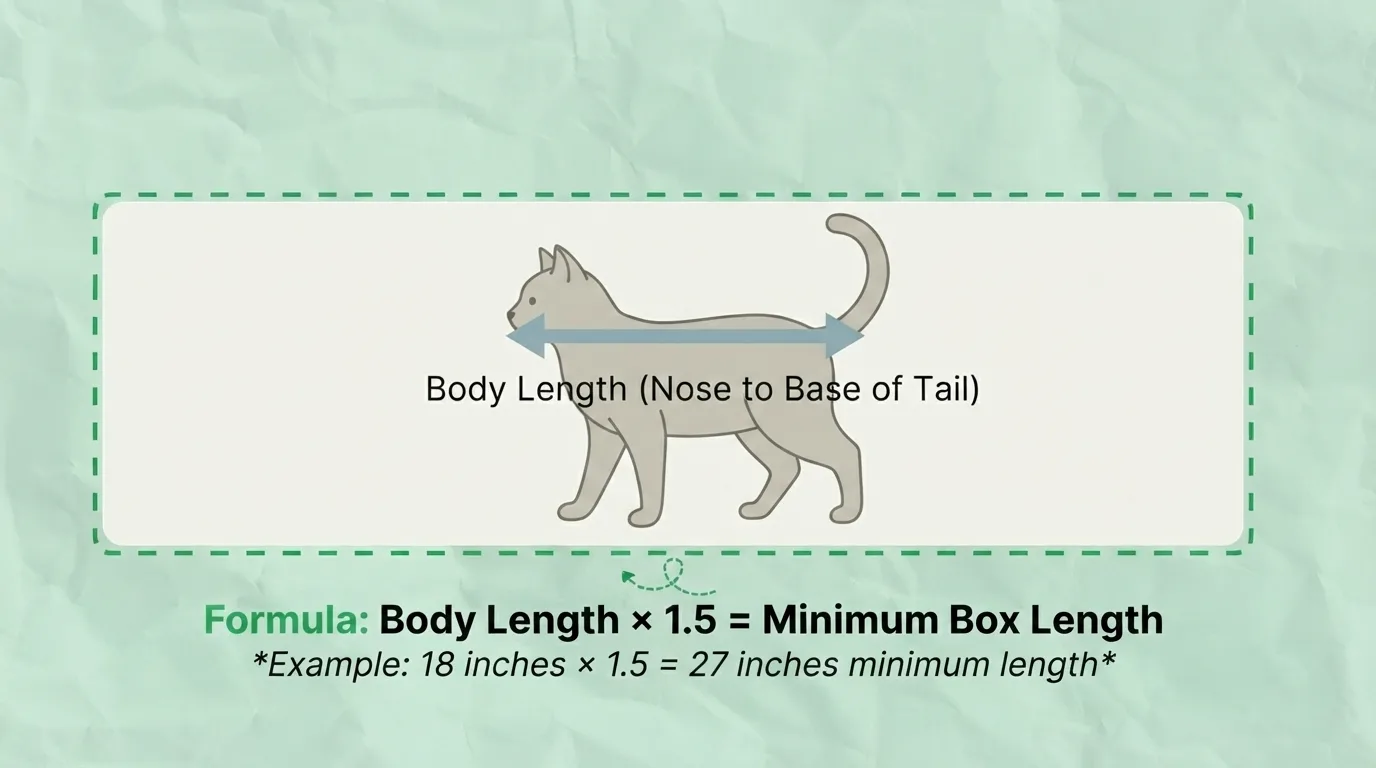
The standard sizing rule is to multiply your cat's body length by 1.5 to get the minimum interior length the box should have. This comes from veterinary behavior guidelines, which recommend a rectangular box at least 1.5 times the cat's length, with a minimum of 22 by 17 inches for an average adult cat.
Cat Body Length | Minimum Box Length | Minimum Box Width |
12 inches (small cat) | 18 inches | 12 inches |
15 inches (average cat) | 22.5 inches | 15 inches |
18 inches (large cat) | 27 inches | 18 inches |
For width, sources differ slightly. Some size the width at roughly 65 to 70 percent of the calculated length, while others simply match the width to the cat's own body length. Either approach works as long as your cat can turn a full circle inside the box without touching the walls. Matching width to your cat's full body length is the safer and more generous choice if you are unsure which to use.
How Much Extra Size Do Large Breed Cats Like Maine Coons Need?
Large breed cats such as Maine Coons, Ragdolls, and Norwegian Forest Cats often need a multiplier closer to 1.7 to 1.8 times their body length rather than the standard 1.5x. Their wider frame needs more turning room, not just more length. A 20 inch Maine Coon, for example, needs a box in the 34 to 36 inch range rather than the 30 inches a flat 1.5x calculation would suggest. This is also why standard jumbo boxes sold in stores can still fall short for the largest breeds.
What Litter Box Dimensions Fit Kittens, Adult Cats, and Large Breed Cats?

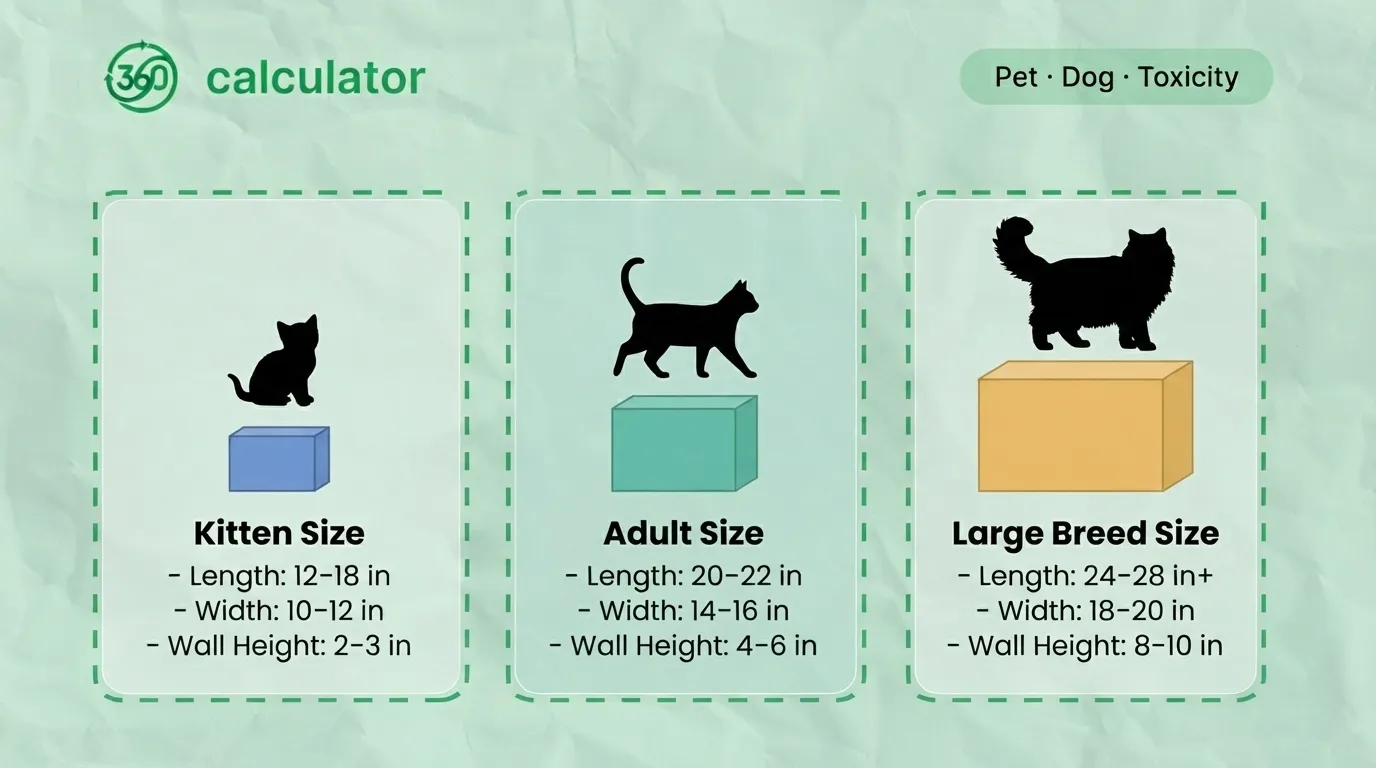
Life Stage | Typical Weight | Body Length | Interior Length | Interior Width | Wall Height |
Kitten | Under 5 lbs | 8 to 12 inches | 12 to 18 inches | 9 to 14 inches | 4 to 6 inches |
Adult | 5 to 10 lbs | 15 to 18 inches | 20 to 22 inches | 14 to 16 inches | 6 to 8 inches |
Large breed | Over 10 lbs | 18 to 24+ inches | 24 to 28+ inches | 18 to 22+ inches | 8 to 10 inches |
What Are the Standard Litter Box Size Categories and Does Yours Fit Your Cat?

Litter boxes sold in stores generally fall into a handful of size categories. Comparing your current box against this list is a quick way to check whether it is already too small, without doing the full 1.5x calculation.
Category | Typical External Size | Fits an Average Adult Cat? |
Standard small | About 14 by 10 inches | No, too small for most cats |
Standard medium | About 17 by 13 inches | Borderline |
Standard large | About 20 by 15 inches | Yes, adequate |
Jumbo | About 24 by 18 inches | Yes, generous |
DIY storage tote | About 30 by 20 inches | Yes, excellent for large or multiple cats |
How Much Extra Space Do Covered and Top-Entry Litter Boxes Need?
Covered and top-entry boxes lose usable interior length to the curve or shape of the lid, so the same sizing rule needs a few extra inches added on top. Clearance height also needs to be checked separately, so your cat can stand fully upright inside without its back brushing the roof.
For example, a covered box that measures 24 inches on the outside may only offer about 18 to 20 inches of usable length once the lid is accounted for. Research comparing covered and open boxes has found cat preference is close to evenly split, so this is mainly a space trade-off decision rather than a simple better-or-worse choice. Avoid sizing a covered box off its exterior measurement alone.
What Size Litter Box Do Kittens Need?
Kittens need a smaller box with lower walls and a lower entry point so they can climb in and out safely. Resize the box as the kitten grows rather than starting with a full adult sized box, since a box that is too large can be intimidating or hard to access for a very young kitten. Litter depth should also stay shallower for kittens, to avoid them sinking into the litter or swallowing clumps while grooming.
What Size Litter Box Do Senior Cats Need?
Senior cats generally need the same interior length as any adult cat of their size, but with a lower entry height, typically around 2 to 3 inches, so an arthritic or less mobile cat does not have to climb over a tall wall on every visit. A large, low sided open box is usually the safest choice for older cats. The interior size should still meet the 1.5x calculation for that specific cat. A senior cat does not need a smaller box, just easier access.
How Much Litter Depth Do You Need for Each Box Size?
Litter depth is connected to wall height. A shallower walled box holds litter comfortably up to a point before it starts spilling over the sides, while a deeper walled box can hold more without the same problem.
Wall Height | Comfortable Litter Depth |
4 to 5 inches | 2 to 3 inches |
6 to 8 inches | 3 to 4 inches |
8 to 10 inches | 4 inches or more |
As a general range, most adult cats do well with 2 to 4 inches of litter. Kittens need a shallower layer, and cats that dig enthusiastically often do better with slightly deeper litter so they have more material to work with.
What Happens When a Litter Box Is Too Small for Your Cat?
An undersized box forces a cat into an unnatural position every time it is used. A cat that cannot fully turn around may perch on the edge instead of stepping fully inside, or end up standing in its own waste because there is no room to move away from it. Cats dislike dirty paws, and this kind of discomfort is a common trigger for a cat to stop using the box altogether, often leading to accidents just outside the tray or on nearby carpet and furniture.
What Are the Signs Your Cat's Litter Box Is Too Small?
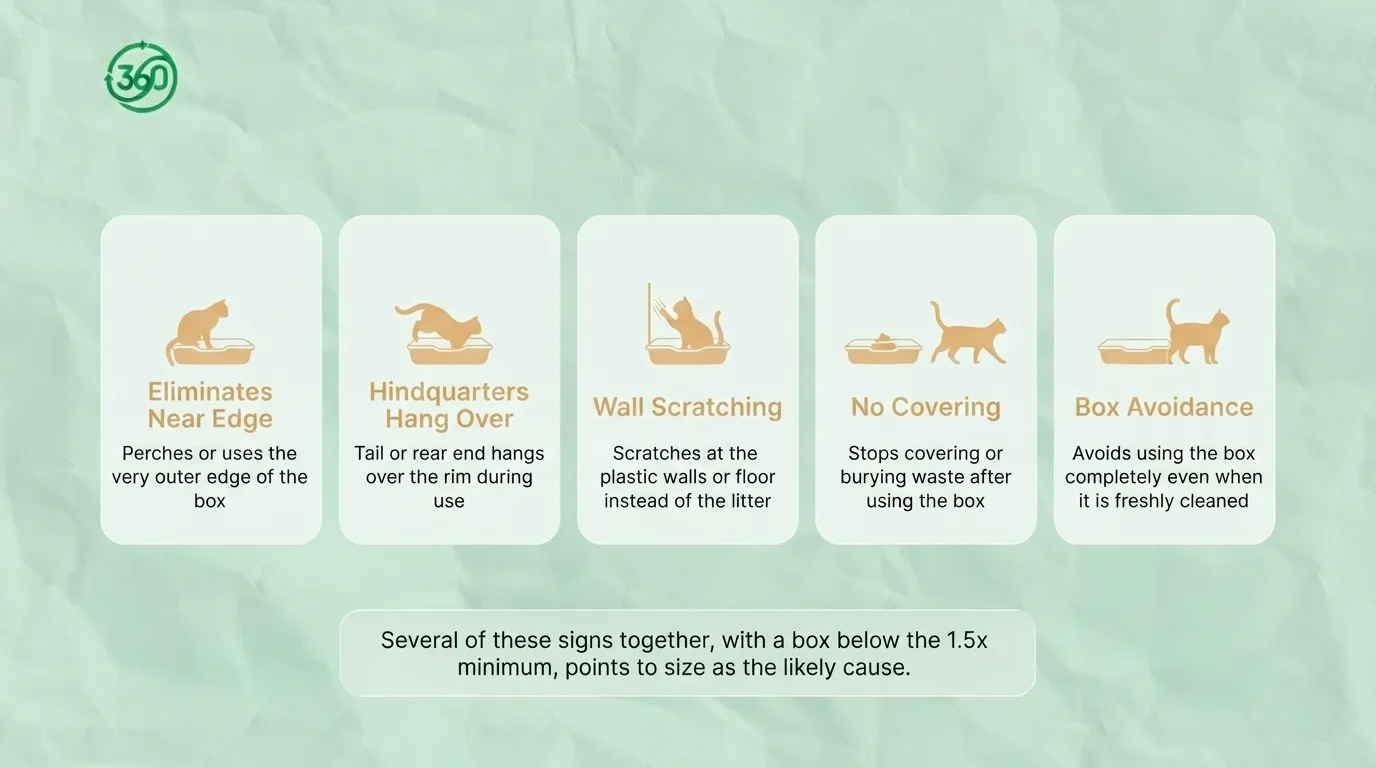
• Your cat eliminates near the edge of the box or partly outside it
• Your cat's tail or hindquarters hang over the rim while inside the box
• Your cat scratches at the walls or rim instead of the litter itself
• Your cat has stopped covering its waste
• Your cat avoids the box even when it has just been cleaned
If you notice several of these signs together, and the box measures below the 1.5x minimum for your cat, size is very likely contributing to the problem.
What Does the Research Say About Cats' Preferred Litter Box Size?
A study published in the Journal of Veterinary Medical Science compared how cats used litter boxes of different sizes in real households and found a clear preference for boxes measuring at least 50 centimeters, about 19.5 inches, in length. Cats in the study used the larger boxes more consistently, and house soiling dropped when a properly sized box was available. This lines up with the 1.5x rule described above, and shows that the recommendation is grounded in observed cat behavior rather than being a marketing figure invented by retailers.
How Does the Right Litter Box Size Work Together With the Right Number, Litter Amount, and Setup?
A correctly sized box only solves half the problem. A multi-cat household also needs enough boxes for the number of cats and floors in the home, since even a perfectly sized box can lead to accidents if cats are forced to share or compete for it.
Box size also changes how much litter you need to buy each month, since a larger box needs more litter to reach a comfortable depth, and needs the right liner to fit its new dimensions without tearing.
The sections below cover each of these related factors in the specific context of the box size you have just worked out, with a dedicated calculator for each one.
How Many Litter Boxes Do You Need for Multiple Cats and Multiple Floors?
The standard guideline is one litter box per cat, plus one extra, sometimes called the N+1 rule. Once you know the right size per cat, a multi-cat household needs that same size box, one per cat plus one spare. Homes with more than one floor generally need at least one box on each level, regardless of how many cats live there, since a cat should not have to travel far to reach a clean box. Home square footage and layout both affect the ideal count for your household. Use the Cat Litter Box Count Calculator to get a personalized number based on your cats and your home.
How Much Litter Do You Need to Fill and Maintain a Properly Sized Box?
A bigger box, sized correctly using the method above, needs more litter to reach a comfortable depth, generally 2 to 4 inches depending on wall height and life stage. Monthly litter needs depend on the box's surface area, the depth you maintain, the number of cats using it, and the litter type, since clumping clay, crystal, and natural litters are all used at different rates. The Cat Litter Usage Calculator works out exact monthly amounts based on your box size and setup.
What Size Liner Fits Your Litter Box?
Once you resize your box using the 1.5x rule, standard liners made for small or medium boxes usually will not fit properly, and tend to tear or bunch at the corners. Liners should be measured against the box's interior length, width, and wall height, not just its marketed size category. The Cat Litter Box Liner Calculator matches a liner to your box's actual measurements.
What Life Stage Is Your Cat In and How Does That Change Box Size?
Life stage, kitten, adult, or senior, changes the sizing guidance covered earlier on this page, and it is not always obvious from weight alone, especially for large breed cats that mature more slowly than average cats. If you are unsure whether your cat should still be sized as a kitten or has moved into adult or senior sizing, the Cat Age Calculator can help you place your cat correctly before choosing a box.
Is Your Cat's Weight and Body Condition Affecting the Right Box Size?
Body length matters more than weight when it comes to box sizing, but weight and body condition still matter indirectly. A heavier cat needs more turning room and a lower entry than a lean cat of the same length. If you are unsure whether your cat is at a healthy weight, check the Cat BMI Calculator before assuming your cat fits the standard adult sizing chart above.
What Carrier Size Fits Your Cat for Travel and Vet Visits?
The same nose-to-tail measurement used for litter box sizing is reusable for carrier sizing. Carriers use a similar but distinct formula, generally cat length times about 1.5 for minimum length, and standing height plus a few inches for interior height, so your cat can stand, turn, and lie down comfortably. The Cat Carrier Size Calculator applies that formula to your cat's exact measurements.
How Much Indoor Living Space Does Your Cat Need Overall?
Litter box size is one part of a bigger picture that includes vertical space, resting areas, and floor space per cat, especially in multi-cat homes. The Cat Indoor Space Calculator walks through the complete method for working out how much space your cat or cats need at home.
Will Your Cat Fit Comfortably in an Automatic Self-Cleaning Litter Box?
Automatic and self-cleaning litter boxes advertise a weight limit, but weight capacity is not the same as interior comfort. A cat still needs roughly 1.5 times its body length of usable space inside the unit to turn and dig comfortably, regardless of what the weight rating allows. Some automatic boxes also need an added multi-cat feature or unlock for households with more than one cat. The Cat Automatic Litter Box Compatibility Calculator checks your cat's measurements against specific automatic box models.
Frequently Asked Questions
How big should a cat litter box be?
A litter box should be at least 1.5 times your cat's body length, measured from the nose to the base of the tail. Large breed cats often need closer to 1.7 to 1.8 times that length.
Should I measure my cat including the tail?
No. Measure from the tip of the nose to the base of the tail only, and leave the tail itself out of the measurement.
Are covered litter boxes smaller inside?
Yes. Covered and top-entry boxes usually offer less usable interior space than their outer measurements suggest, so they generally need to be sized up.
How many litter boxes should I have for multiple cats?
A common rule is one litter box per cat, plus one extra. Two cats generally need three litter boxes.
What size litter box is best for a large cat?
Large cats often need jumbo boxes or larger, since many standard retail litter trays fall short once compared against the 1.5x, or 1.7 to 1.8x, body length rule.