

Most adult cats have a healthy weight between about 8 and 12 pounds (3.6 to 5.4 kg), though the exact number depends on breed, frame size, sex, and body condition. The most reliable way to check is to use a weight calculator alongside a Body Condition Score check, since the number on the scale alone does not tell the whole story. This page covers how the calculator works, what the result means, and how often a cat should be weighed.
How Does a Cat Weight Calculator Work?
A cat weight calculator compares a cat's current weight against typical ranges for cats of similar breed, age, sex, and frame. Some calculators also factor in activity level and neuter status for a more precise estimate. The result is only an estimate, not a diagnosis, and works best alongside a hands on body condition check.
What Information Does a Cat Weight Calculator Need?
Most calculators ask for a cat's breed or body type, age, sex, current weight, and frame size. More detailed tools also ask about activity level (low, moderate, or high), neuter or spay status, and whether the cat lives indoors, outdoors, or both. Each input changes the expected range. Male cats commonly run 15 to 20 percent larger than females, so sex shifts the target weight up or down. Neutered cats typically need fewer calories, so some calculators lower the expected range slightly to account for that. If the exact breed is unknown, domestic cat or mixed breed is the safest default, since it reflects the majority of pet cats.
How Is a Cat's Ideal Weight Range Determined?
Weight ranges are built from breed standards and veterinary reference data rather than a single fixed number. Most adult domestic cats fall between about 8 and 12 pounds (3.6 to 5.4 kg), with smaller and larger breeds sitting outside that band.
Some calculators go a step further and turn a current weight into an estimated ideal weight using a Body Condition Score formula. Each BCS level corresponds to a rough percentage over or under a cat's ideal weight. A BCS of 5 out of 5, for example, is treated as about 30 percent overweight. The formula is:
Ideal Weight = Current Weight x (100% minus the percentage over or underweight)
For a 15 lb cat scored at BCS 5, the calculation works out to 15 x 70%, or about 10.5 lb as an estimated ideal weight. This is only a starting estimate, and a vet visit is the best way to confirm it.
How Does a Cat's Age Group Affect the Calculator Result?
A cat's ideal weight and calorie needs shift across its life, so many veterinary tools split adult cats into age groups: young active adults from 1 to 6 years, mature or neutered adults from 7 to 11 years, seniors from 12 to 15 years, and geriatric cats over 15 years. Energy needs generally decrease through the middle years and then rise again after about 12 years old, since older cats often digest fat and protein less efficiently. This is why the same current weight can point to a slightly different target depending on a cat's age group.
Can a Cat Weight Calculator Predict a Kitten's Adult Size?
Some calculators estimate a kitten's future adult weight from its current age and weight using a simple formula:
Final Size = (Current Weight / Age in Weeks) x 32
At 16 weeks old, a kitten is typically about half of its eventual adult weight. This kind of estimate only works before a cat reaches full size, generally somewhere between 32 and 52 weeks old.
What Do the Calculator Results Mean?
A calculator result usually falls into one of three bands: underweight, ideal, or overweight. An ideal result confirms the current feeding and activity routine is working. An underweight or overweight result is a signal to look closer, not an automatic diagnosis, especially for a result that sits close to the boundary between two bands. The most useful next step after any result is a hands on Body Condition Score check, since weight alone does not account for muscle, frame, or coat thickness.
What Is a Normal Weight Range for Adult Cats?
Weight ranges vary more by size and breed than most owners expect. The sections below break down average weight, how it changes by breed size, and how it differs between male and female cats.
What Is the Average Weight for a Domestic Cat?
An average adult domestic cat weighs about 8 to 12 pounds (3.6 to 5.4 kg). Some veterinary references cite a slightly wider range of 3 to 6 kg as typical for adult cats. This figure is a general starting point, and an individual cat's healthy weight still depends on its frame and body condition.
How Does Weight Vary by Breed Size?
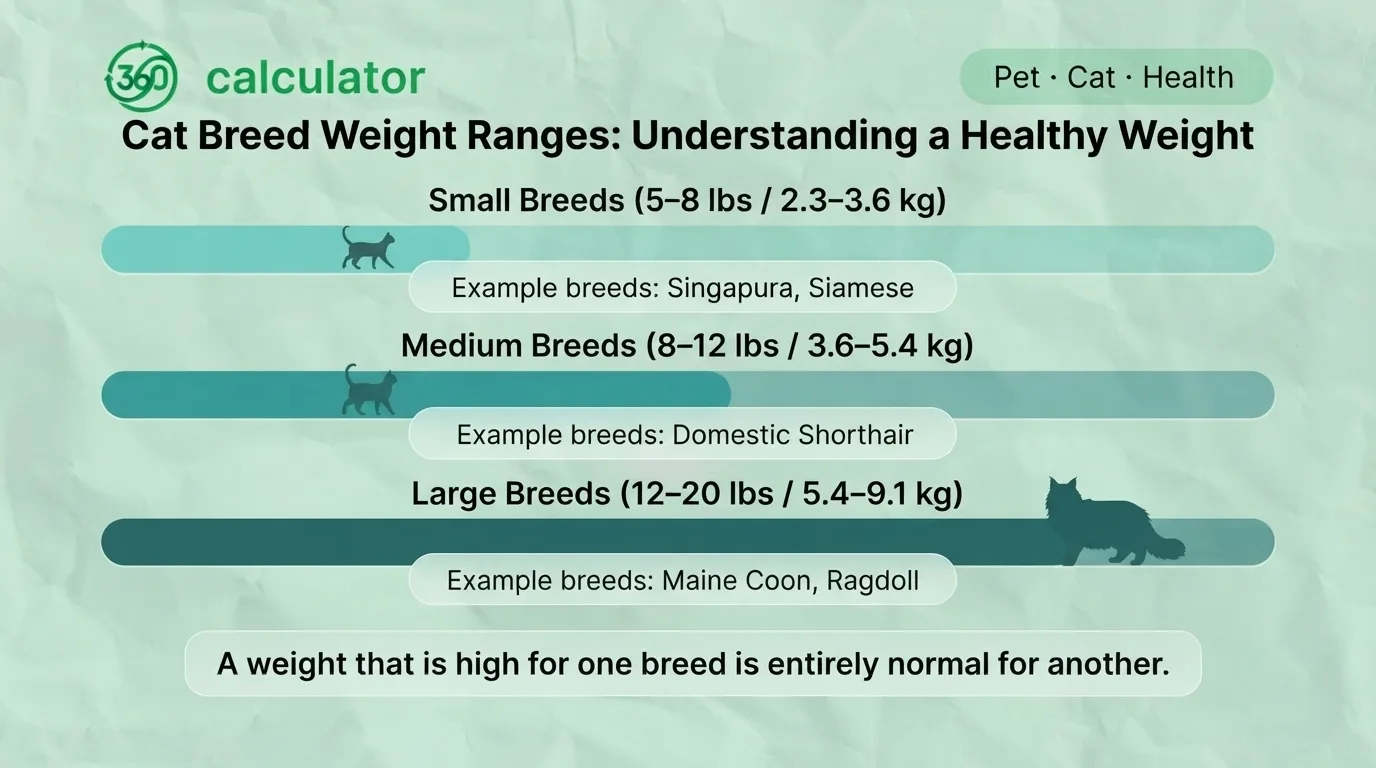
Cat breeds are often grouped into three broad size classes. Small breeds typically weigh 5 to 8 lbs (2.3 to 3.6 kg). Medium breeds, which include most domestic shorthairs, typically weigh 8 to 12 lbs (3.6 to 5.4 kg). Large breeds, such as the Maine Coon, typically weigh 12 to 20 lbs (5.4 to 9 kg). A weight that looks high for a medium breed can be entirely normal for a large breed cat with a bigger frame.
How Much Heavier Are Male Cats Than Female Cats?
Male cats are commonly 15 to 20 percent larger than female cats of the same breed, a natural difference known as sexual dimorphism. This gap tends to widen as a cat reaches full adulthood rather than being obvious in kittenhood. Neuter status can also shift adult weight, since neutering commonly lowers a cat's calorie needs.
How Do You Check a Cat's Weight Beyond the Number on the Scale?
A number on a scale does not show how that weight is distributed. Body Condition Score, paired with a simple hands on check, gives a fuller picture of whether a cat is carrying too much or too little fat.
What Is a Body Condition Score and How Is It Scored?

Body Condition Score, or BCS, is a scale, commonly 1 to 9 and sometimes simplified to 1 to 5, that estimates a cat's body fat through a visual and hands on check rather than weight alone. A score of 4 to 5 out of 9 is considered ideal for most cats. Lower scores point toward underweight, and higher scores point toward overweight, with the extremes at either end reflecting a medical concern rather than a cosmetic one.
How Do You Check Ribs, Waist, and Abdominal Tuck at Home?

Run both hands gently along a cat's ribcage. The ribs should be easy to feel under a thin layer of fat, without pressing hard and without seeing them clearly. Next, look at the cat from above. There should be a visible waist that curves in slightly behind the ribs. Finally, look at the cat from the side. A slight upward tuck behind the ribcage, before the back legs, is normal and expected. Long haired cats are harder to judge by eye alone, so the hands on rib check matters even more for them.
Why Does Frame Size Matter as Much as Weight?
Two cats can weigh the same number on a scale and still have very different body conditions. A large framed Maine Coon at 12 lbs may be lean and muscular, while a small framed cat at the same weight may be carrying excess fat. Body length offers a simple secondary reference point. An average cat measures about 18 inches long, not including the tail, so a notably longer cat can reasonably weigh more without being overweight. This is why a calculator result and a Body Condition Score check work best together rather than on their own.
What Do the Calculator Results Mean for a Cat's Health?
An underweight or overweight result matters because of what it can signal about a cat's health, not just how a cat looks. The sections below cover the visible signs of each, plus when a change in weight is worth a vet visit.
What Are the Signs a Cat Is Overweight?
An overweight cat often has no visible waist when viewed from above, and its ribs are difficult to feel even with firm pressure. Other common signs include reduced interest in jumping or climbing, audible or labored breathing, and trouble self grooming, which can lead to matted fur along the back and hindquarters.
What Are the Signs a Cat Is Underweight?
An underweight cat commonly shows visible ribs, spine, or hip bones with little to no fat covering them. A pronounced abdominal tuck, low energy, and a dull rather than shiny coat are also common signs. Sudden or unexplained weight loss deserves a vet visit even without other symptoms, since it can point to an underlying illness rather than a simple feeding issue.
How Much Weight Loss in a Cat Is a Cause for Concern?
Weight loss of about 6 percent of a cat's body weight is considered clinically significant. For an average 10 lb cat, that is under 10 ounces, an amount that is easy to miss without regular weigh ins. This is one of the clearest arguments for weighing a cat on a consistent schedule rather than relying on how it looks day to day.
What Is the Difference Between a Cat's Ideal Weight and Target Weight?
Ideal weight is a longer term estimate based on breed, frame size, Body Condition Score, and veterinary assessment. Target weight is a more practical, nearer term goal used during an active weight loss plan, and it is often adjusted at follow up visits as a cat's body and muscle condition change. A cat working toward its ideal weight may pass through several target weights along the way rather than aiming for one number from the start.
How Often Should You Weigh Your Cat?
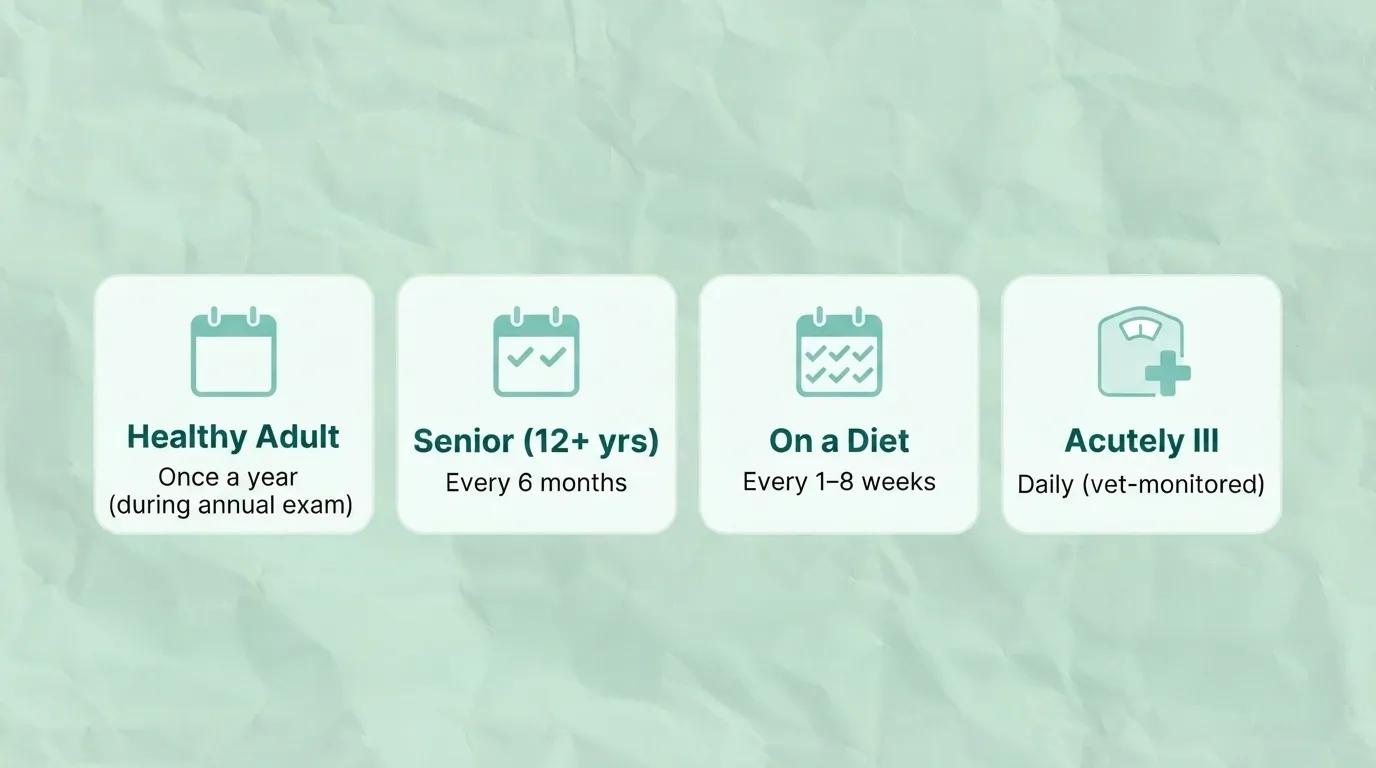
Regular weigh ins catch changes early, before they become obvious by eye. How often that should happen depends on a cat's age and health status.
How Often Should Healthy Adult Cats Be Weighed?
Healthy young to middle aged cats should generally be weighed about once a year, often during an annual checkup or vaccination visit. This is enough to catch a gradual trend without adding unnecessary stress to routine care.
How Often Should Senior Cats or Cats on a Diet Be Weighed?
Senior cats over 12 years old should be weighed about every six months, since weight changes become more common with age. Cats on an active weight loss or weight restricted diet should be checked more often, typically every 1 to 8 weeks depending on the plan. Hospitalized or acutely ill cats are weighed daily by veterinary staff, though this level of frequency is not something owners need to replicate at home.
What Other Weight and Growth Milestones Should Cat Owners Track?
Adult weight checks are only one part of tracking a cat's overall health. Kittens, specific breeds, daily feeding amounts, and even medication all connect back to weight in different ways. The sections below cover each of these in more detail.
How Much Should a Kitten Weigh Week by Week?
Newborn kittens weigh about 3 to 4 oz (85 to 115 g) at birth and should double that weight within the first week. From there, healthy kittens gain roughly 0.25 to 0.5 oz (7 to 14 g) per day through the early months, reaching about 1 to 1.5 lbs by one month old. Kitten tracking relies on weekly milestones rather than the breed and Body Condition Score approach used for adult cats.
For the full week by week breakdown, see the kitten growth chart.
What Is the Average Adult Weight for Popular Cat Breeds?
Adult weight varies widely by breed. A Maine Coon typically reaches 12 to 20 lbs, while a Siamese tends to stay leaner and smaller framed. Persians and Ragdolls fall closer to the middle of that range. Since breed changes what counts as ideal on a weight calculator, it is worth checking breed specific numbers rather than relying on the general adult average alone.
See the full average cat weight by breed guide for a complete breakdown.
How Do You Calculate Daily Calories and Treat Allowance for a Cat?
Once a cat's ideal weight is known, that number sets a daily calorie target, sometimes called RER or MER by veterinarians. A cat with a 10 lb ideal weight commonly needs roughly 180 to 200 kcal per day. Treats should stay under about 10 percent of total daily calories to avoid undermining that target. Spay or neuter status also affects the number, since it lowers a cat's energy needs.
For a full calculation based on a specific cat's weight and food, use the cat calorie calculator.
How Do You Use a Cat BMI Calculator to Check Body Fat?
A cat BMI calculator works differently from a standard weight calculator. Instead of relying on breed and current weight, it uses two body measurements, typically leg length and rib circumference, to estimate body fat percentage directly. This makes it a useful second check for owners who want more than one data point beyond weight and Body Condition Score.
Try the cat BMI calculator for a body fat based estimate.
How Do You Help an Overweight Cat Lose Weight Safely?

Safe weight loss in cats is slow and closely monitored. Veterinary guidance generally recommends a loss rate of about 0.5 to 1 percent of body weight per week, sometimes up to 2 percent under close veterinary supervision. Losing weight faster than that raises the risk of a serious liver condition called hepatic lipidosis, so sudden food restriction should always be avoided.
The cat weight loss plan covers a full, step by step approach.
How Do You Dose Flea and Medication Treatments by Cat Weight?
Most flea and medication products are dosed in weight bands, so an accurate current weight matters more than a breed based estimate. Guessing a cat's weight can lead to underdosing, which reduces effectiveness, or overdosing, which raises the risk of side effects.
See the flea treatment dosing by weight guide for exact weight bands by product type.
How Does Spaying or Neutering Affect a Cat's Weight?
Neutering lowers a cat's metabolic rate, which is why many neutered cats need fewer daily calories than the standard estimate to hold their ideal weight. Some weight calculators now include neuter status as an input for exactly this reason.
Read the spay and neuter weight guide to see how much feeding amounts typically need to change after the procedure.
Frequently Asked Questions
How much should an average adult cat weigh?
Most adult cats weigh between 8 and 12 pounds (3.6 to 5.4 kg), though breed and frame size can shift that range higher or lower.
Is 12 pounds overweight for a cat?
Not necessarily. A 12 lb cat can be at an ideal weight for a large breed or a large frame, while the same weight may be overweight for a small framed cat. A Body Condition Score check gives a clearer answer than the number alone.
How can I check my cat's weight at home without a vet?
Weigh the cat on a home scale, then check its Body Condition Score by feeling the ribs and looking for a waist from above and a slight tuck from the side.
Why is my cat losing weight even though it eats normally?
Unexplained weight loss, even with a normal appetite, can point to an underlying health issue and is worth discussing with a vet rather than waiting to see if it continues.
How often should I weigh my kitten?
Kittens grow quickly, so weekly weigh ins during the first few months are the best way to catch a growth problem early.