


A Dog Calorie Calculator is an online tool that determines the daily calorie needs of a dog based on its weight, age, activity level, and metabolism. It uses veterinary-approved formulas, like Resting Energy Requirement (RER) and Maintenance Energy Requirement (MER). MER adjusts calories according to the activity factor, ranging from 1.2 for inactive dogs to 3.0 for highly active ones. The dog calorie calculator provides data-based and accurate calorie requirements for puppies, adult dogs, and senior dogs, helping in healthy growth and weight control. It also helps owners in weight-loss, or weight-gain goals safely. Moreover, the calculator estimates calorie density in both commercial and homemade foods to help in precise diet planning.here you will see standard dog calorie charts categorized by weight and breed, helping users identify daily energy intake and prevent overfeeding or underfeeding directly. By combining all these factors, the Dog Calorie Calculator offers a complete, evidence-based guide to manage nutrition and overall health.
What Is a Dog Calorie Calculator and How Does It Work?
A Dog Calorie Calculator is an online tool that helps dog owners understand how many calories their dog needs per day. A Dog calorie calculator uses veterinary nutritional formulas (Resting Energy Requirement and Maintenance Energy Requirement) to provide an accurate feeding amount to balance a dog’s weight. It works by entering details about your dog like its age, weight, activity level, and neuter status, and then calculates your dog’s daily caloric needs. It works with both homemade and commercial dog foods. It helps owners to maintain their dog’s weight by making informed decisions to prevent overfeeding and underfeeding and supporting long-term energy balance and overall health.
What Are RER and MER in Dogs, and What Formula Is Used to Calculate Them?
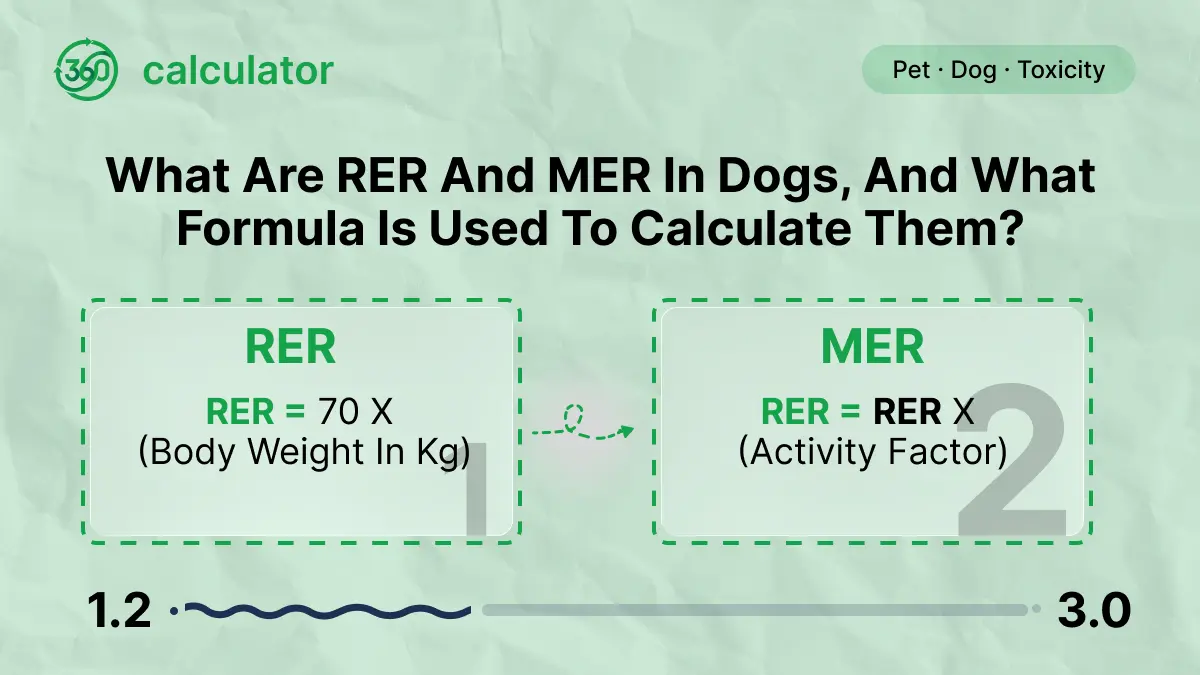
Resting Energy Requirement (RER) is the number of calories a dog needs when he is at rest, and Maintenance Energy Requirement (MER) is the number of calories dogs need for daily activities. RER is calculated by the formula (RER = 70 × (Body Weight in kg)^0.75). (MER) is calculated according to the dog’s activity level. Active dogs or growing puppies need more calories, while senior or less active dogs need fewer calories. It is calculated by the formula (MER = RER × Activity Factor). Activity factor depends on the activity level. The activity factor ranges from 1.2 to 3.0, depending on how active your dog is, for example, inactive, average active, or highly active.
Which Factors Affect a Dog’s Calorie Requirements?
Factors affecting a dog’s calorie requirements depend on how its body works (metabolism), how much it is growing, and how active it is. These factors affect the amount of food and energy your dog needs to stay healthy.
Factors that Affect a Dog’s Calorie Requirements are;
Metabolism: It means how fast a dog burns food for energy. (Fast metabolism = more calories needed).
Growth: A young dog needs more calories because its body is growing and building muscles. Therefore, it affects calorie intake.
Daily Activity: A dog that runs, plays, or walks a lot burns more calories than a resting dog.
How Many Calories Does a Puppy, Adult, or Senior Dog Need?
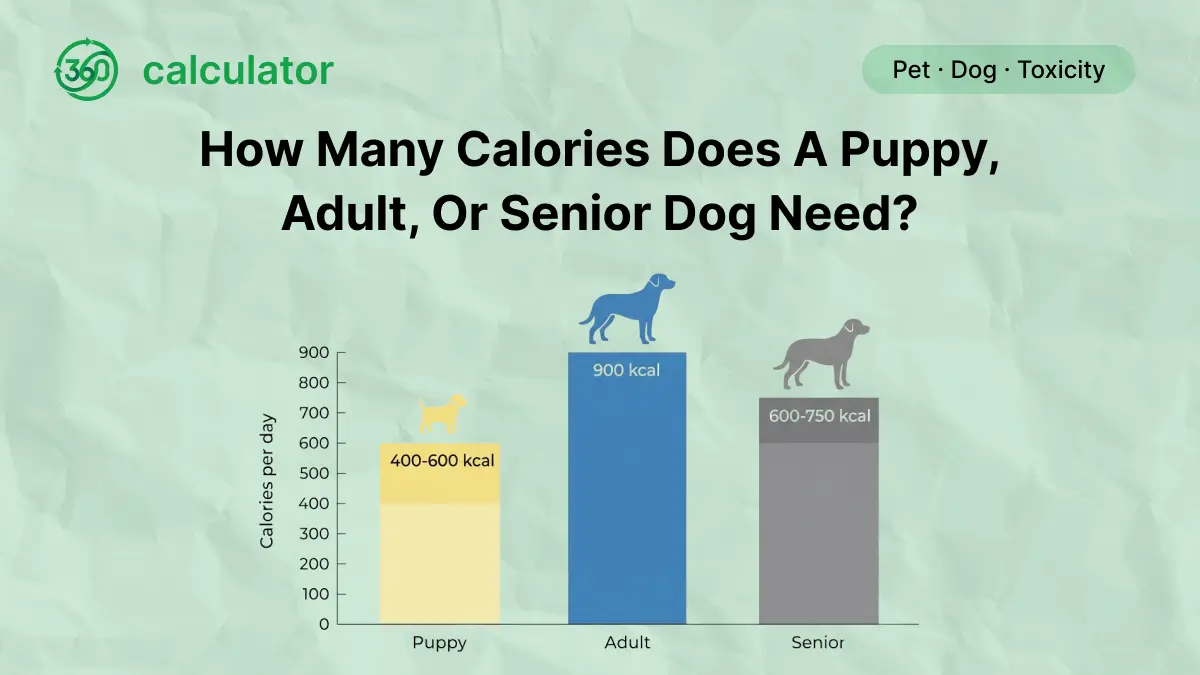
A Puppy, Adult, or Senior Dog Needs around 400 to 900 per day. It depends on their age, weight and activity level. A puppy grows fast, an adult maintains their weight, and a senior dog slows down its activity, therefore, the caloric needs change over time. According to the American Kennel Club (AKC), a puppy needs 2 to 3 times more calories than adult dogs of the same weight because of its growth. For Example, A 10-pound (4.5 kg) puppy may need 400 to 600 calories per day. An average adult dog needs 30 calories per pound (66 calories per kg) of its body weight to maintain its weight and energy. For example, a 30-pound (13.6 kg) dog needs 900 calories per day. A senior dog moves less, and its metabolism slows down with age. It needs around 20 to 25 calories per pound (44 to 55 calories per kg) of body weight. For example, a 30-pound senior dog may need around 600 to 750 calories per day.
How Many Calories Does a Dog Need per Pound of Body Weight?
A dog needs about 25 to 30 calories per pound of body weight per day for a healthy weight.
For example, a 20-pound dog needs 500 to 600 calories daily. An active dog needs more, while an old or less active dog needs less for a healthy weight.
What Is the Difference Between Weight Loss, Maintenance, and Weight Gain Calorie Calculations?
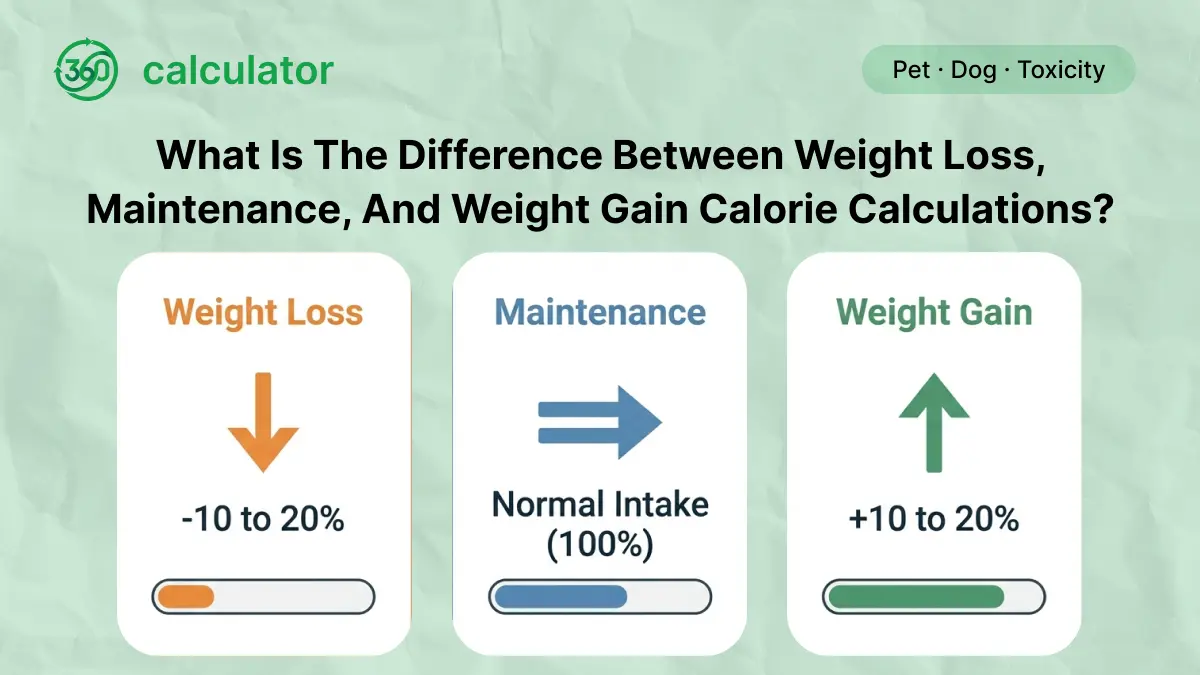
The Difference Between Weight Loss, Maintenance, and Weight Gain Calorie calculations is that a Weight Loss Calorie Calculation helps find and reduce extra fat by a less caloric intake plan, a Maintenance Calorie Calculation provide a balanced caloric intake to keep a steady and healthy dog weight, and a Weight Gain Calorie Calculation provide a diet plan with increases daily caloric intake to help underweight dogs reach a healthy weight weight.
This table shows each calculator type and how it adjusts daily calories based on the goal:
Calculator type | Goal | Daily Calories Target |
Weight loss | To help dog loss weight safely | Feed 10 to 20% less than normal intake |
Maintenance | Keep dog in healthy weight | Feed normal daily calories based on size, activity level. |
Weight Gain | To help an underweight dog gain weight | Feed about 10 to 20% calories extra |
These calorie calculations help you feed the right amount of food your dog requires.
How Do Homemade and Commercial Dog Foods Differ in Calorie Content?
Homemade and commercial dog foods differ in the number of calories they provide. Commercial dog foods (store-bought brands) have a higher calorie density, around 300 to 500 calories per cup in dry kibble and 150 to 250 calories per cup for canned food and are less in volume. These foods are consistent in calories, so the calorie amount stays the same every time. They have weight-management formulas with fewer calories to help prevent obesity. Homemade dog foods have more variation in calorie content because the amount of ingredients are not balanced. They have a lower calorie density, often 200 to 350 calories per cup, and require a larger volume for a dog’s energy needs. For lower-fat or grain-free diets, even more food is required to reach the right number of calories.Commercial foods are clearer with the number of calories they provide, while homemade foods are inconsistent with the amount of calories, and it needs close monitoring.
What Are High-Calorie Foods for Active Dogs?
High-calorie foods for active dogs are chicken, beef-based kibble, salmon, fish oil blends, peanut butter, and cooked egg. These foods are rich in proteins and healthy fats, helping dogs maintain energy for exercise, training, and play.
What Are Low-Calorie Food Options for Overweight Dogs?
Low-calorie foods for overweight dogs are lean chicken or turkey (150 to 200 calories per cup cooked), green beans (30 to 40 calories per cup), and pumpkin puree (50 to 60 calories per cup). They reduce fat and keep them full and healthy. These foods are high in fibre and lean protein but lower in calorie density. It helps dogs lose weight without losing muscle.
What Does a Typical Dog Calorie Chart Look Like by Weight or Breed?
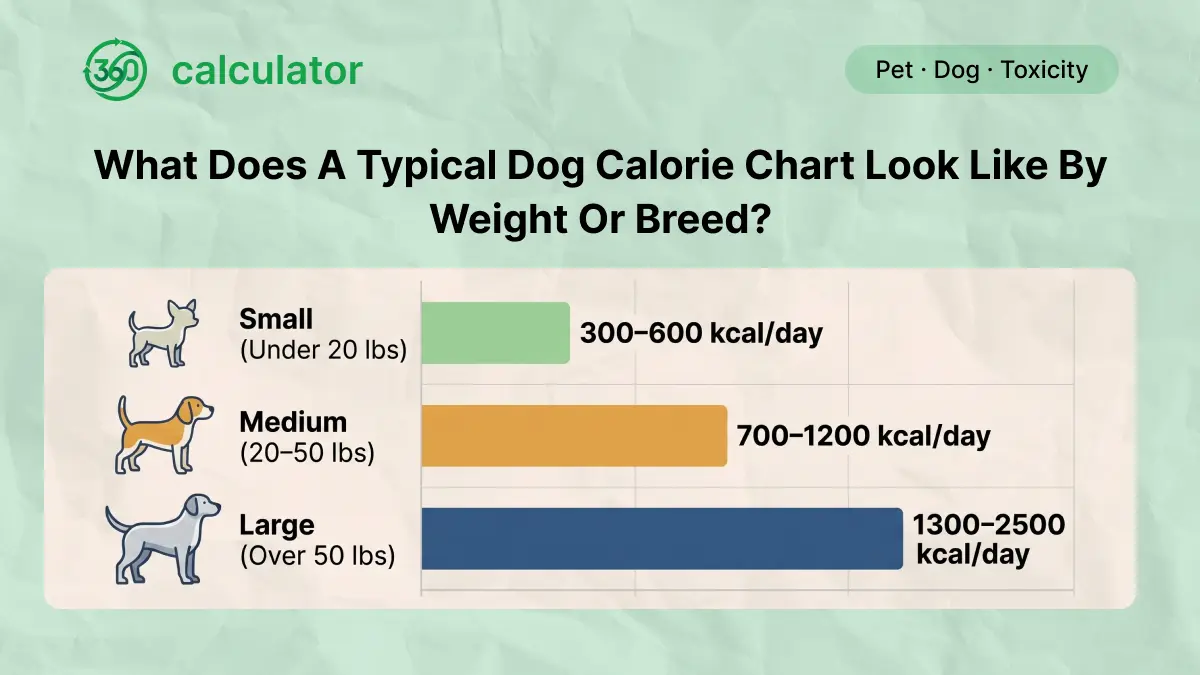
A Typical Dog Calorie Chart by Weight or Breed shows the daily calorie needs based on a dog’s weight and breed size. It helps pet owners understand how much to feed their dog every day.
The chart below shows the calorie requirements for dogs of different sizes.
Breed size | Weight rang | Daily calories need |
Small breed | Under 20 lbs | 300 to 600 Kcal per day |
Medium breed | 20 to 50 lbs | 700 to 1200 kcal per day |
Large breed | Over 50 lbs | 1300 to 2500 kcal per day |
These values are general estimates. Use the calculator to find out the exact amount.
What Are the Risks of Feeding Too Many or Too Few Calories?

Feeding too many calories leads to being overweight, which causes joint problems, diabetes, heart disease, and a shorter lifespan. It also reduces mobility and overall energy. Feeding too few calories causes nutrient deficiencies, muscle loss, fatigue, and poor immune health. Dogs that don’t get enough energy may appear weak, lose coat shine, and struggle to maintain overall body health. Feeding the right number of calories keeps a dog healthy.
What Are the Different Types of Dog Nutrition Calculators?
Different types of dog Nutrition Calculators are dog Calorie Calculator, dog Food Calculator, Homemade dog Food Serving Size Calculator, and Dog Weight Calculator. They help owners manage their pet’s diet accurately
How Can I Calculate My Dog’s Daily Energy Requirement (DER)?
To calculate your dog’s Daily Energy Requirement (DER), start with the Resting Energy Requirement (RER = 70 × (Body weight in kg)^0.75) and multiply it by the activity factor. The formula is DER = RER × Activity Factor. The activity factor depends on the dog’s age and activity level, ranging from 1.6 to 30. This gives the exact energy your dog needs every day.
Is There a Specific Calculator for Diabetic Dogs?
Yes, there are specific diabetic dog calculators. These calculators help pet owners and veterinarians find insulin doses, blood glucose trends, and feeding schedules based on the dog’s weight, diet, and blood sugar readings. They help in stabilising glucose levels and proper diabetes management for dogs.
How Do I Calculate a Calorie Deficit for My Dog to Lose Weight?
To calculate a calorie deficit for your dog to lose weight, first Daily Energy Requirement (DER) is calculated using the formula (DER = RER × Activity Factor). RER (Resting Energy Requirement) is 70 × (body weight in kg)^0.75, and the Activity Factor for weight loss is between 1.0 and 1.2.
Then, create a calorie-deficient diet by feeding your dog 80 to 90% of the calculated DER. This controlled reduction helps weight loss without nutrient deficiencies.
Can I Estimate My Dog’s Calorie Intake by Breed or Age?
Yes, you can estimate your dog’s calorie intake based on breed and age. Both of these factors influence the metabolism and energy needs. Puppies and active breeds like Border Collies or Labradors need more calories per pound due to higher growth and activity levels, while senior or small breeds need fewer calories for a healthy weight.
How Do I Calculate My Dog’s BMI or Ideal Body Weight?
To calculate your dog’s BMI (Body Mass Index) or Ideal Body Weight, you can use the formula: Dog BMI = (Weight in kg) / (Height in meters)².
For example, if your dog weighs 20 kg and stands 0.5 m tall, the BMI would be 20 / (0.5)² = 80.
To find Ideal Body Weight (IBW), use this formula: IBW = Current Weight × (Ideal Body Condition Score ÷ Current Body Condition Score)
These calculations help you know that your dog is underweight, overweight, or within a healthy range.
Which Other Pet Calorie Calculators Are Available?
Other available pet calorie calculators are the Cat Calorie Calculator, Rabbit Calorie Calculator, and Horse Calorie Calculator, which help determine daily calorie needs based on weight and activity level. These calculators help maintain your pet’s health and weight
How Can I Estimate Calories in Dog Treats and Snacks?
To estimate the calories in dog treats and snacks, check the packaging label. Most commercial treats list calories per piece or per serving. If the label doesn’t provide this information, you can use a general estimate. Many dog treats contain about 2 to 5 calories per small treat and up to 20 to 40 calories per larger biscuit or chew. For homemade treats, calculate the calories by using the calorie calculator, add the calorie item in the treat in the calculator and then divide the total sum by this will give you the amount of calories per treat.
FAQs
What is a dog calorie calculator, and how does it work?
A dog calorie calculator is a free online tool that takes your dog's weight, age, breed, and activity level as input and calculates their daily calorie requirement, helping you plan their diet correctly.
How many calories does my dog need per day?
This depends on your dog's weight, age, breed size, and activity level. A smaller, less active dog consumes fewer calories, while a larger or more active dog requires more. The calculator gives you an exact figure once you enter these details.
What details do I need to enter into the calculator?
You need to enter your dog's current weight, age, breed/size category, and daily activity level (low, moderate, or high). Based on these inputs, the calculator determines the daily calorie need.
Is this calculator accurate for all dog breeds?
The calculator is based on general estimation formulas that are reliable for most breeds, but every dog's metabolism can vary. It's best to consult a vet before making any major diet changes.
What should I do if my dog is underweight or overweight?
If the result shows your dog is underweight or overweight, gradually adjust their calorie intake and monitor their weight regularly. For serious cases, it's important to get a professional diet plan from a vet.