

This page helps you find the right age to spay or neuter your cat. There is no single number that fits every cat. The right timing depends on your cat's current weight, breed, sex, and whether they spend time outdoors. Use the calculator below to get a personalized age recommendation, then read on to understand the reasoning behind it and what to plan for next.
When Should You Spay or Neuter Your Cat by Age?
Most timing advice for cats falls into three general brackets: early or pediatric surgery, the standard window most vets recommend, and surgery for adult or senior cats who are fixed later in life. There are also a few situations that come up often, such as what to do if your cat has already started her first heat cycle. The sections below cover each one.
What Age Do Veterinary Organizations Recommend for Spay/Neuter?
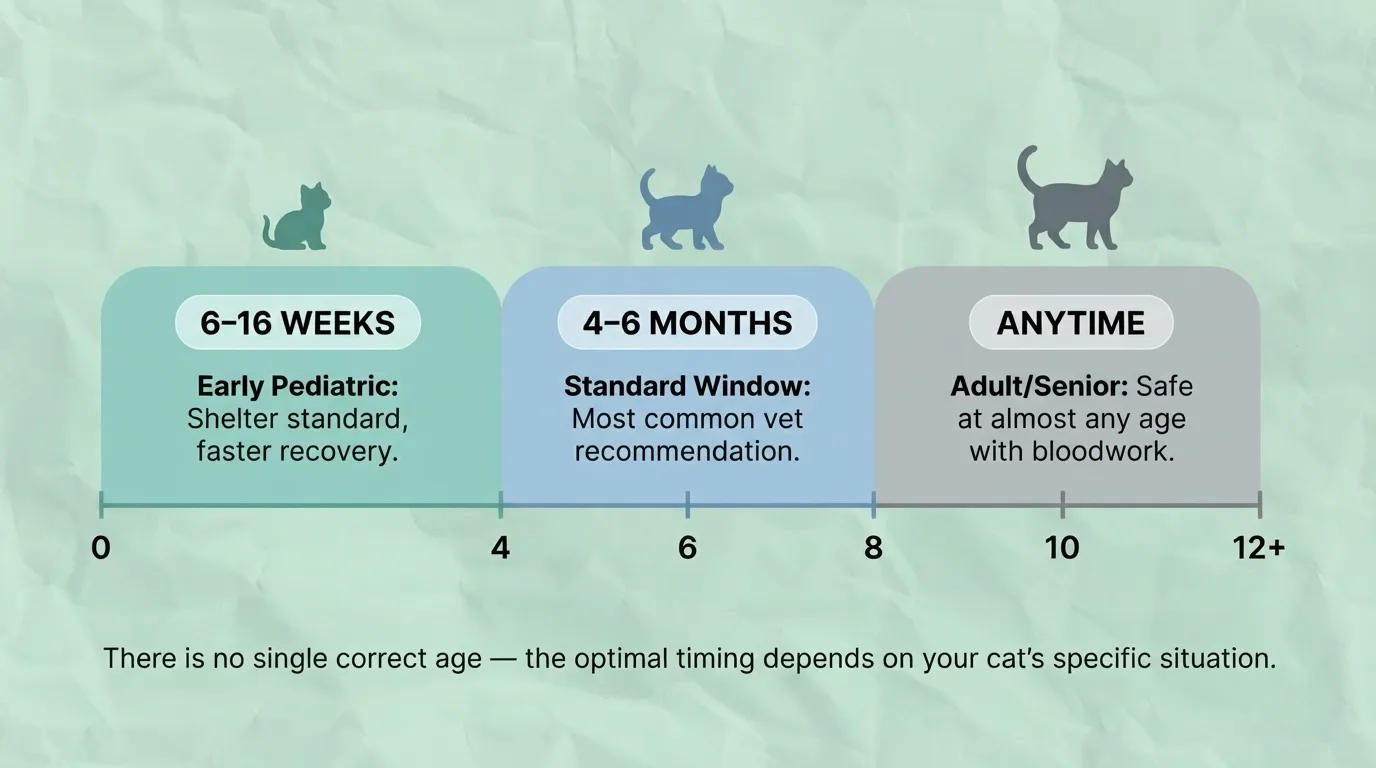
Several national veterinary groups have looked at this question and published guidance. The American Animal Hospital Association and the American Association of Feline Practitioners back the Feline Fix by Five initiative, which recommends sterilizing cats by five months of age. The American Veterinary Medical Association supports early spay and neuter between eight and sixteen weeks, an approach mainly used by shelters to make sure kittens are fixed before they go to a new home. This position is also backed by the Association of Shelter Veterinarians, the WINN Feline Foundation, and The Cat Fanciers Association.
Organization | Recommended Age | Notes |
AAHA and AAFP | By 5 months | Feline Fix by Five initiative |
AVMA | 8 to 16 weeks (early); by 5 months (general) | Early timing mainly used in shelters |
Association of Shelter Veterinarians, WINN Feline Foundation, Cat Fanciers Association | By 5 months | Co-endorse the same consensus recommendation |
What Age Is Considered Early or Pediatric Spay/Neuter?
Early or pediatric spay and neuter refers to surgery done between about six and sixteen weeks of age. This is the standard approach in many shelters, since it guarantees a kitten is already fixed before adoption instead of relying on a future owner to schedule it. Most shelters ask for a minimum weight of about two pounds before going ahead with surgery, regardless of the exact age in weeks. Research comparing different age groups has found that younger kittens tend to recover faster, lose less blood during surgery, and have fewer minor complications than cats fixed at an older age.
What Age Is Considered Standard Spay/Neuter?
For most pet cats, four to six months is still the most common age range recommended by general practice vets. At this stage a kitten is large enough for straightforward surgery, but young enough to be fixed before puberty or a first heat cycle begins. Some vets prefer to wait toward the later end of this window simply because it is easier to schedule around vaccination visits and because owners tend to feel more comfortable once their kitten looks a bit more grown up, not because there is a medical reason to wait.
Is It Too Late to Spay or Neuter an Adult Cat?
It is never too late to spay or neuter a healthy cat. Adult and senior cats can be fixed safely at almost any age, though your vet will likely run bloodwork first to confirm the surgery is safe. One thing worth knowing is that some hormone driven habits, such as spraying or roaming, may not fully go away once they are established, even after the surgery. If you have adopted an older cat, a checkup with your vet is the best way to confirm they are a good candidate.
Can a Cat Be Spayed While She Is in Heat?
Yes, spaying during heat is possible, though some vets prefer to wait a couple of weeks until the cycle ends. During heat, blood flow to the reproductive organs increases, which can make the surgery slightly more involved. If your cat has already gone into heat and you missed the ideal window, talk to your vet about whether to proceed right away or wait a short time.
How Does the Cat Neuter/Spay Age Calculator Work?
The calculator on this page is meant to turn general guidance into a personal recommendation. Instead of giving you one age that applies to every cat, it takes a few details about your cat and adjusts the suggested timing accordingly.
What Inputs Does the Calculator Use to Recommend an Age?
The tool asks for the following details:
● Current age of your cat
● Current weight
● Sex, male or female
● Breed
● Indoor or outdoor lifestyle
Each of these shifts the output slightly. For example, outdoor access usually moves the recommendation earlier, while a slow maturing large breed may push it a bit later. The next section explains why each factor matters on its own.
How Accurate Is an Online Spay/Neuter Age Calculator?
The calculator gives a research based estimate, not a medical exam. It draws on published veterinary guidance to suggest a reasonable window for your cat, but it cannot account for health conditions that only a physical exam can catch. Before booking surgery, confirm the timing with your veterinarian, especially if your cat has any health concerns or was recently adopted with an unclear history.
What Factors Change the Ideal Spay/Neuter Age for a Cat?
The four to six month range works for most cats, but several factors can shift that window earlier or later. Weight, breed, lifestyle, sex, and overall health all play a part. Each is covered below.
How Does Weight Affect the Right Age to Spay or Neuter a Cat?
Weight matters just as much as calendar age. Many shelters and vets set a minimum weight of about two pounds before considering anesthesia safe, no matter how many weeks old the kitten is. A vet will typically check both age and weight together before scheduling surgery, since a kitten that is small for its age may need a bit more time to grow.
How Does Breed Affect the Ideal Spay/Neuter Age?
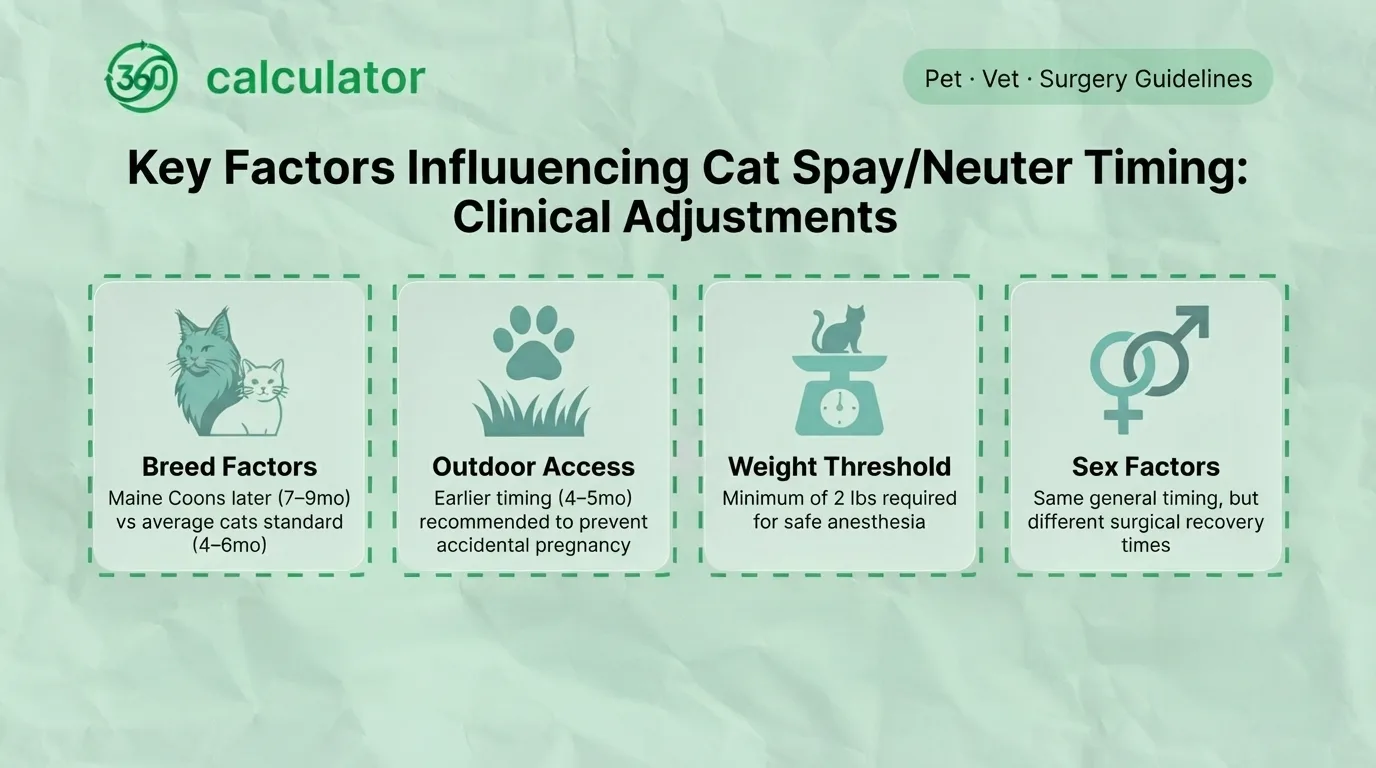
Most domestic shorthair and mixed breed cats fit comfortably into the standard four to six month window. Slower maturing large breeds, such as the Maine Coon and Norwegian Forest Cat, sometimes do better waiting closer to seven to nine months to allow for fuller development. It is worth noting that orthopedic concerns linked to early sterilization in large dog breeds have not been found in cats, so that particular worry from the dog world does not carry over to feline patients.
Breed Type | Typical Recommended Age |
Domestic shorthair or mixed breed | 4 to 6 months |
Maine Coon, Norwegian Forest Cat, and other slow maturing large breeds | 7 to 9 months |
Shelter or rescue kittens | As early as 8 weeks, once at least 2 pounds |
How Does Indoor vs Outdoor Lifestyle Affect Spay/Neuter Timing?
Cats with outdoor access are usually fixed earlier, around four to five months, to lower the risk of an unplanned pregnancy or roaming related injury. Indoor only cats have a bit more flexibility and can often wait closer to the six month mark without added risk.
How Does Sex (Male vs Female) Affect the Ideal Age to Fix a Cat?
Female and male cats are usually fixed around the same age, but for different reasons. In females, the deadline is the first heat cycle, which can start as early as four months in some cats. In males, the concern is the onset of spraying and roaming behavior once testosterone rises. The medical terms differ too: a female spay is technically an ovariohysterectomy, and a male neuter is an orchiectomy. The surgical details of each procedure are covered separately in our cat spay vs neuter procedure guide.
Does a Cat's Health Change the Recommended Spay/Neuter Age?
Yes. Vets may delay surgery for kittens with a congenital condition, low body weight for their age, or an active illness until they are stable. Cats that have already had a litter can still be spayed safely, usually about two to three months after weaning their kittens.
Why Does the Age of Spay or Neuter Matter for a Cat's Health?
Timing affects more than convenience. Operating too early and waiting too long each carry their own considerations, and understanding both sides helps you make a decision that fits your cat rather than just following a general rule.
What Are the Health Risks of Spaying or Neutering a Cat Too Early?
The two concerns raised most often are growth plate closure and urethral narrowing in male cats. On the urethral concern, a controlled study found no difference in urethral diameter between cats neutered at seven weeks, cats neutered at seven months, and cats left intact, which directly challenges the idea that early neutering causes urinary blockages later on. Separately, a study comparing complication rates across age groups actually found more minor complications in the oldest neutered group than in the youngest one.
What Are the Health Risks of Waiting Too Long to Spay or Neuter a Cat?

Waiting has its own risks. Unspayed females face a higher lifetime risk of mammary cancer, pyometra, and other reproductive disease. Mammary tumors in cats are especially serious, since up to 96 percent are malignant and median survival after diagnosis is generally under a year. Intact males face a higher risk of testicular cancer, and the longer a cat goes unfixed, the more likely hormone driven behaviors like spraying and roaming become permanent habits.
What Happens If You Spay a Cat Before Her First Heat?
Spaying before the first heat cycle significantly lowers a cat's lifetime risk of mammary cancer. Because first heat can start as early as four months in some kittens, waiting for a fixed calendar date without checking for early signs of heat can mean missing this protective window.
Does the Age of Spay or Neuter Affect a Cat's Life Expectancy?
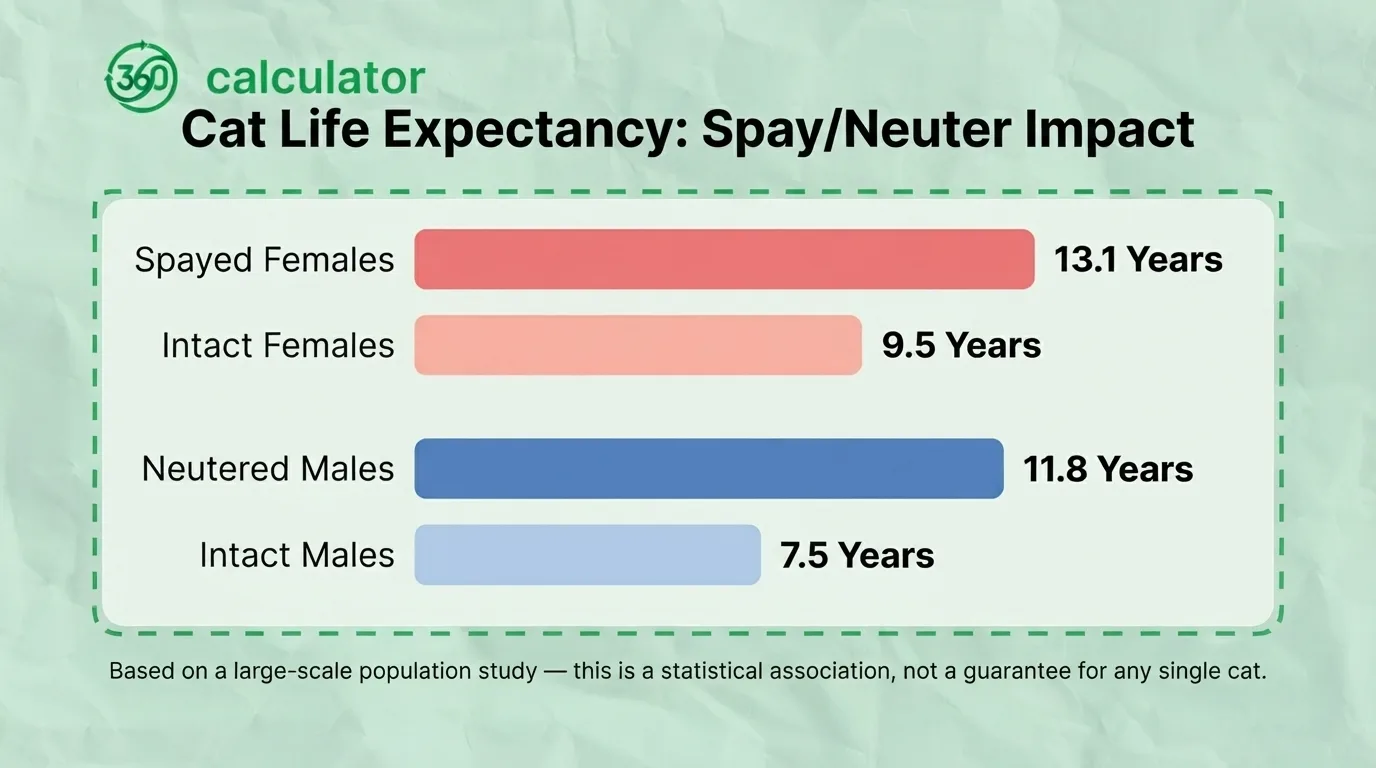
A large scale report covering 460,000 cats found that spayed females lived an average of 13.1 years compared with 9.5 years for intact females, and neutered males lived 11.8 years compared with 7.5 years for intact males. This is an association drawn from population level data rather than a guarantee for any single cat, and the exact causes behind the gap were not identified. Even so, it is one of the clearer data points showing why timing matters.
Group | Average Life Expectancy |
Spayed females | 13.1 years |
Intact females | 9.5 years |
Neutered males | 11.8 years |
Intact males | 7.5 years |
What Are Common Myths About Cat Spay/Neuter Age?
A few misunderstandings about spay and neuter timing keep circulating in forums and comment sections. The sections below address the most common ones directly, using current veterinary evidence rather than opinion.
Does a Female Cat Need to Have One Litter Before Being Spayed?
No. There is no medical or behavioral benefit to a female cat having a litter before being spayed. Waiting can instead let hormone driven behaviors settle in and adds the risk of an unwanted litter in the meantime.
Does Neutering Too Early Stunt a Cat's Growth?
This is a common worry, but current evidence does not support it. Studies comparing cats sterilized between six and fourteen weeks with cats fixed later found no significant weight difference between the groups. One study even found that the limbs of early sterilized animals grew for a slightly longer period, resulting in marginally taller cats, though the practical significance of that finding is still unclear. Overall, there is no solid evidence that early surgery stunts a cat's growth.
Will Neutering or Spaying Change My Cat's Personality?
A cat's core personality and temperament stay the same after surgery. What changes are the hormone driven behaviors, such as spraying, roaming, yowling, and heat related restlessness, which reduce or disappear. Your cat will still be the same cat, just without the behaviors tied to mating instinct.
What Else Should You Know Before Scheduling Your Cat's Spay or Neuter Surgery?
Once you know the right age for your cat, a few practical questions usually come next: what the surgery costs, how to prepare, what recovery looks like, and how to find the right vet or clinic. The sections below cover each of these briefly and point you to a dedicated resource for more detail.
How Much Does It Cost to Spay or Neuter a Cat?

Cost varies by location, sex, and provider. Neuter surgery for a male cat commonly runs around 200 to 300 dollars, while spaying a female usually costs more since it is a more involved procedure. Shelters and nonprofit clinics often charge less, and pediatric surgery through these programs tends to be priced lower than adult surgery at a private practice. Pregnant cats or those with a retained testicle typically involve an added fee. For a personalized number, try our cat spay/neuter cost calculator.
Procedure | Typical Cost Range |
Male neuter | $100 to $300 |
Female spay | $200 to $500 |
Low-cost clinic or shelter | Often $25 to $100 |
How Many Human Years Is Your Cat's Age?
Cat aging does not follow a simple formula of one year equals seven human years. Kittens age quickly in their first two years, then the pace slows down. Knowing your cat's true life stage can help confirm whether they have already passed the ideal spay or neuter window, especially for an adopted cat with an uncertain birth date. Our cat age calculator converts your cat's age into the human year equivalent in a few seconds.
How Long Is Recovery After a Cat Is Spayed or Neutered?
Most cats recover within ten to fourteen days. Younger kittens tend to bounce back faster than older cats, which is one more reason staying within the recommended age window can make the whole experience easier. For a full breakdown of what to expect day by day, including cone use and activity limits, see our cat spay/neuter recovery guide.
How Do You Prepare a Kitten for Spay or Neuter Surgery?
Preparation is usually simple. Most vets ask for a short fast of two to four hours before surgery rather than a longer one, since very young kittens can develop low blood sugar if food is withheld too long. Your vet will also confirm your kitten's vaccination status, which is typically complete around sixteen weeks, and perform a quick pre-op exam. Our cat surgery preparation checklist walks through each step in order.
How Much Should a Kitten Weigh at Different Ages?
Weight ties directly back to the minimum surgical threshold mentioned earlier in this page, generally around two pounds. Below is a rough reference for typical kitten weight by age. For a chart built around your specific kitten, use our cat weight calculator.
Age | Typical Weight Range |
8 weeks | 1.5 to 2.5 lbs |
12 weeks | 2.5 to 3.5 lbs |
4 months | 3.5 to 5 lbs |
6 months | 5 to 7 lbs |
Is My Cat at a Healthy Weight After Being Spayed or Neutered?
Body condition scoring is a more reliable way to judge a healthy weight than a single number on a scale, since frame size varies by breed. Even cats fixed within the recommended age window still need weight monitoring afterward, since metabolism changes regardless of the age at surgery. Check your cat's score with our cat BMI calculator.
Will Neutering or Spaying Affect My Cat's Weight After Surgery?
A cat's metabolic rate typically drops after surgery, so portion control matters regardless of which age you chose for the procedure. For a feeding plan built around your cat's new needs, use our cat calorie calculator.
What Is the Difference Between Spaying, Neutering, and Other Sterilization Options?
The standard procedures are an ovariohysterectomy for females and an orchiectomy for males, both of which remove the hormone producing organs. Less common alternatives, such as a hysterectomy or a vasectomy, prevent reproduction without removing those organs, which means hormone driven behaviors typically continue. For a full comparison of surgical techniques, pros, and cons, see our cat spay vs neuter procedure guide.
How Do You Find Low-Cost Spay/Neuter Clinics Near You?
If cost is a concern, shelters, nonprofit organizations, and community clinics are worth checking first. These clinics often follow standardized early age protocols and can be significantly cheaper than a private practice visit. Search your area with our low-cost cat clinic finder.
What Is Trap-Neuter-Return and How Does It Work for Community Cats?
Trap-neuter-return, often shortened to TNR, is the process of trapping community or feral cats, having them sterilized, and returning them to their outdoor territory. Unlike a scheduled pet appointment, TNR timing is opportunistic: cats are fixed at whatever healthy age or weight they happen to be when trapped. Learn more in our cat TNR program guide.
How Many Kittens Can One Unspayed Cat Produce?
A single unspayed female and her descendants can produce a surprising number of cats within just a few years if none of them are sterilized along the way. This is part of why timing matters beyond your own cat, since delaying surgery even briefly can add to a much larger number over time. See the full projection with our cat litter and overpopulation calculator.
How Do You Know If Your Cat Is in Heat?
Common signs include loud yowling, rolling on the floor, raising the hindquarters, and unusually affectionate behavior. Recognizing these signs matters because, as covered earlier, spaying before the first heat offers the strongest protection against mammary cancer. For a complete symptom and timing breakdown, see our cat heat cycle guide.
How Do You Choose a Veterinarian for Your Cat's Spay or Neuter Surgery?
A few good questions to ask a prospective vet include their experience with early age spay and neuter if you are considering the pediatric route, their anesthesia protocol, and what aftercare instructions they provide. Our choosing a cat vet guide covers this in more detail.
Frequently Asked Questions
What is the youngest age a kitten can be neutered or spayed?
Kittens can typically be sterilized as early as eight weeks old, provided they weigh at least two pounds and are healthy.
Is it bad to spay a cat too early?
Current evidence does not show meaningful harm from early spay or neuter within the recommended weight and age guidelines. Minor complication rates are actually lower in younger cats than in older ones.
Can a cat get pregnant before 6 months old?
Yes. Cats can reach sexual maturity as early as four months, so pregnancy is possible before six months of age.
Is it too late to neuter my 2 year old cat?
No. Adult cats can be safely spayed or neutered at almost any age if they are healthy, though some established hormone driven behaviors may not fully disappear.
Does neutering cause weight gain?
Neutering itself does not directly cause weight gain, but it lowers metabolic rate, so cats need fewer calories after surgery. Weight gain is preventable with proper portion control.